Book Review: Riders of the Storm by Rob Skinner

There is a peculiar experience in reading a book about something you were part of—you half-recognize the story, the way you might half-recognize yourself in a group photo taken from across the room. Rob Skinner’s Riders of the Storm: The Inside Story of London Edinburgh London and Storm Floris gave me exactly that sensation, and then some.
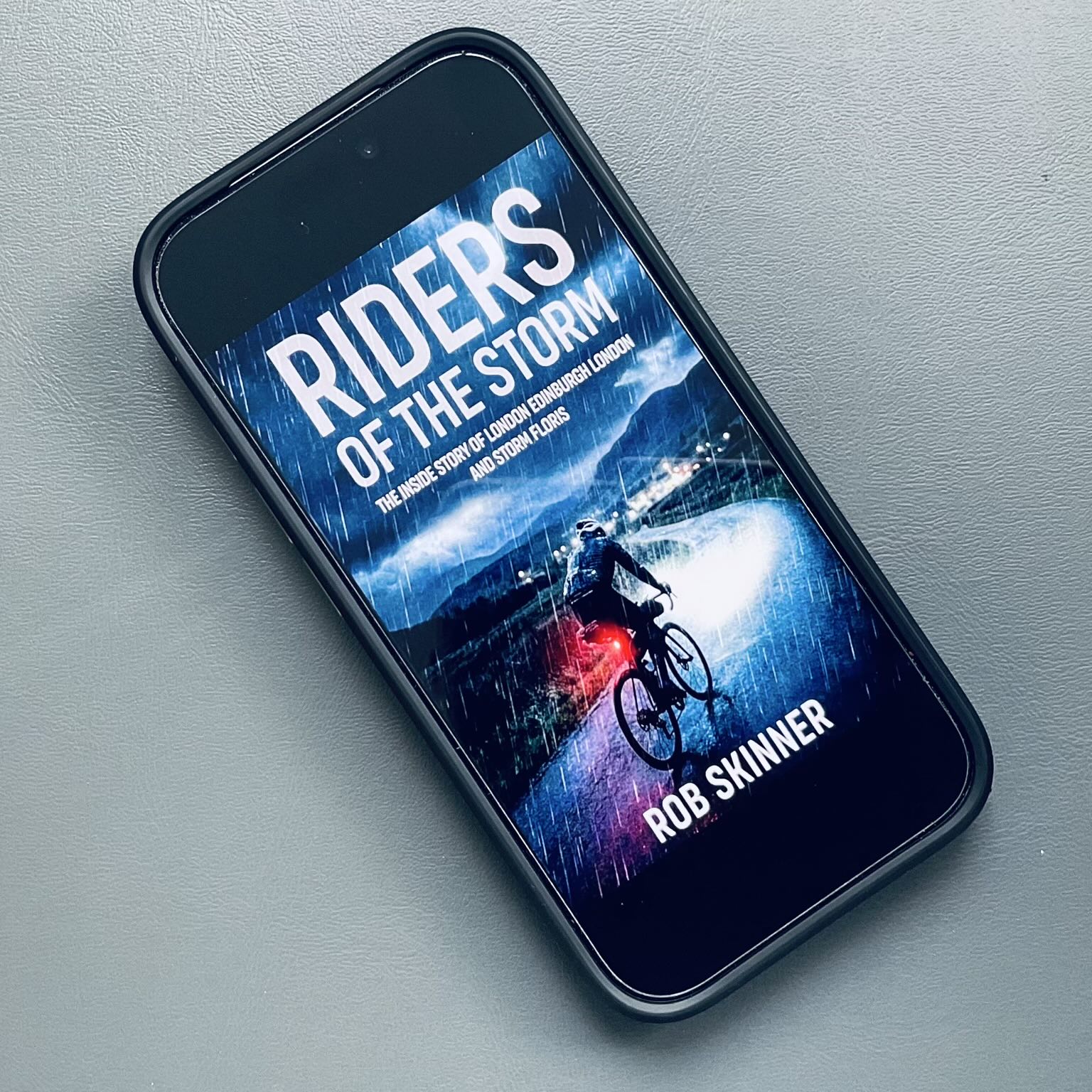
I read the first 200 pages on various planes and finished the rest over a weekend—which, for a book about a cycling event, felt appropriately endurance-flavored. Rob is a good writer: structured enough to give you the organizational backstory of LEL, loose enough to let the individual rider stories breathe. There’s the inside account of what it actually takes to put on an event of this scale—the logistics, the volunteers, the contingency planning—and then there are the rider narratives, which range from quietly moving to genuinely harrowing.
Two of the most dramatic of the lot belong to Ian McBride and Therese Johansson, who were farthest up the road among the men and women when the event was curtailed. Johansson and fellow leading female rider Kirsty Bramley had gone without sleep for 36 hours and were soaked to the bone for much of it before they were forced to stop. Reading about that, I kept thinking: there’s endurance, and then there’s that.
Other accounts included how the marriage of Radha Krishnan—a doctor in India—was tested by the rigorous demands of training for the event. Another one described how Angelo Failla tried to figure out how to get back home after another cyclist crashed into him, irreparably snapping off his rear derailleur.
Rob’s own preparation for the event makes for an entertaining chapter too—specifically his London-Wales-London training ride, which he has described as something of a fiasco. He had loaded the full route onto his Garmin as one sprawling map, which meant the overlapping outbound and return legs sat on top of each other. When he made a wrong turn, the device calmly confirmed he was still on course. He was, technically—just on the next day’s route. By the time the error became clear, it was too late. Anyone who has stood at an intersection with a navigational device confidently pointing the wrong direction will feel this story in their bones.
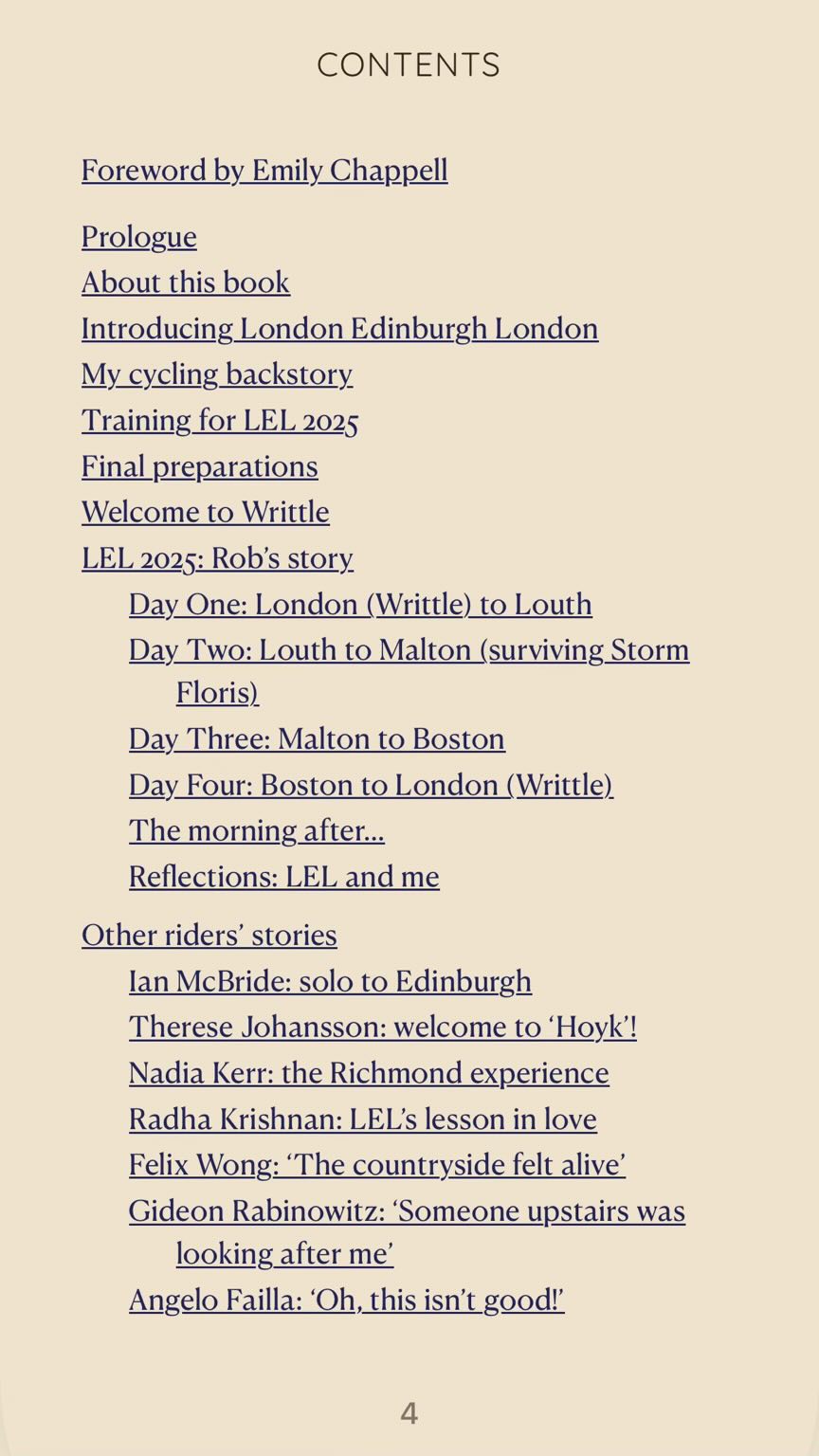
There is a short chapter about my own experience, which I found both flattering and slightly surreal. Rob noted that our journeys tracked closely with each other: he left Boston heading for Louth just 40 minutes before I rolled in, and he reached Malton—the control where the event was ultimately called—roughly an hour ahead of me. He also quoted from my blog post about the ride, including a passage about the landscape on the return south: “rural lanes barely wide enough for one car, bordered by stone walls and windswept fields where sheep grazed and horses stood at the very edge of the tarmac, their tails flicking in the stiff breeze.” Seeing your own words reflected back at you through someone else’s account is an odd pleasure—like hearing a song you wrote played by a different musician.
Despite the curtailed route, I still count my London-Edinburgh-London experience among my Greatest Epics, and Rob’s book is a worthy companion piece to that memory. If you rode LEL 2025, it will make you feel less alone in what you went through. If you didn’t, it will make you want to—or at least understand why anyone would.
You can purchase the book on Amazon. At the time of this writing, the Kindle version is on sale for 42% off. Take advantage of it while you can.