Exploring Berlin: A Five-Day Journey Through a Reborn City

After a Great American Trip Through the Southwest and a couple of days in New Orleans with Andrea, it was time to head back to Europe. But whereas Andrea was heading directly to Spain, I was off to Germany—thanks largely in part to a passing comment from my friend Dave earlier in the year.
He had casually mentioned that he was signing up for the Berlin Marathon through Marathon Tours. I’d been trying to get into this World Marathon Major for years through the lottery and always came up short, so when he said he was going, I asked if I could join the tour and split a room to save him the single supplement. He—and the tour company—said yes.
It wasn’t just the chance to run Berlin, one of the flattest and fastest courses in the world, but also to reconnect with Dave, whom I hadn’t seen since his visit to Spain and Portugal two years ago. I’d also get to meet his Reno friends, Olivia and Sam, who were doing the same tour and race.
I met up with Dave on Thursday after taking the train from the Berlin airport into the city. Marathon Tours held a meet-and-greet with hors d’oeuvres at the Marriott—just a short walk from our actual lodging at the Grand Hyatt.
The next morning—Friday—we joined the bus tour organized by Marathon Tours, a great introduction to the city’s landmarks and history. Our first stop was the Platz der Republik (“Republic Square”), the large open space in front of the Reichstag. From there we visited the Reichstagskuppel, the glass dome built atop the German Parliament, symbolizing transparency in government; and a somber memorial dedicated to assassinated politicians who died defending democratic values.

Of course, no Berlin tour is complete without the Brandenburg Gate, the neoclassical arch that has served alternately as a Prussian symbol, a Cold War boundary, and now a European Union icon. It’s also deeply tied to the marathon: the race finishes just beyond it on Straße des 17. Juni.

Along the way, our guide pointed out Traffic Light Man—the iconic “Ampelmännchen,” the little green and red pedestrian figures on former East German traffic lights. Designed in 1961 by traffic psychologist Karl Peglau, the charismatic design became beloved for its friendliness and clarity. After reunification, Berliners fought to preserve it, and today it appears on souvenirs, T-shirts, chocolates, and even crosswalks in former West Berlin—an unexpected pop-culture survivor of the GDR.

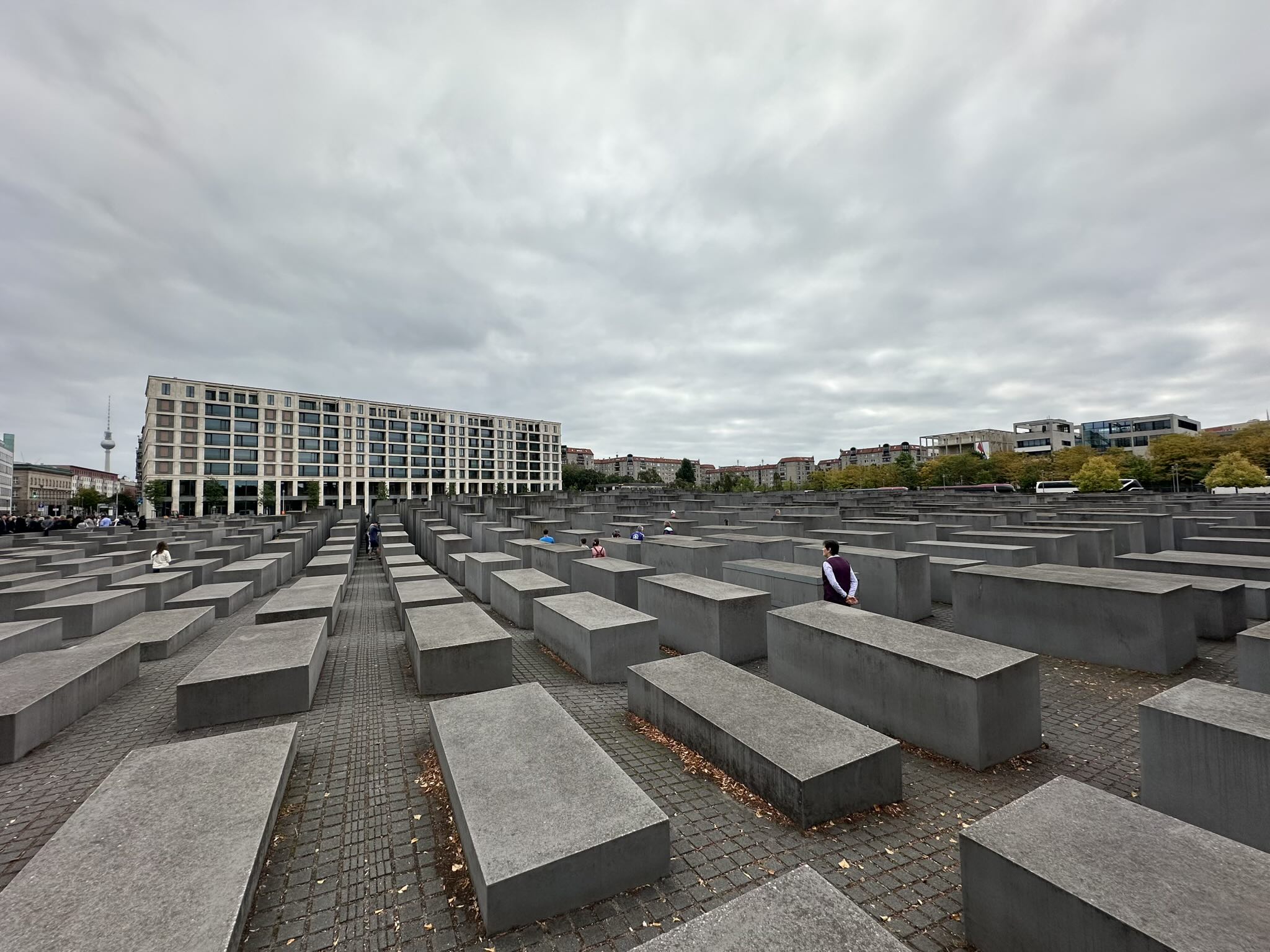
We visited the Memorial to the Murdered Jews of Europe, a field of 2,711 concrete stelae arranged in a grid. We were given 15 minutes to walk through and reflect. As I moved deeper into the memorial and the blocks rose higher and higher around me, I felt increasingly anxious, disoriented, and even trapped—a powerful physical metaphor for the enormity of the tragedy.
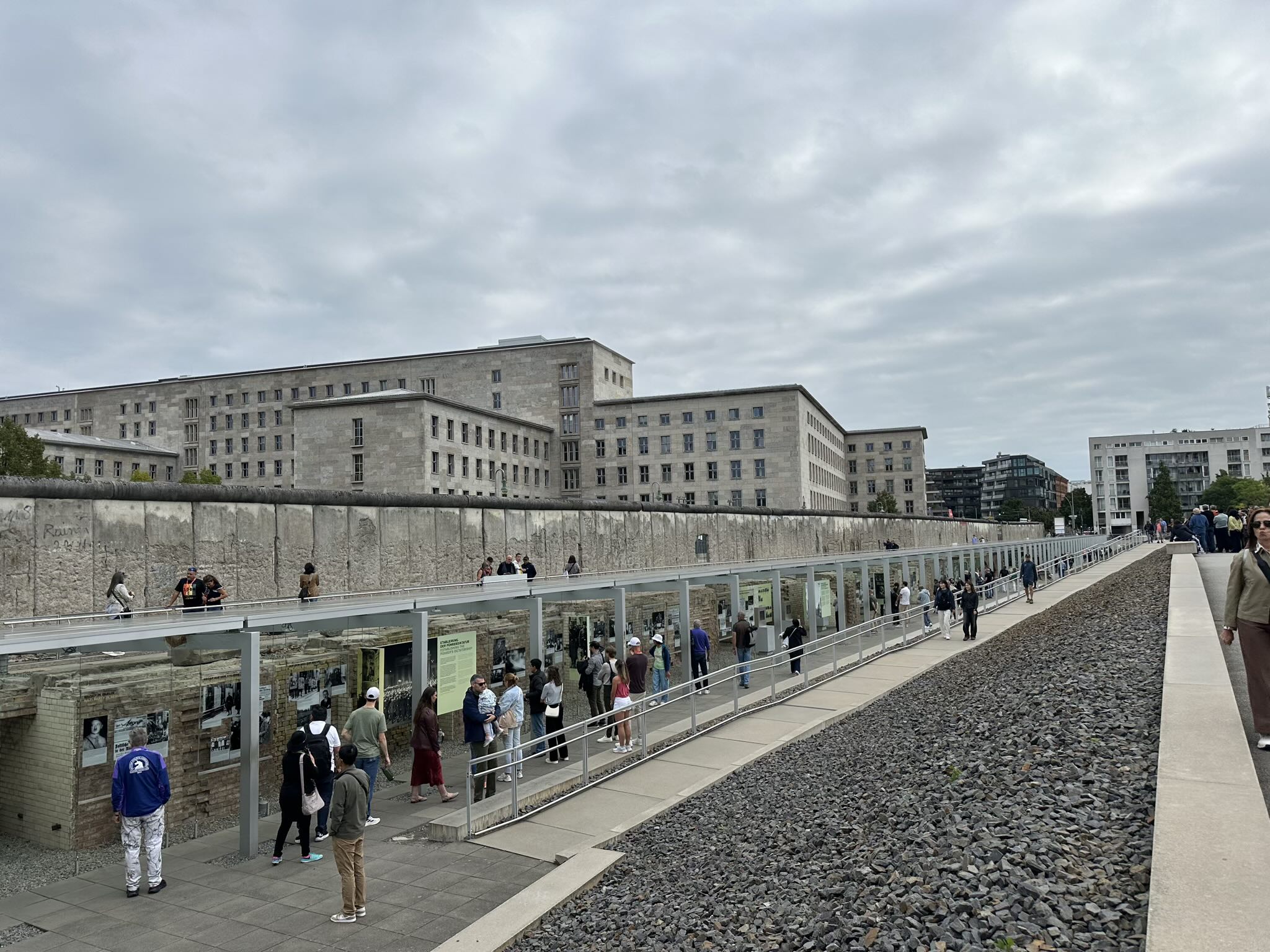
Next was Topographie des Terrors, an outdoor and indoor museum built on the former headquarters of the Gestapo and SS. Sections of the Berlin Wall still stand here in their original location, a reminder of how physically and psychologically divided the city once was.

We continued on to Potsdamer Platz, a bustling, modern district filled with gleaming towers and shops. Hard to imagine that for decades it was a wasteland—literally a dead zone of the Berlin Wall. Now it has the vibe of a youthful, energetic neighborhood.
After the tour we headed to Messe Berlin for the marathon expo—huge, efficient, and buzzing with runners from around the world.
After the marathon, I took advantage of an hour of free time and got a haircut. I often do this abroad because it gives me a chance to talk with a local and learn about their customs. My barber was in his 20s or 30s, very friendly, and, like seemingly every German I met, spoke flawless English. We ended up talking mostly about running, so I learned little about German culture, but I did walk away with a good haircut.
That evening, the four of us went to Ensenza, an Italian restaurant Olivia had found. It was elegantly decorated and full of well-dressed locals, so we felt slightly underdressed, but the staff was professional and welcoming. I ordered a plate of fusilli that really hit the spot.
For dessert, we went to Häagen-Dazs. I wondered out loud whether the name was German. I was pretty sure it wasn’t—and indeed, it’s not. The brand was founded in New York in 1960 by Reuben and Rose Mattus. They invented a faux-Danish/German-sounding name to evoke craftsmanship and European quality. Maybe that’s why it seemed appropriate to eat Häagen-Dazs here!
On Saturday morning, we did a shakeout run. Both the Brandenburg Gate finish line and the Victory Column—located near the start of the marathon—were close to our hotel, so it was easy to jog by both landmarks. Later we watched a 5K race that took place nearby. I grabbed lunch on my own at The Playce mall afterward while Dave rested.
Sunday was marathon day—deserving of its own separate post.
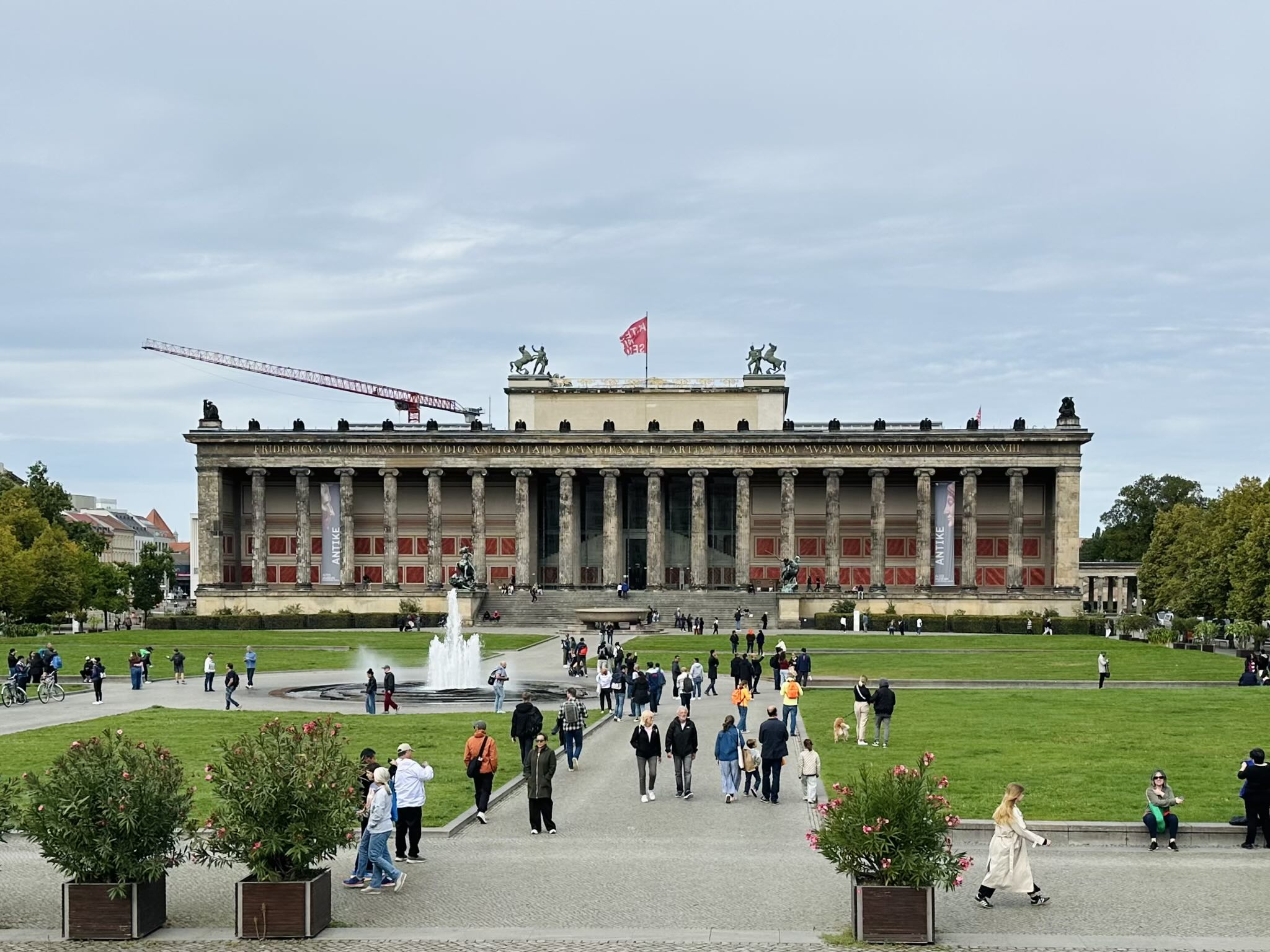
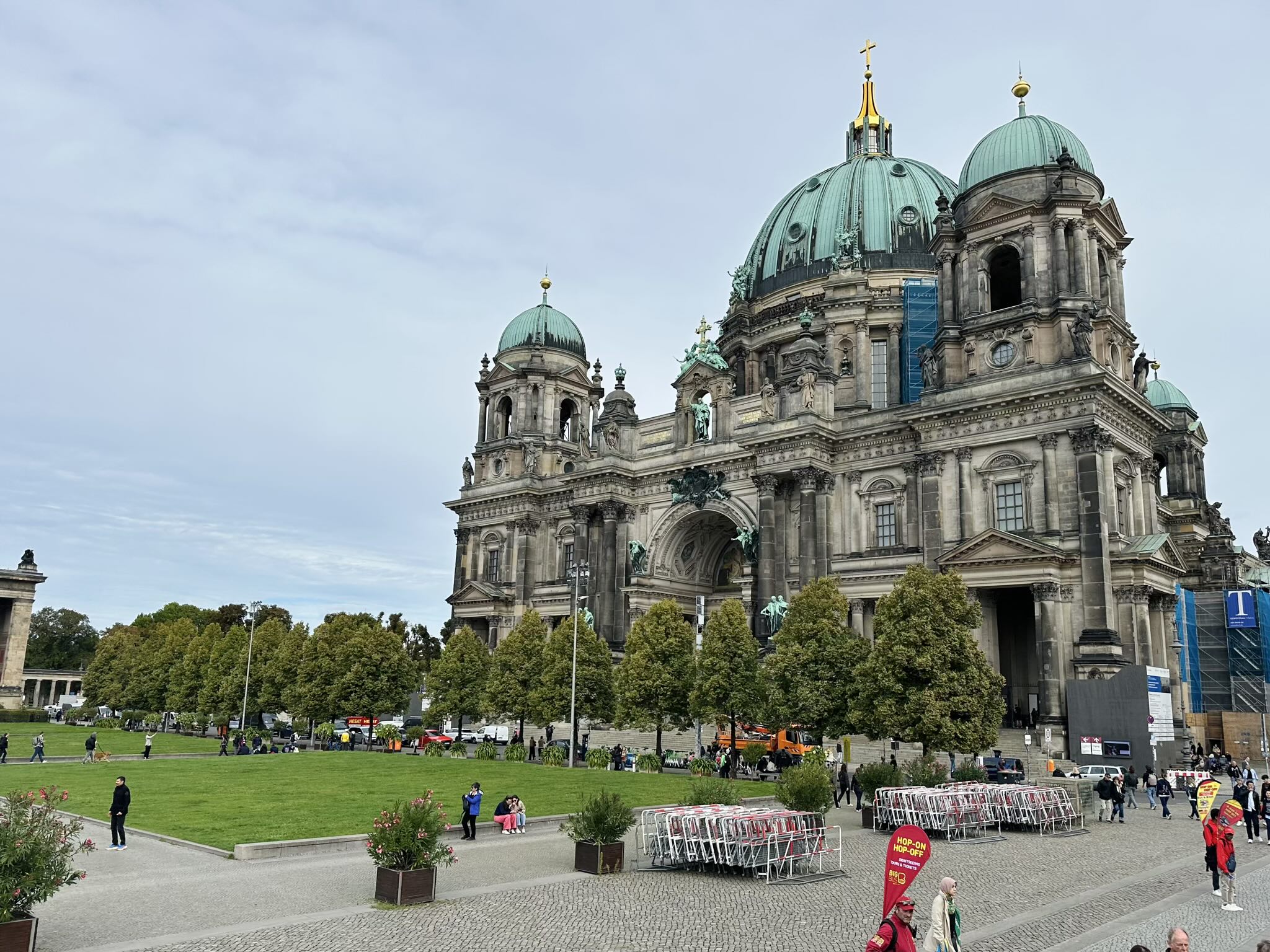
By Monday, our legs were unsurprisingly very sore, so a hop-on-hop-off bus tour was the perfect idea. We visited the East German TV Tower (Fernsehturm), the Altes Museum, Lustgarten, and the magnificent Berlin Cathedral.
While walking around looking for coffee for Dave, I spotted what looked like a Volkswagen showroom or museum. So while he went into Starbucks, I went next door. I’m glad I did.

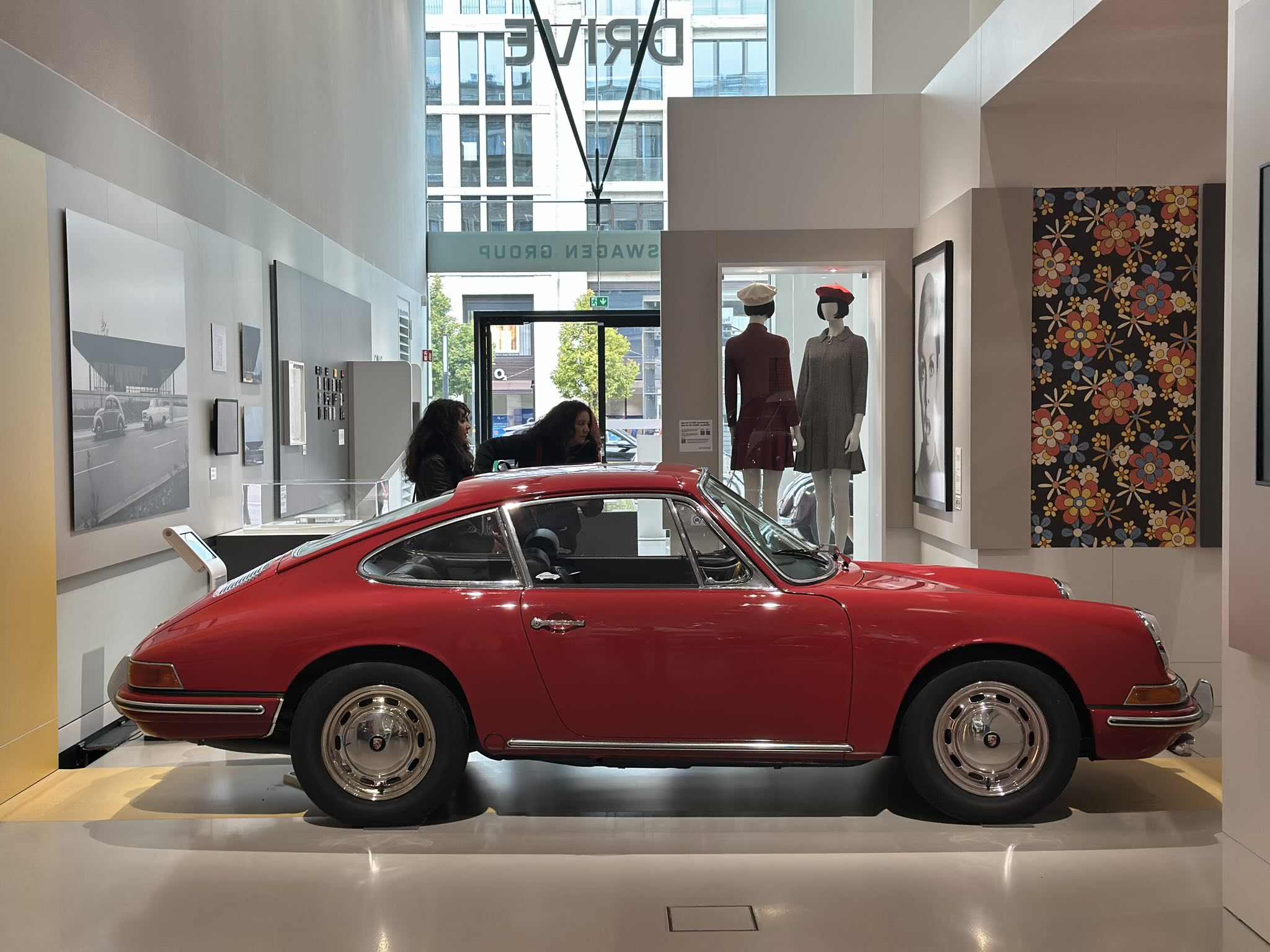
Inside was “ICONIC–A Timeless Journey of Culture, Society and Mobility,” an exhibition highlighting the Volkswagen Group’s most influential vehicles from the 1950s to today. They had a bright green VW Beetle convertible; a white five-door GTI; an orange, early-generation three-door Golf (the original Rabbit in the U.S.); and a two-tone red-and-white VW Bus. The modern, all-electric ID. Buzz was also there—the name suddenly clicked: “buzz” evokes electricity but sounds like “bus.”
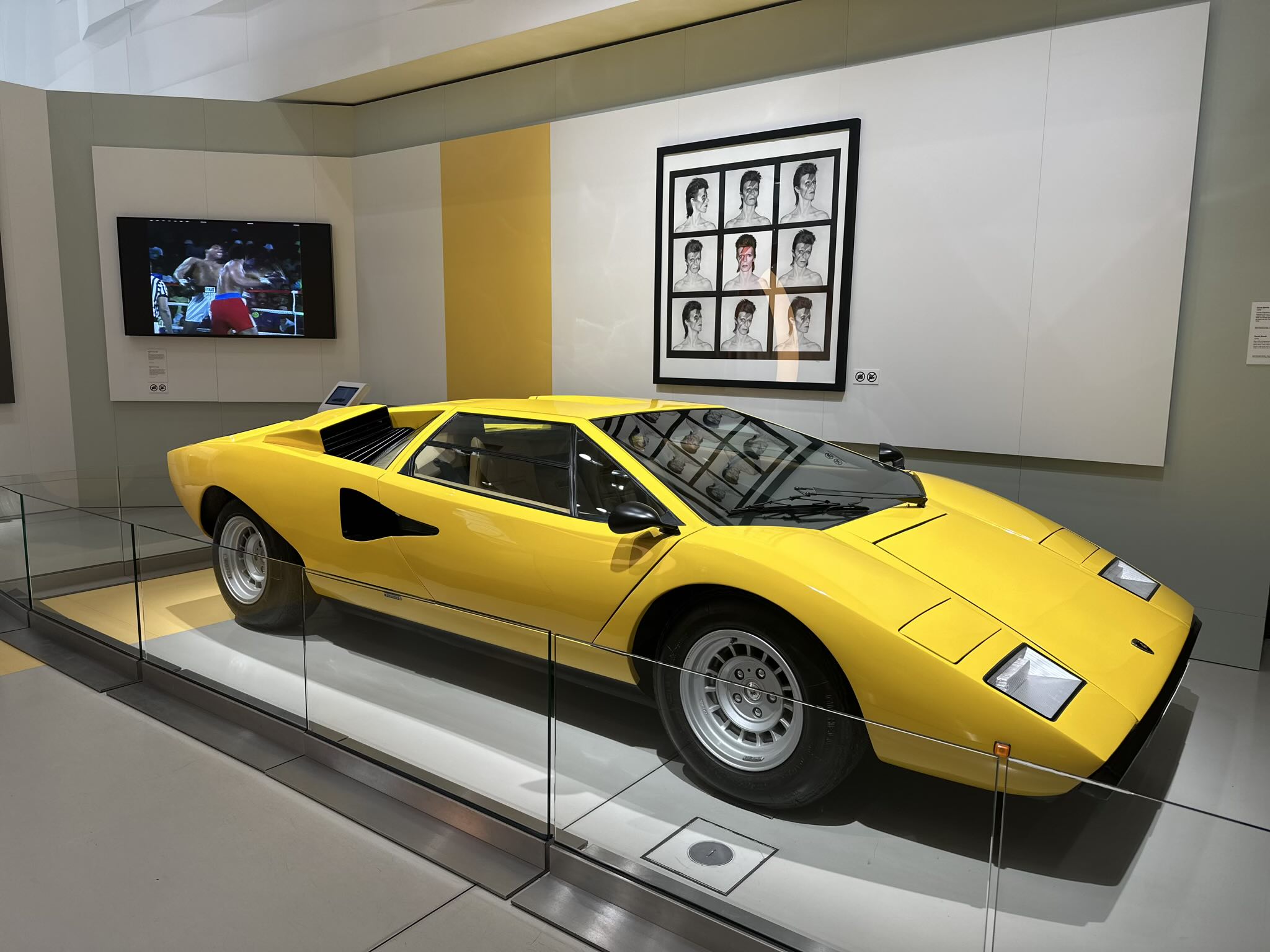
I was very pleased to see a bright yellow first-generation Audi TT Coupe—a sibling to my TT Roadster. The exhibit also featured a red Porsche 911, a silver Porsche Carrera GT (likely the priciest car in the building), and a yellow Lamborghini Countach. The latter isn’t German, but Volkswagen—via Audi—owns Lamborghini today.
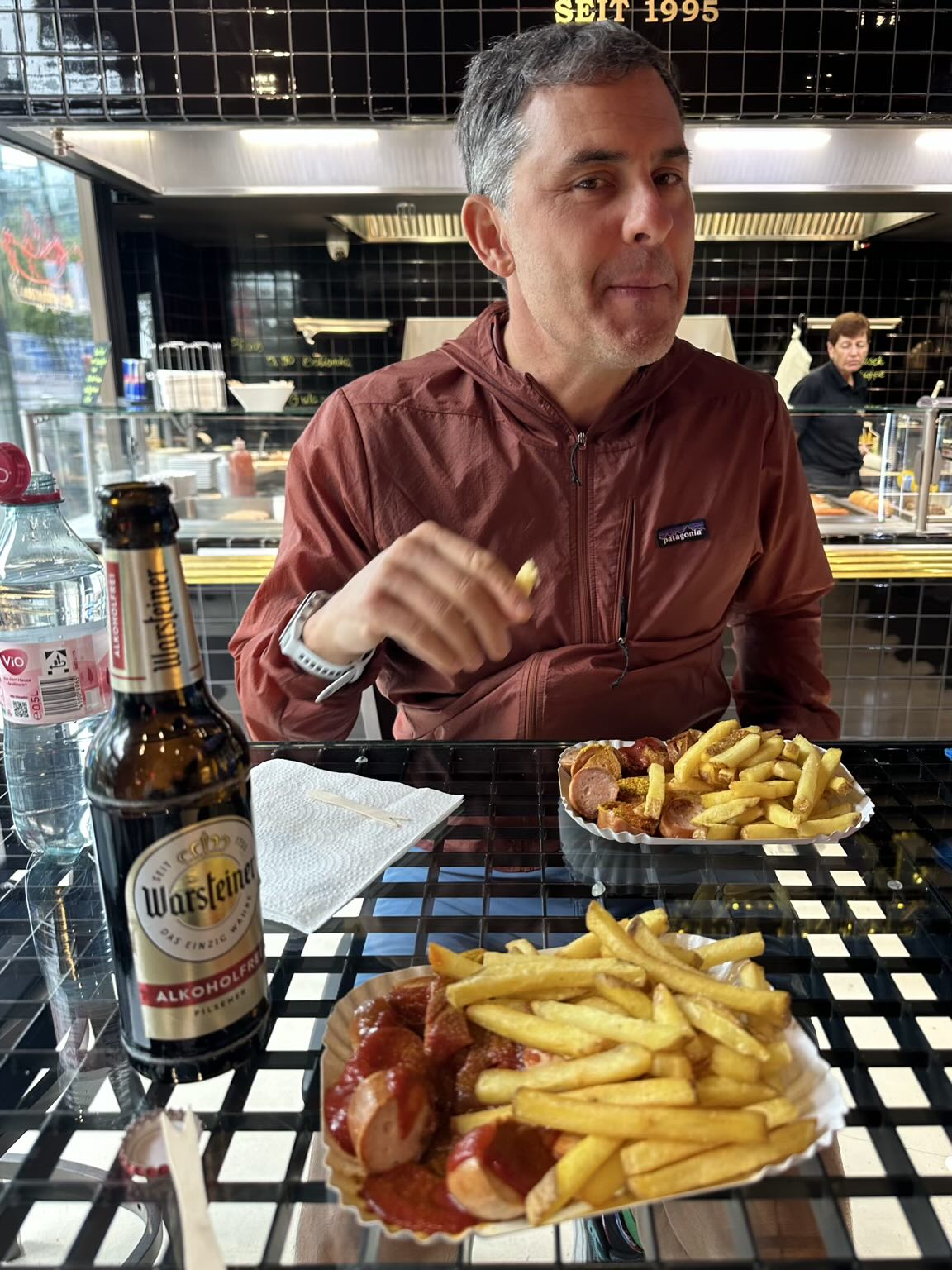
For lunch, we went to Borkowskis Original Berliner Currywurst at Potsdamer Platz, a Berlin institution since 1995. They’re famous for their patented “Original Berliner Currywurst,” homemade sauces, and perfectly grilled bratwurst served with crispy fries. It was delicious.
While wandering the area afterward, I spotted the familiar yellow scallop shell on a blue background—the symbol of the Camino de Santiago. I had no idea that Berlin was on a recognized pilgrimage route. The Way of St. James actually begins at the Brandenburg Gate and heads southwest toward Leipzig along the medieval Via Imperii, eventually connecting with the Via Regia, crossing into France, and then joining the Camino Francés at Saint-Jean-Pied-de-Port. It’s roughly 3,000 km from Berlin to Santiago if done continuously, months of walking. I found this unexpectedly moving—Berlin as a starting point for pilgrims.
We also visited Checkpoint Charlie, once the most famous border crossing between East and West Berlin. Today it’s surrounded by a McDonald’s and KFC within 100 meters—capitalism’s stamp of victory, perhaps—but the historical weight is still palpable. We took the obligatory photo at the old U.S. Army post.

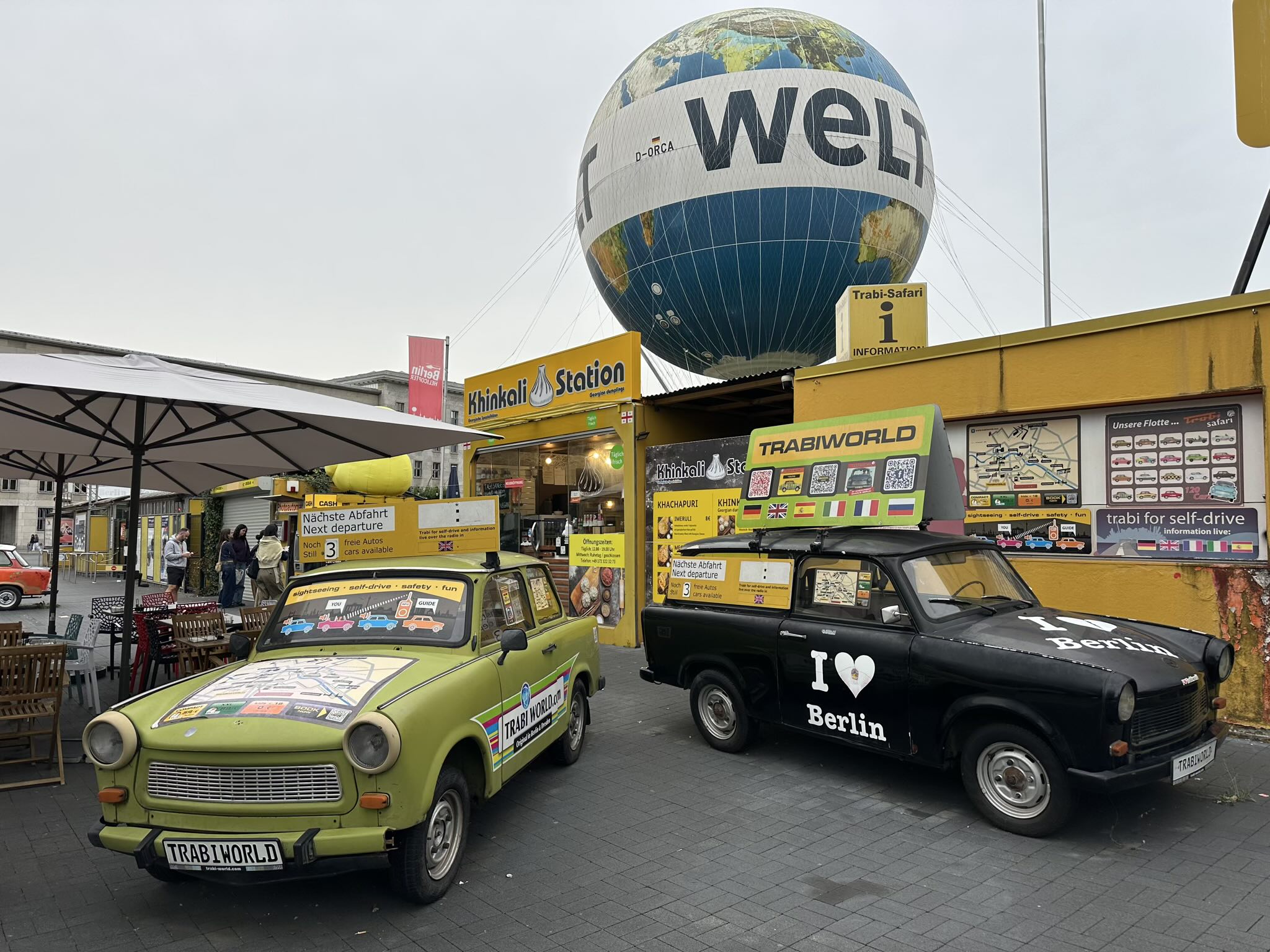
Nearby was Trabiworld, with its fleet of colorful Trabants. The Trabant, the “Trabi,” was the quintessential East German car—so primitive that the fuel gauge was literally a wooden stick you dipped into the tank like a dipstick.
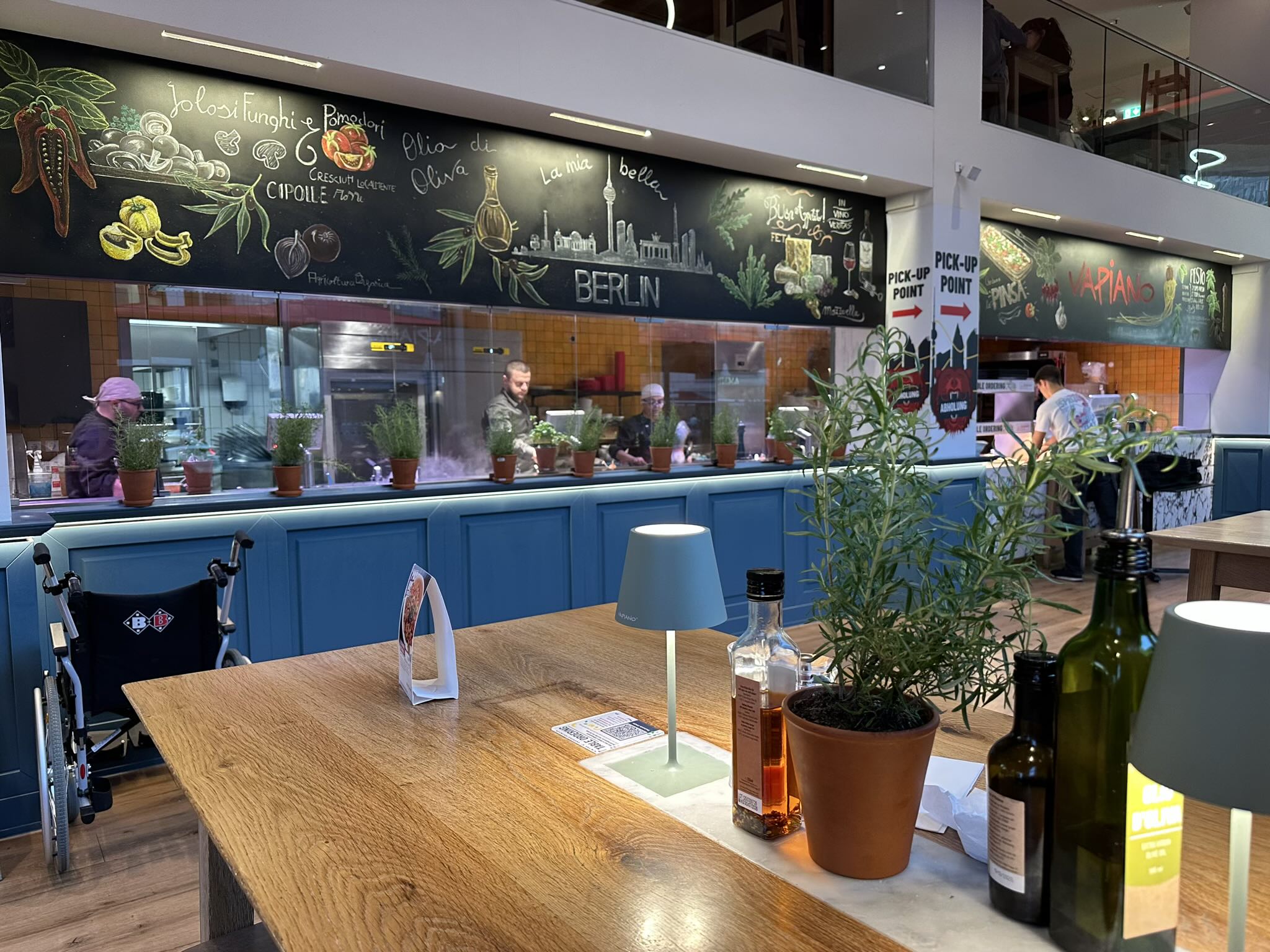
That night, Dave and I both craved pizza. I was delighted to see a Vapiano, a chain I’d eaten at twice back in 2013 in Amsterdam—on what I recall was the fifth floor of the amazing Openbare Bibliotheek Amsterdam (OBA, a public library). I hadn’t realized it was a global franchise, but apparently Vapiano was founded in Hamburg in 2002 and now has more than 155 locations in over 30 countries. Supposedly, the name comes from the Italian proverb “Chi va piano, va sano e va lontano”—“If you take life easy, you’ll live healthily and longer.”
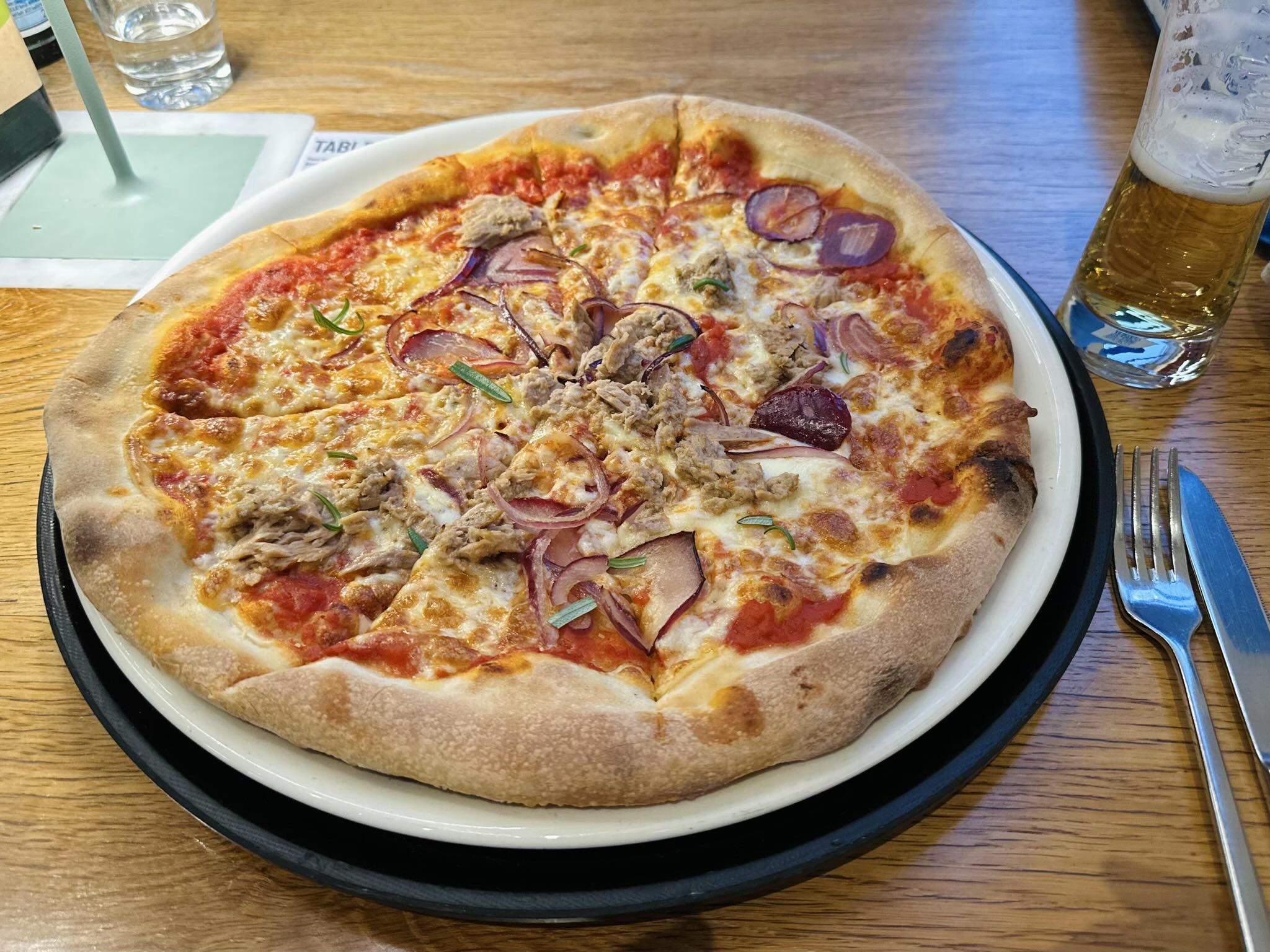
Vapiano serves stone-baked pizza (also handmade pasta) in a stylish, relaxed setting. In Amsterdam, they had fresh basil plants on every table that you could pluck from for your pizza. In Berlin, the tables had fresh rosemary. I added some to my delicious tuna pizza.
The next morning, it was time for me to fly to Spain. But I left with warm memories—of running one of the world’s great marathons, of spending meaningful time with Dave, and of exploring a city layered with history yet unmistakably modern.
I had arrived in Berlin with few preconceived notions, so it was a pleasure to discover it on its own terms. Berlin today seems to be popular with young people, and for good reason: it feels clean, safe, forward-looking, and relatively affordable compared to other major European capitals. While it doesn’t quite have the jaw-dropping grandeur of Paris or London—and the River Spree is much narrower than the Seine or Thames—Berlin’s charm lies in its energy, reinvention, and openness. I’m glad I finally got to experience it.