Berlin Marathon: Heat, Hustle, and Type 2 Fun

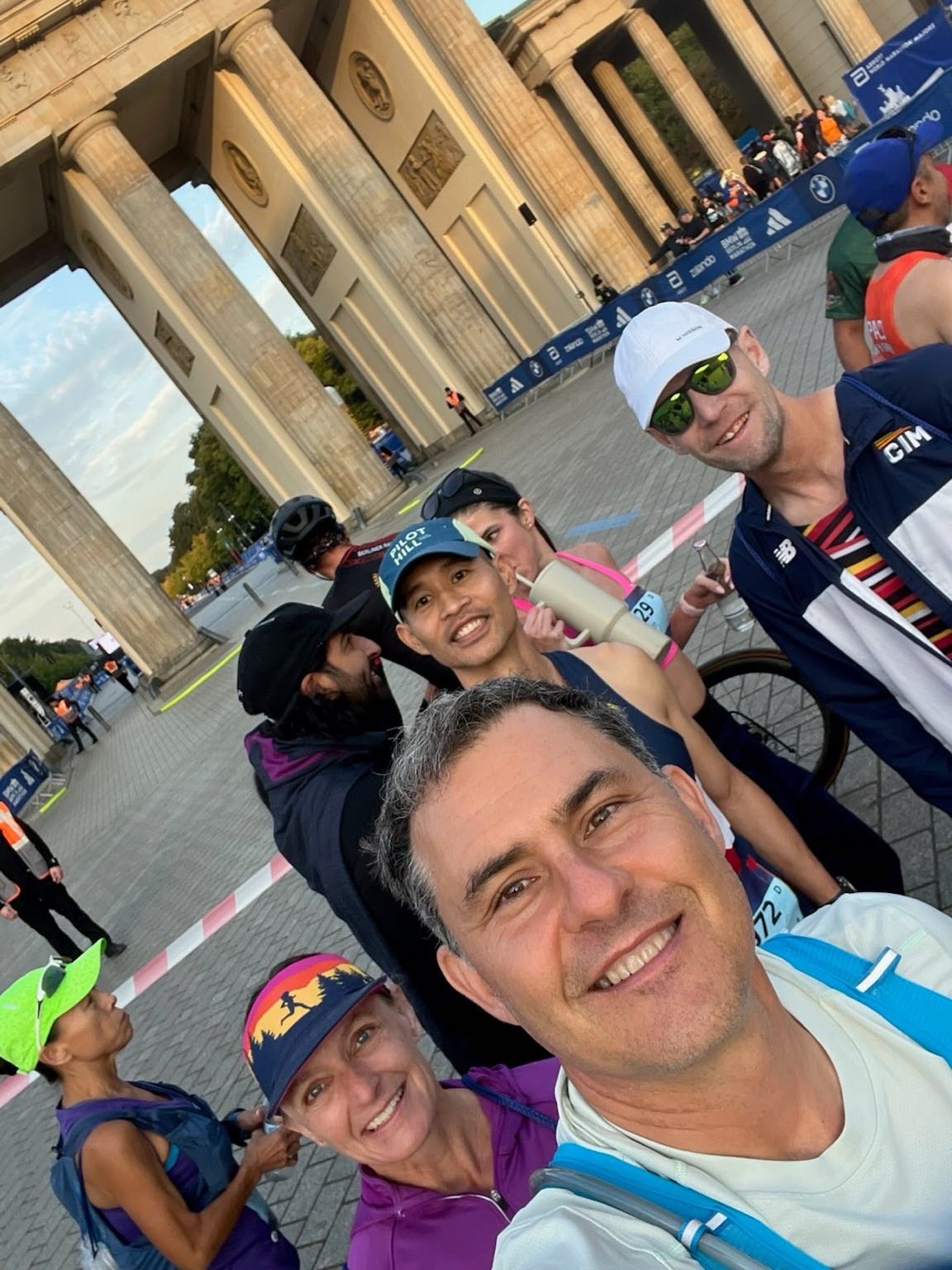
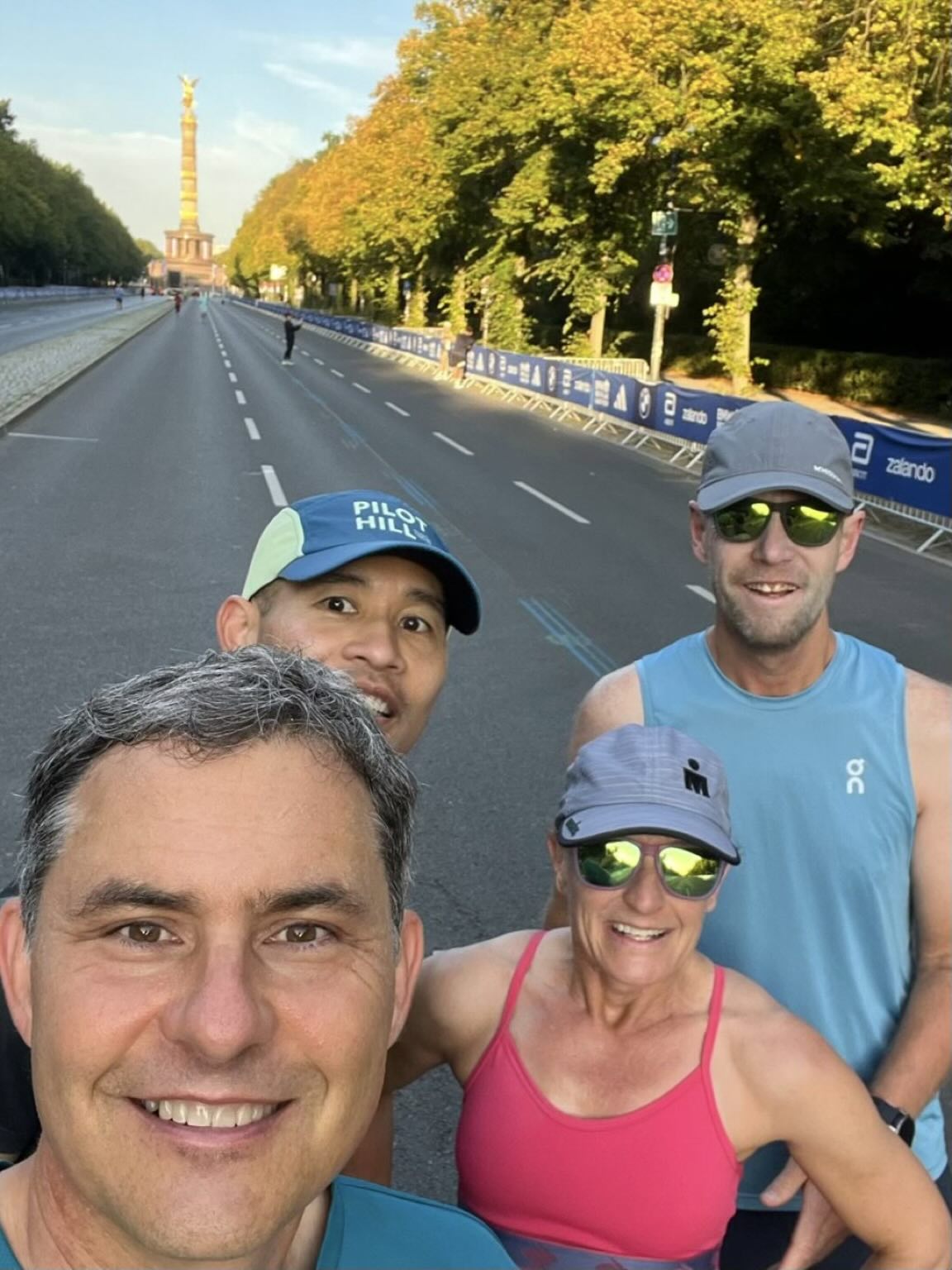
Dave had mentioned it casually earlier in the year—he was signing up for the Berlin Marathon through Marathon Tours. I’d been trying to get into this World Major for years via the lottery, always coming up short. So when he said he was going, I asked if I could sign up too and split a room to save him the single supplement. He and the tour company said yes. That simple exchange set the stage for one of the most memorable, chaotic, and strangely satisfying marathon experiences I’ve had in recent years.
It wasn’t just a chance to run Berlin, one of the fastest courses in the world, but also to reconnect with Dave—who I hadn’t seen since his visit to Spain and Portugal two years ago—and meet his Reno friends, Olivia and Sam, who were also doing the tour and race. Berlin’s course is famously flat, a magnet for world records, and I figured the weather would be ideal for a fast time.
But a few days before the race, race organizers sent out a warning: temperatures were expected to spike, possibly ten degrees centigrade warmer than the preceding days. They advised runners to forget about personal bests and focus on enjoying the experience. That was the first sign that this race wouldn’t go as planned.
Race day arrived with heat and humidity. It would hit 81°F (27°C) by the finish, and while there was a brief rain shower after I crossed the line, the sun dominated most of the run. The UV index was only moderate due to the high latitude and time of year, but the heat and was relentless. Ten kilometers into the race, I already had to start wiping the eyes and brow of sweat with my hand despite wearing a somewhat absorbent cap.
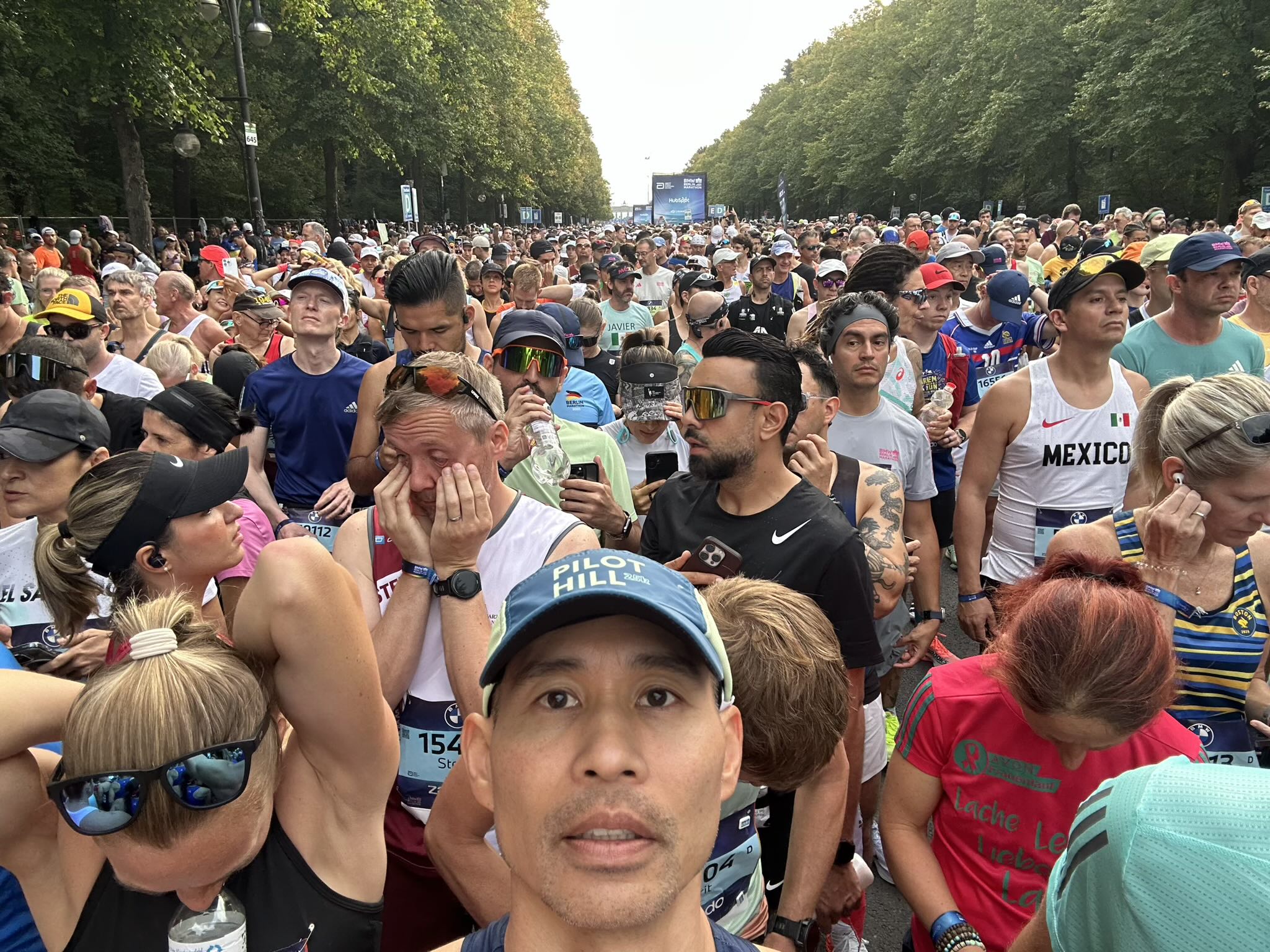
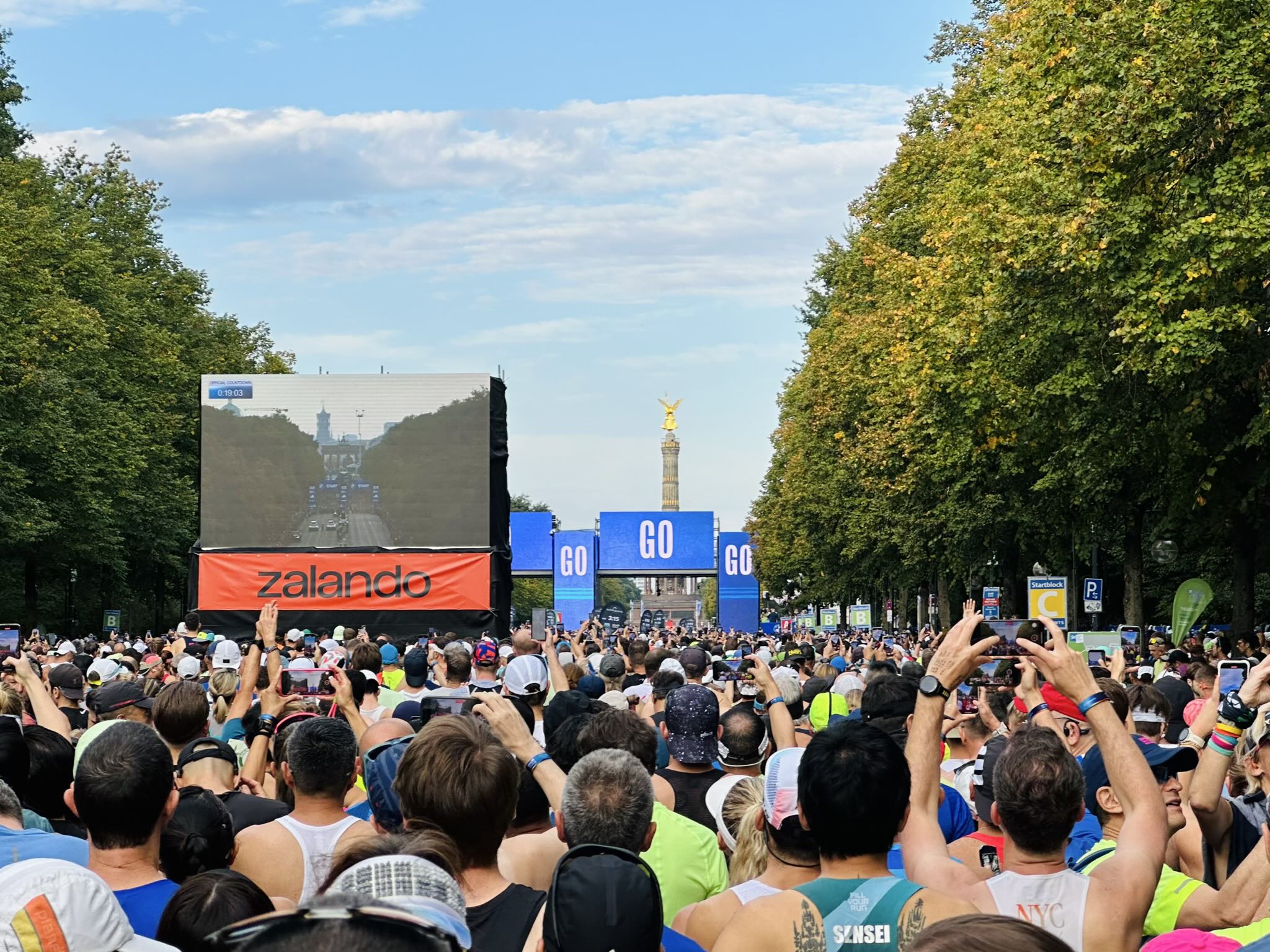
It wasn’t just the weather that made things tough. The course was absolutely congested from start to finish. Supposedly, runners were grouped by pace, but only those with times under 3:15 had to provide proof. Sam and I both later observed that we were dodging walkers and slow joggers within the first few miles. Olivia had asked one of them why they were in an early wave. The answer? More time to finish before the course closed. I get their motivation, but it contributed to turning the race into an obstacle course.
Even sticking to the blue line—the shortest route—was a challenge. Of course, many others wanted that line, and I had to veer off it constantly to pass. Aid stations were every 3K, but they were chaotic. People slowed, cut across, even stopped. I lost 10+ seconds at each one, sometimes coming to a full standstill. Supposedly, every other station had Maurten drinks, but I saw only one. That meant virtually no electrolytes—hardly ideal, given that Garmin Connect estimated I lost 3.6 liters of sweat over the course of the marathon.
The pavement near each aid station was remarkably slick, thanks to the sea of discarded cups left by passing runners. At first, I chalked it up to the Saucony Endorphin Pro 3s I was wearing—maybe they just had poor wet traction. But later in the day, Sam brought it up before I could. “The pavement by the aid stations was super slippery!” he exclaimed.
For this race, I decided to shake things up and experiment with Maurten Gel 100s, which promised marine-derived, “Hydrogel” technology that was easy on the stomach and easily digestible. At their price, they had better be—at the pre-race expo, they sold for 3.90€ apiece, which converts to US$4.60 each at today’s exchange rate. I purchased three non-caffeinated gels and two caffeinated ones, planning to consume a non-caffeinated every hour (starting one hour in) and the caffeinated at 1.5 and 2.5 hours in.
Each gel had 25g of carbs, giving me 50g/hour. But they were light on electrolytes—just 50mg sodium, no potassium, and negligible calcium. I didn’t bonk, but I did cramp. From KM 30, my arms started seizing, suggesting an early systemic electrolyte imbalance. By KM 35, the calves painfully cramped with every step. I managed to relax them slightly by focusing on my nose-breathing and driving the knees as, thankfully, my quads held up.
Ultimately, I could not conclude that those expensive Maurten gels served me any better than my usual practice of simply drinking Gatorade every three miles or so starting at Mile 6. But as no Gatorade was provided at this race, it was worth conducting this experiment despite the old adage of “never do something new on race day.”
I ran the first half—13.1 miles plus an extra 300 meters from all the dodging—in 1:44:57. Along the way, I noticed a surprising number of Felixes on the course, judging by runners’ bibs (some worn on their backsides), enthusiastic cheers, and even a homemade sign from a spectator that read “Go Felix!” I also got plenty of shoutouts for “Colorado!” thanks to the singlet I was wearing, and I made sure to return the gesture with a wave each time.
By KM 32, I still envisioned surging during the final eight kilometers (or five miles). But cramps at KM 35 killed that plan. Still, I finished in 3:35:11—just five minutes slower in the second half. Given the heat, humidity, congestion, cramps, and chaos, I consider my finishing time to be near-miraculous.
But post-race, I had a bad moment: blurred vision and light-headedness for maybe 10-15 seconds. I seriously considered stopping at a medical tent just so the medics could keep an eye on me in case I passed out. But I didn’t see one.
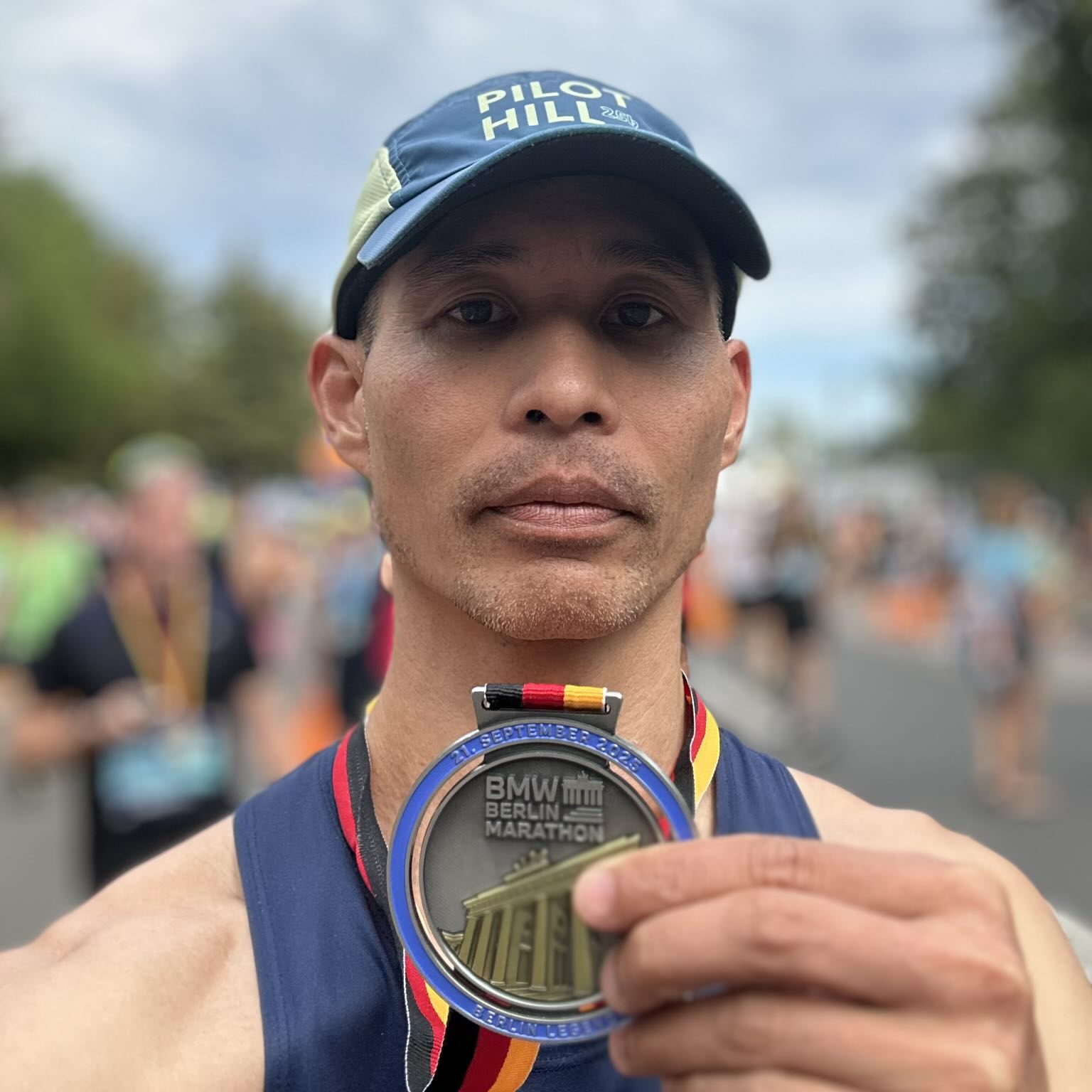
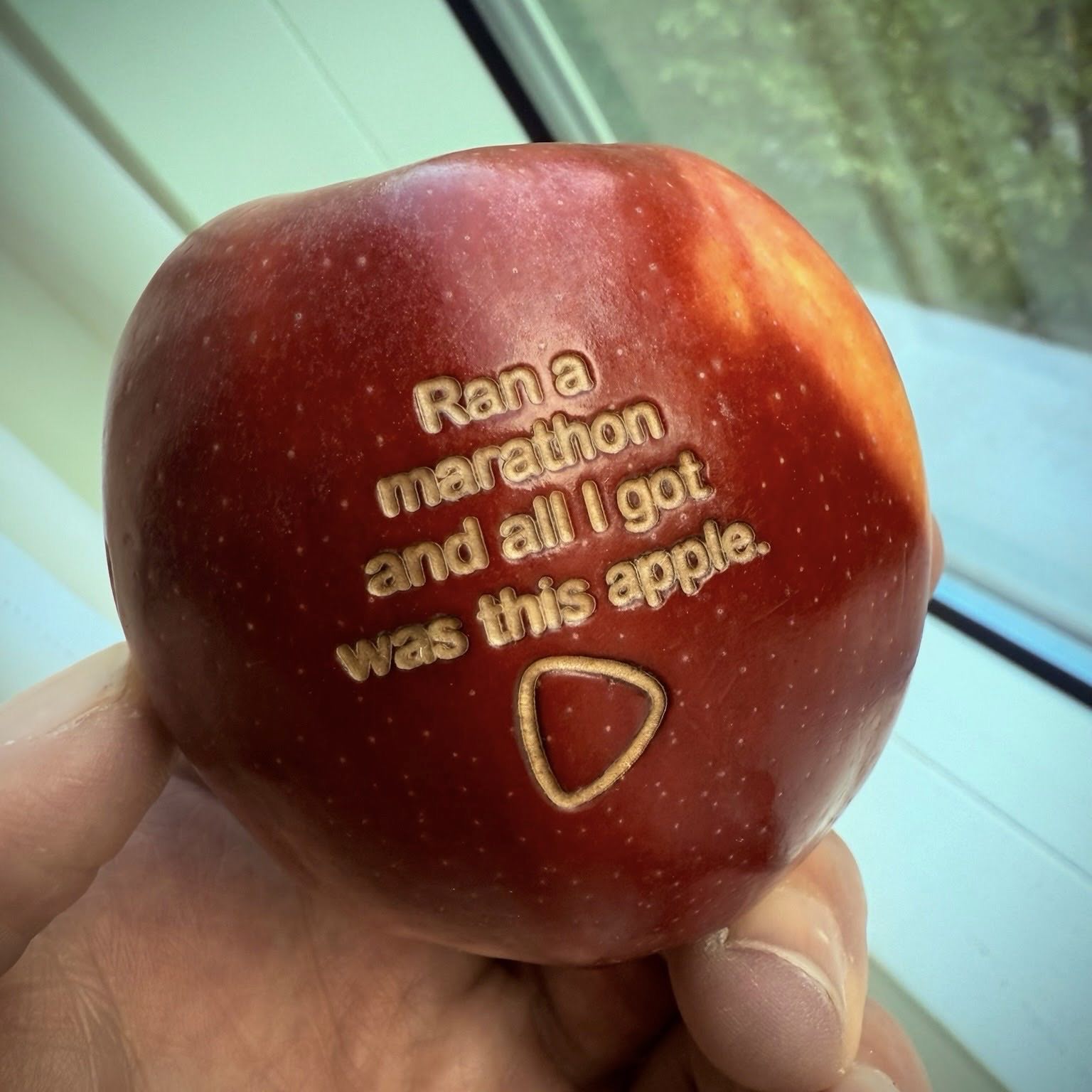
So instead, I accepted a finisher’s medal and a food bag—pretzels, banana, apple, croissant, Kit Kat, and tea—and gingerly set myself onto a curb, using a hand to help lower myself down. I devoured the salty pretzels first, which offered instant satisfaction. I ate the rest of the contents in the food bag so fast that I didn’t notice the apple had a carved message.
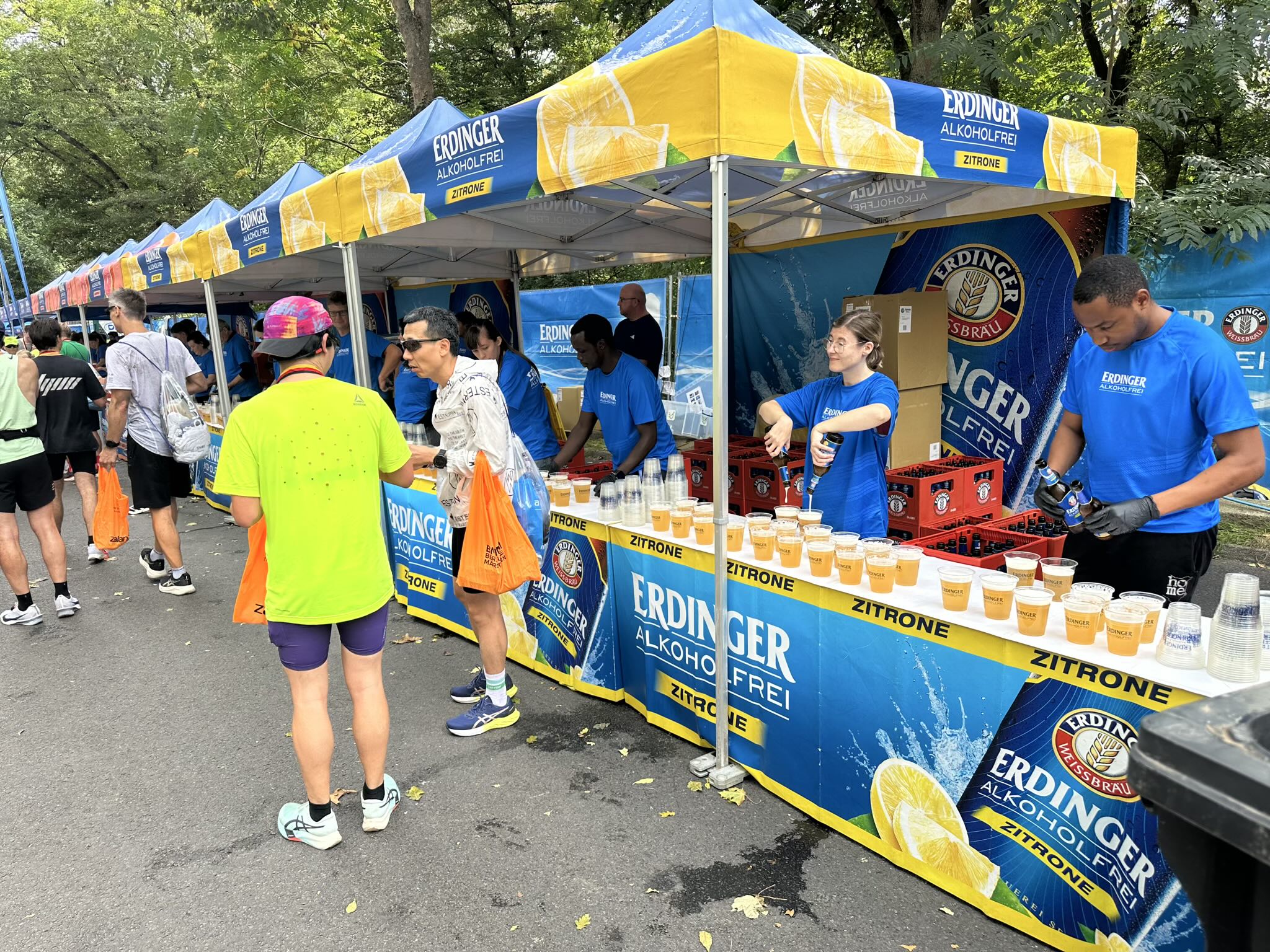
I also drank a refreshing alcohol-free Erdinger—a German beer company. Honestly, I wish more American races offered non-alcoholic beer at the finish line. Not only do modern NA beers often taste as good or better than most regular ones, but they also skip the unpleasant and deleterious effects that come with alcohol. Refreshing, satisfying, and recovery-friendly—it’s the kind of post-race tradition more events should get behind.
Later, I heard the war stories. Dave’s Strava activity showed an average pace nearly identical to mine, and his splits were impressively even whereas mine had my characteristic end-of-race dropoff. I thought the Nathan hydration pack he bought at the pre-race expo must have helped and been a brilliant idea—until I learned that it was leaking all over his back by Mile 2. He had to stop, ditch it, transfer food to his pockets, and improvise hydration. The time it took to deal with this cost nearly 10 minutes that wasn’t included in his Strava moving time.
Olivia and Sam—a married couple who first met in high school—started together. Sam, despite having IT band issues during the race and hip arthritis—severe enough that doctors told him that he should get a hip replacement—finished only a few minutes after Olivia. He had been logging 65 miles/week following one of Hanson’s running plans. Clearly, his pain tolerance threshold is off the charts.
Olivia, an internal medicine doc like Dave, suffered heat exhaustion. Sam took her to a medical tent and reported “carnage”: it was packed with runners sprawled out on the ground, some of them puking. Olivia recovered after a Maurten gel given to her by Sam and an extended sit-down. Eventually, they left the tent in search of ice cream.
Meanwhile, I walked back to the hotel. It was only a mile away—as the crow flies. But with barricades and fencing, I had to take a roundabout route. It took nearly an hour. I didn’t mind. I had finished the race. I was alive. And I had a story.
The 2025 Berlin Marathon was the epitome of Type 2 fun—grueling while it was happening, but unforgettable in retrospect. The heat, the chaos, the camaraderie—it all blended into a wild, messy, and strangely satisfying experience.
But for my next World Major (date unknown), I’d seriously consider bringing my own fluids and electrolytes—learning from Dave’s well-intentioned plan that was foiled by the hydration bladder debacle. His strategy made perfect sense: skip the chaos of aid stations, stay consistent, and avoid the electrolyte drought that plagued so many of us.
Other Runners’ Experiences (2025)
- Roger Canham: Ran 3:21 in the 60-64 age group.
Race Data
First half: 1:44:57
Second half: 1:50:14
Final time: 3:35:11 (8:13/mile or 5:06/km)
Official results