Revisiting American Flyers 40 Years Later: A Cycling Classic

At the beginning of 2025, Andrea and I had been watching Yellowstone, the hit Netflix Wild West drama featuring Kevin Costner. We’re both fans of the show, and seeing Costner in his rugged, cowboy-hat-wearing role reminded me of another film he starred in early in his career—American Flyers (1985). In it, he plays a doctor and a cyclist who competes in a grueling race across Colorado. Given that Andrea is a doctor and I’m a cycling enthusiast who lived in Colorado, revisiting this movie felt like a must.
I first watched American Flyers during my freshman year at Stanford, about nine years after it was released. Back then, I heard about it from one of the rec.bicycle USENET groups. I borrowed the movie on VHS tape from the library and watched it on a library VCR hooked up to a clunky cathode-ray tube TV—one that had about the same screen area as the iPad Pro 12.9 I am typing this on, but with much lower resolution and far worse color accuracy. Fast forward 31 years from that day—and 40 years after the release of the movie—and here we were, streaming it effortlessly on Apple TV+ from the comfort of home, projected onto a crisp 55-inch Samsung QLED TV.
The film opens with a college student named David Sommers bicycling along the Mississippi River by the Gateway Arch in St. Louis, Missouri. Having lived in St. Louis for a time, it was nice to see that familiar landmark on screen. In hindsight, I should have brought one of my many bicycles when I lived there.
Seeing Kevin Costner in American Flyers was almost like watching him in Yellowstone—the same facial features, haircut, and signature smile, only younger, thinner, and sporting a mustache. This was one of his first lead roles before he became a world-famous star.
The film leans heavily into patriotic themes, which makes sense given its mid-80s Cold War setting. There are American flags, cowboy hats, a theme song about the American Dream, a rival Soviet cycling team, and even shows clips of the space shuttle and the moon landing. Davey Sommers (David Grant) belts out the national anthem at one point, reinforcing the film’s all-American spirit.
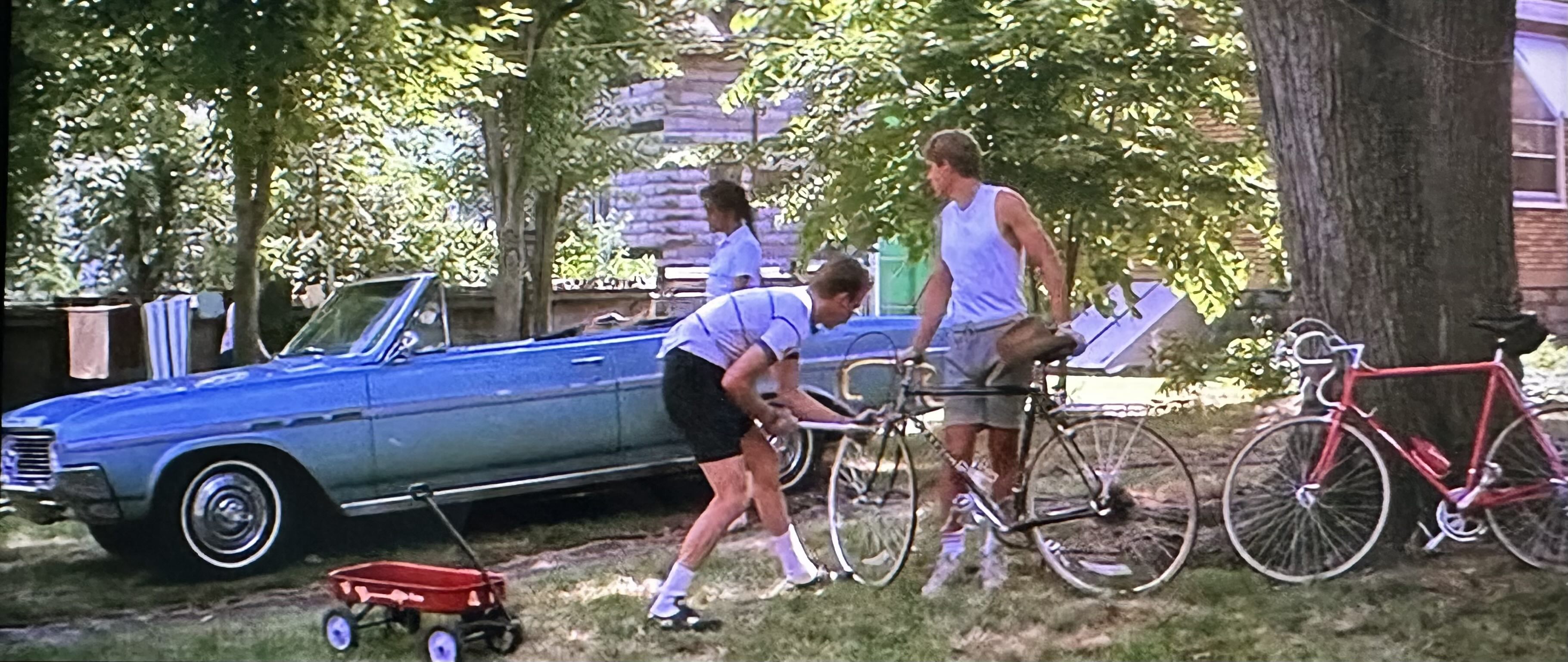
Naturally, American Flyers features a great assortment of cars that defined the period. Some of them—like the ugly Ford van with Specialized sponsorship logos—were relics of the Malaise Era, but others are now classics, such as the then-new F-body Chevy Camaro and the sky blue 1964 Buick Skylark that Sarah (played by Rae Dawn Chong) drove. The movie even features the just-released Dodge Caravan, which pioneered the modern minivan segment and helped Chrysler Corporation stave off bankruptcy in the 1980s.
The bike technology in the film is a fascinating time capsule. The racers rode steel-framed bikes with un-dropped seat stays, polished metal parts, drilled brake levers, downtube shifters, and 6-speed freewheels. They used toe clips and straps instead of the now-common clipless pedals that five-time Tour de France champion Bernard Hinault only started using during the year of the movie’s release, full-frame bicycle pumps, and 32-spoke wheels with box-section rims that frequently needed to be trued. Exposed brake cables emerged from the tops of the hoods. Disc brakes on bicycles were still many years away from becoming commercially available. Cyclists didn’t wear helmets while training, and even during the races they were mostly wearing leather hairnets.
One bike in particular caught my eye—a blue frame with yellow handlebar tape, which reminded me of my 1984 Gitane, which was the exact vintage of bicycle used in the movie. It took me back to when I raced that Gitane in the 2011 Furnace Creek 508, winning the Classic Bike division. In this movie, the Gitane would have been state-of-the-art.
The Specialized Allez in the film just had “Allez” written on the downtube, unlike today when “S-Works” dominates the branding. The bright red frame stood out and was beautiful. If only the ShaverSport Ford van looked half as good.
And then there was the fictional Hell of the West race—clearly inspired by Paris-Roubaix, which has the nickname “Hell of the North.” It was fun seeing a young Jennifer Grey—who would just two years later become forever remembered for her iconic role in Dirty Dancing—make a brief appearance, playing a giggly, but ultimately tearful, college student. When I first watched the movie while in college, I was completely unaware of the significance of any of these things.
Barry Muzzin, the film’s top antagonist, was nicknamed “The Cannibal,” an obvious reference to Eddy Merckx, who even had a cameo as himself in the movie. Muzzin rode for the 7-Eleven team that rode red Murray bikes. Interestingly, the ShaverSport team had their names printed on the backs of their jerseys—much like they do in the NBA, NFL, and soccer—but is something that still isn’t done in pro cycling today. Why not? It would be a great way to help fans identify riders during races.
While American Flyers had some solid cycling moments—the “shake and break” scene was particularly beautifully shot—many things stood out as unrealistic:
- David’s Torture Test: He was supposedly pushing his limits on the treadmill, but he didn’t look like he was running fast at all.
- ShaverSport’s team size: It seemed to consist of just two riders (Dave and Marcus Summers), with their girlfriends acting as the crew. That’s not how pro teams work, then or now.
- Recycled race footage: For the Hell of the West, the film repurposed shots from the real-life Coors Classic, with visible banners from the real event.
- Marcus’ aneurysm and descent: The was a scene where Marcus was starting to bleed out of his ears and nose—but made no effort to brake despite being conscious enough to stay upright at speeds over 30 miles per hour. He ended up needing to be “saved” by Sarah hanging out of the driver’s window while Becky took over the steering wheel. After he finally fell, the Specialized Allez went tumbling off a cliff. This scene was simply unbelievable, although entertaining.
- Overly muscular cyclists: Many of the riders, including the Soviet champion, Muzzin, and even David, had unusually large upper bodies for pro cyclists.
- Muzzin’s aggressive riding – Punching other cyclists in the gut and physically leaning onto David for 30 seconds to try to push him off the road? That’s not typical in real racing—and certainly not without immediate disqualification.
- Wheezing Olympic champions: The Soviet cyclist was wheezing loudly on a climb, which simply doesn’t happen at the elite level, no matter if they are riding at altitude or not.
- Davey’s instant cycling prowess: Winning an elite stage race with zero racing experience? Not happening.
That said, the movie did get some things right. The crashes, while dramatic, weren’t far-fetched at all. In fact, most of them looked positively tame compared to real-world spills like Tadej Pogačar’s recent 50-mph slide-out into a thorn bush in Strade Bianche. And the scene where “breakaway Dave” got caught with just 200 meters to go was very realistic.
After featuring St. Louis and Madison, Wisconsin, the film highlights Colorado’s stunning landscapes. The Boulder Flatirons, Golden (with the Coors factory), and the Colorado National Monument all make appearances. Having ridden through the Monument during the Colorado Mesa Double Century, I immediately recognized its long climbs, exposed roads and steep drop-offs.
The final stage of the race, where David waits anxiously to see if Muzzin will finish in time, eerily foreshadows Greg LeMond’s 8-second Tour de France victory over Laurent Fignon four years later. And when Davey picks up his bike to run to the finish, it’s hard not to think of Chris Froome’s famous run up Mont Ventoux decades later after his bike was damaged.
Final Thoughts
Plot-wise, American Flyers is a bit over-the-top, with many unrealistic elements. It’s about as outlandish as Breaking Away, where the main character drafts behind a semi-truck at 50+ mph on level ground. I’d say Hard Miles (2024) is more grounded and has a better balance of realism and humor than both movies.
Still, American Flyers remains an enjoyable watch. The cameos, the iconic 80s racing scenes, and the nostalgic look at vintage bikes make it a fun trip down memory lane. There were even a few scenes, particularly with an adolescent named Randolph, that provided comic relief. Watching a movie decades after you first did provides the benefit of historical insight and hindsight.
With a elite stage racing supposedly returning to the Centennial State with the 2026 “Tour of Colorado” (it will likely be called something else) planned by Infinity Events Group of Great Britain, it feels like the perfect time to revisit this piece of cycling film history. Or to see how Kevin Costner looked almost exactly the same 40 years ago as he does in Yellowstone.
Update: 40th Anniversary Celebrations of American Flyers in Colorado in September 2025!
Exciting news! Bicycle Colorado is hosting special 40th anniversary screenings of American Flyers in the Centennial state. The event includes a unique pre-show presentation by actor Scott Christopher, who played a team leader in the film. He’ll share behind-the-scenes stories from the intense race sequences filmed across Colorado’s stunning landscapes. Attendees who snag one of the first 700 tickets will also receive a commemorative movie poster.
The dates of the screenings are:
- September 12, 2025 (Friday) at 6:30 pm: Grand Junction Convention Center
- September 19, 2025 (Friday) at 7:00 pm: Historic Elitch Theater in Denver, CO
The celebration extends beyond the screen. The event supports the Forever Cyclists Founders Fund, a campaign aimed at preventing cyclist and pedestrian fatalities on Colorado roads. Donations go toward educational outreach and safety initiatives.
Fans can also purchase limited-edition jerseys designed by Bob Shaver—whose ShaverSport brand famously outfitted the film’s racers—and produced by Primal. The proceeds will benefit the Davis Phinney Foundation and Bicycle Colorado.
For Zwift users looking to channel their inner Sommers brothers, there will even a Zwift race inspired by the film’s legendary “Fast Eddie” chase scene.
More information about the 40th Anniversary celebrations of American Flyers—and how to buy tickets and jerseys—can be found in another blog post I wrote here.
There are 6 comments.
American Flyers is having two 40th anniversary screenings in Grand Junction and Denver this September:
https://www.bicyclecolorado.org/american-flyers-40th-anniversary-showings/
Thanks for the information, Kate! I won't be in Colorado in September, otherwise I would attend. I will, however, pass on the info to some friends and add it to this blog post.
Hi Felix, nice piece on American Flyers. So glad you recognized the movie's milestone. As Kate mentioned, we’re having two shows that I will email more info about within the next couple of days.
A lot of serious cyclists found similar issues with the movie from a technical standpoint. I think many miss the point that it was set up so that non-cyclists would easily grasp the timing and scoring of the race. I know as the writer, Steve Tesich (1942-1996), and I were close friends and we discussed this.
The movie got many more than just racers to take up cycling. In 1992, my grouchy stepdad was surfing for a John Wayne Western when he stumbled on American Flyers. He knew my involvement, of course, but had little interest. After watching the movie, he called me saying he’d like to give cycling a try. I bought him a Specialzed stump Jumper. He died a few years ago. His doctor told me his bike riding added 10 years to his life.
So for all those serious cyclists out there who find technical fault with the movie, they need to step back and honor it for all those who didn’t even know what bike racing was, until they saw American Flyers.
Will be in touch!
Bob Shaver
Hi Bob. Thanks for sharing your insight about the movie’s accessibility for non-cyclists. I first saw American Flyers about nine years after its release, so I hadn’t fully appreciated how many people it inspired to take up cycling!
Your story about your stepdad discovering the film and deciding to give cycling a try is incredibly moving. It’s a powerful testament to the film’s impact beyond the racing community. Ten extra years of life thanks to a Specialized Stumpjumper—that’s a legacy worth celebrating.
Since receiving your message, I’ve added a section to my post with details about the upcoming screenings and events. I’ll definitely help spread the word.
We (my twin brother, Fred, and his daughter Sheryl) would take our summer vacation timed with the Coors Classic. We were there that year they were filming American Flyers. We would stay with friends of Fred—one was a doctor on the medical staff of the race. We would go ride some of the courses before the races started. I.e., Morgul-Bismark, Vail, Battle Mountain, Leadville, then back to Vail. It was great scenery—the best.
Fred once said, "If we lived up here, where would we go on vacation?!"
Hi Bob, thanks so much for sharing that memory—what a vivid slice of cycling history. Riding the Coors Classic courses ahead of the pros, especially during the filming of American Flyers, must have felt like stepping into the movie itself.
Fred’s quote made me smile. When you’re surrounded by that kind of beauty, it’s hard to imagine needing to go anywhere else!