My Tucson Marathon: Downhill Course, Uphill Battle

Arizona was one of the 12 states where I had not yet run a sub-4-hour marathon. The reason was simple. The only previous marathon I had run in the Grand Canyon State was during Ironman Arizona, which meant swimming 2.4 miles and biking 112 before even starting the run. That race took place in April 2006, which is hardly an ideal time of year to run a marathon in Arizona. In truth, there is almost no time of year that is truly optimal in the state, given how warm it is year-round. December in Tucson, though, comes close. It is cooler because of the season and a bit cooler still thanks to the city’s elevation, which made it far more appealing than most Arizona options.
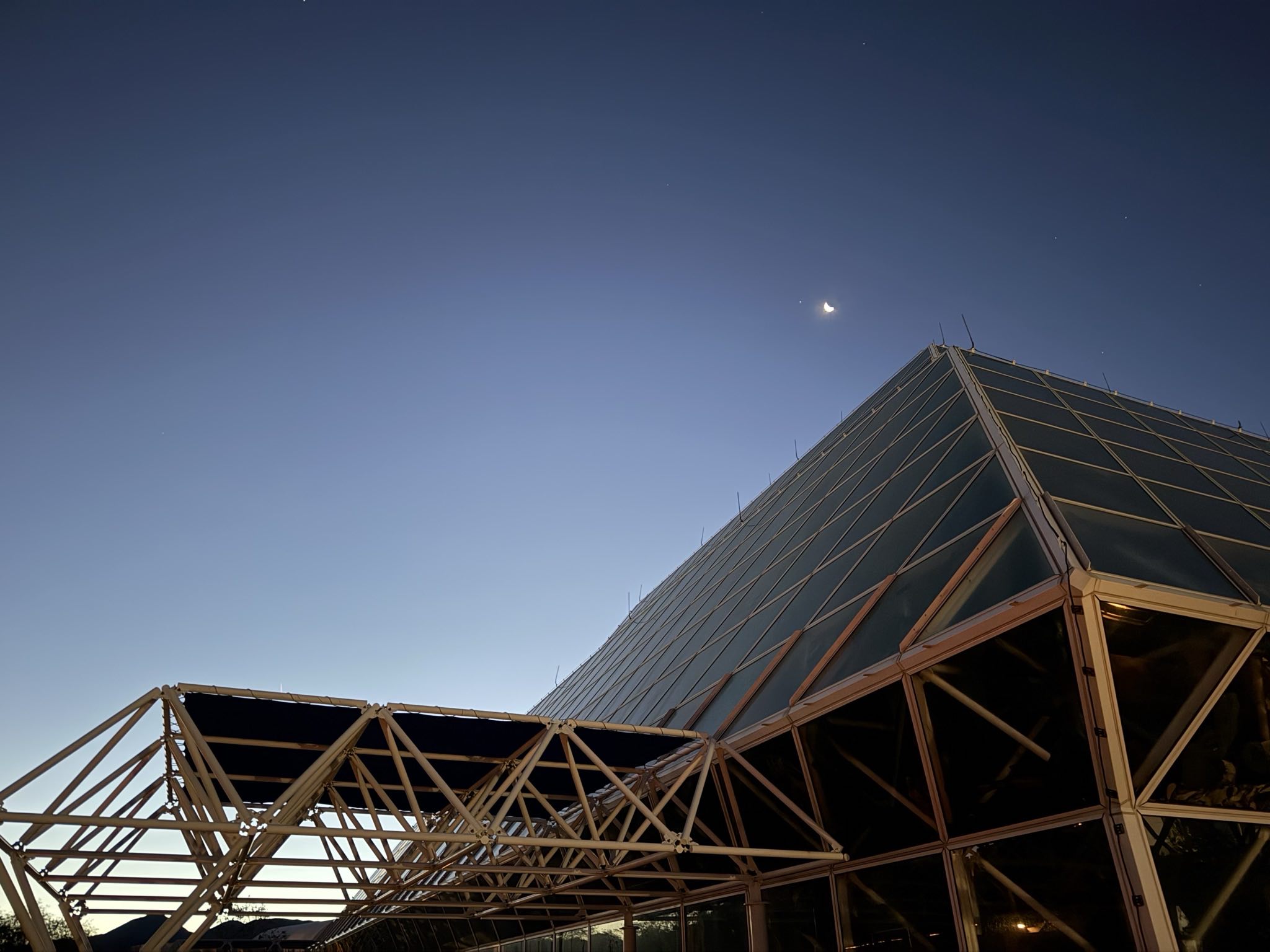
On top of that, the Tucson Marathon is a point-to-point course that is predominantly downhill. The final clincher for me was that it starts at the famous Biosphere 2, a place I had read about with fascination back in the 1990s. With all of that combined, this race finally felt like my chance to check Arizona off the list.
I came into the race with a solid couple of months of training in Fort Collins. I had done nine long runs up to 20 miles, running all of them at under 8:00/mile pace. Between the training and the course profile, I felt like something special might be possible. Sub-3:30 seemed very realistic, and maybe even sub-3:20.
Race morning went smoothly. I woke up at 4:45 a.m. after a pretty good night’s sleep, drank coffee, used some spray-on sunscreen Andrea had bought a few months earlier, and ate a banana along with two bagels slathered with mini Nutellas I had picked up at Dollar Tree a couple of days before. I drove to Oro Valley Marketplace and hopped on a shuttle to the start at Biosphere 2.

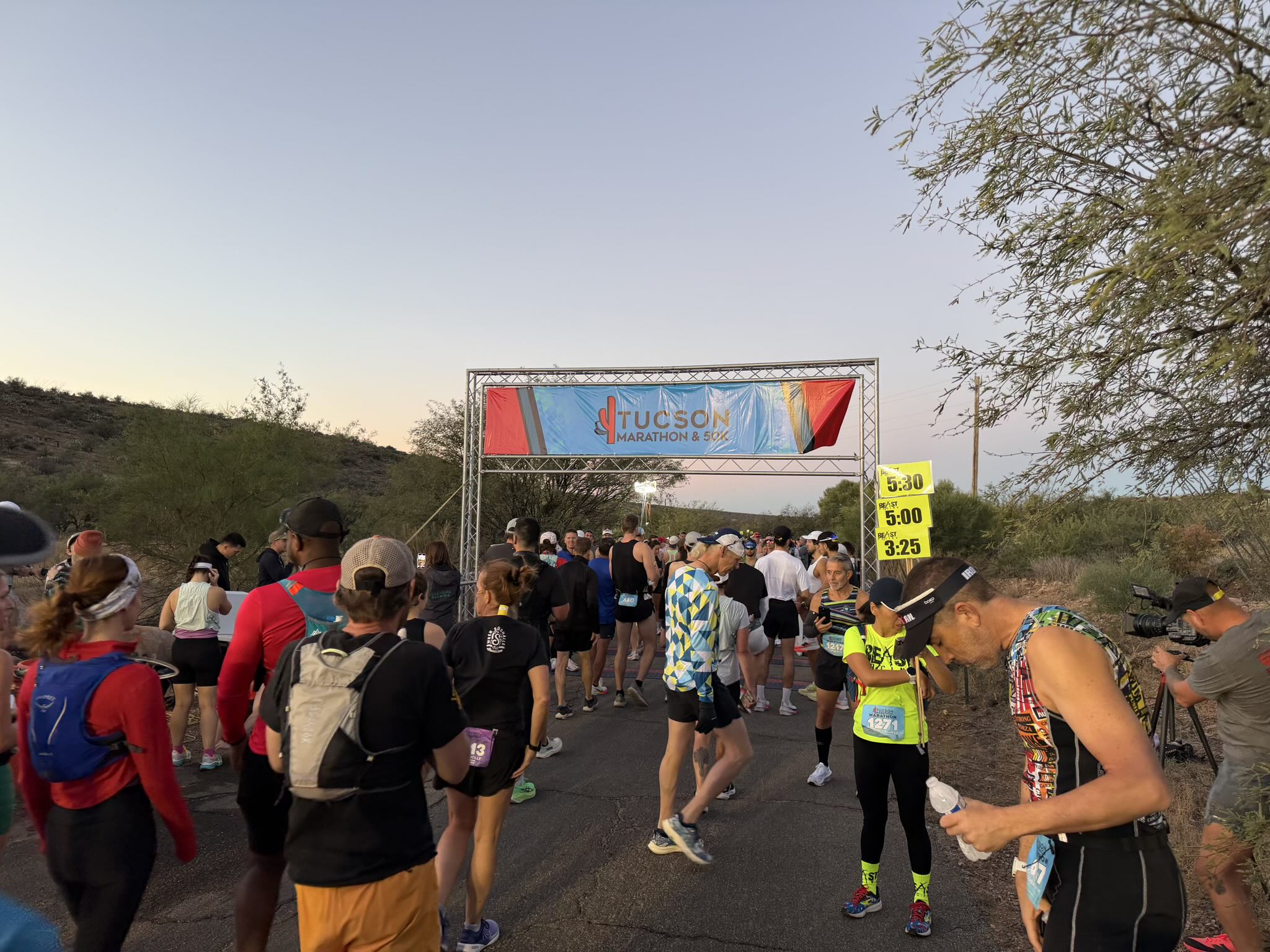
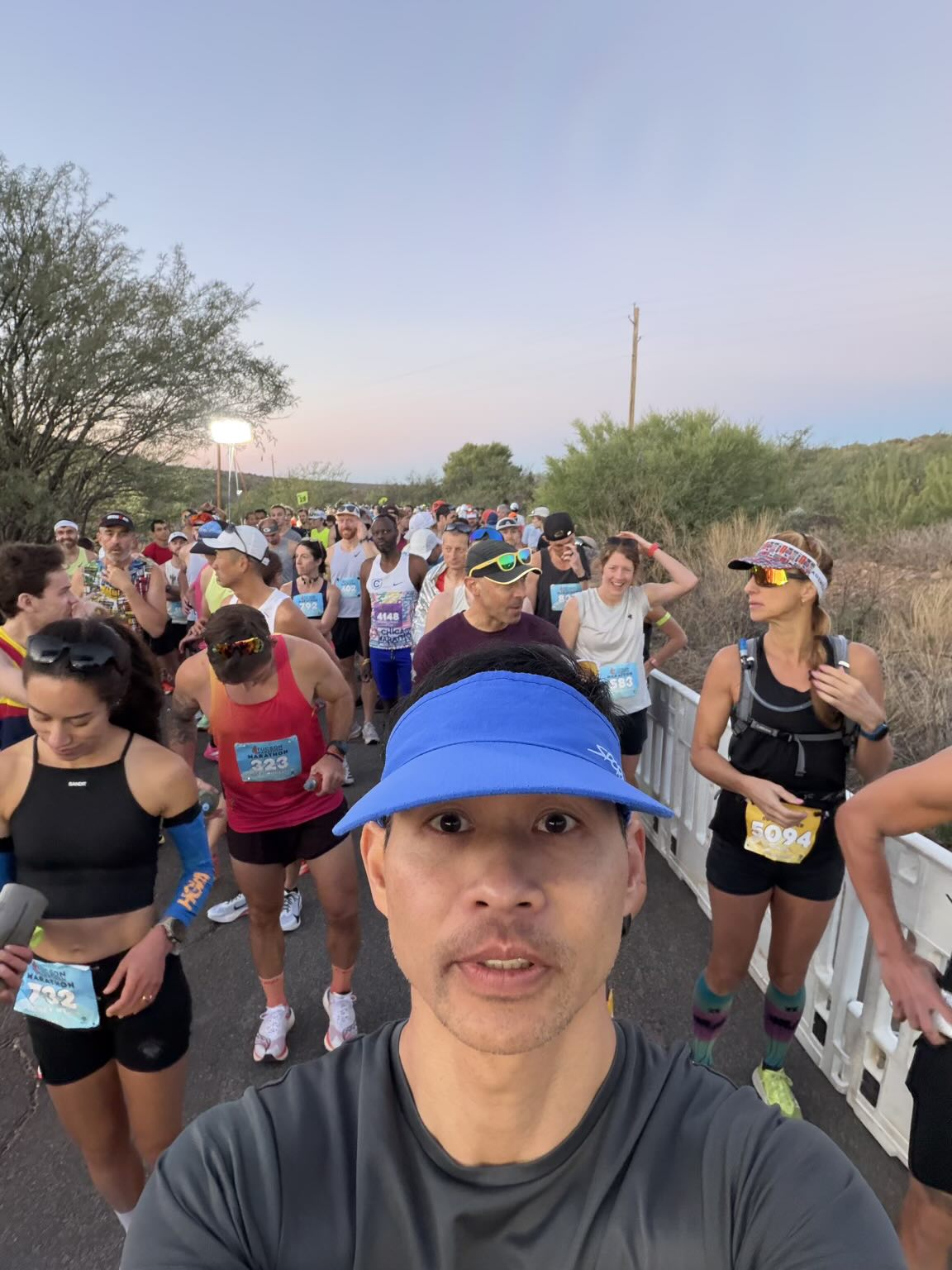
At the start of the Tucson Marathon, I lined up right at the very front, mostly for photos and videos. I set my watch for a 3:18:30 target time. Almost immediately, I regretted starting so far forward. The first mile was uphill, and surprisingly steep. After just one kilometer I already had to slow down. I must have gone out too fast initially because the early split still showed me on target, but by the one-mile mark I had to back off significantly. My data later showed that I slowed to nearly 9:00/mile pace, and it felt like more than 100 runners passed me in short order.
My throat also became scratchy very quickly, the same sensation I used to get during mile races years ago. Maybe exercise-induced asthma, although at least there was no wheezing. It took a good five to six kilometers of focusing on staying relaxed and nose breathing before that feeling finally settled down.
After that, I started to claw back a bit of time on the 3:18:30 stretch goal—though only briefly.
Around that time, a very large group passed me, mostly fast women with sun-damaged skin, led by a female pacer holding a 3:25 sign. For the next 25 kilometers or so, that group stayed in my sights, usually about 50 to 100 meters ahead. I eventually caught them around kilometer 22. According to my watch, I passed the half marathon point in about 1:40:14.
I stayed near or just ahead of that group until around kilometer 35, when I began to slow again. The sun was becoming a problem. There was simply too much solar radiation. By that point, the course had at least moved off the highway and onto a trail with some shade, but only for the legs.
One drawback of that trail section was the presence of cyclists trying to use it despite the fact that it was clearly being used by more than 3,000 marathon or half-marathon runners. The worst was an entitled-feeling woman riding at speed who angrily shouted at runners to stay on their side of the trail. A male runner just ahead of me responded, “chill out woman,” which summed up my feelings perfectly. We were racing a marathon and hurting, after all. If I were the one on the bike, I would have felt bad for using biking on the trail during a once-a-year sporting competition and would be completely yielding to the runners, even if the trail wasn’t strictly closed for it.
Nutrition-wise, I took NeverSecond sports drink at every available aid station. This was my first time even hearing about the brand, but it was fine. In the past, I would wait until around mile six to start taking liquids, but not on this day, especially with the early throat issues.
I also took a NeverSecond gel at mile 13.9 and again around mile 18, though I honestly cannot remember if I managed to take a third. The plan was three. I did take two SaltStick Electrolyte Fastchews out of the four I brought, each containing 100 grams of sodium.
Starting around kilometer 35, I also made sure to grab enough water to dump some on my head, which I did three times. By this point, the solar radiation was intense as there were no more than whispy clouds in 5% of the sky. Thankfully, aid stations were spaced fairly closely, generally every two to two and a half miles.
Around kilometer 37, I moved ahead of the 3:25 pacer as she slowed and started jogging backward. I wondered if her legs were hurting to the extent that she’d miss her goal time. That question was sort of answered when she ran past me again with about two kilometers to go. I could not respond and was simply content to keep my kilometer splits between 5:15 and 5:30.
With about a quarter mile remaining, I tried to pick up the pace. Then, with roughly 50 meters to go, my right leg started cramping. At that point I was basically dragging the right foot, and my “sprint” never got faster than 7:40/mile pace.
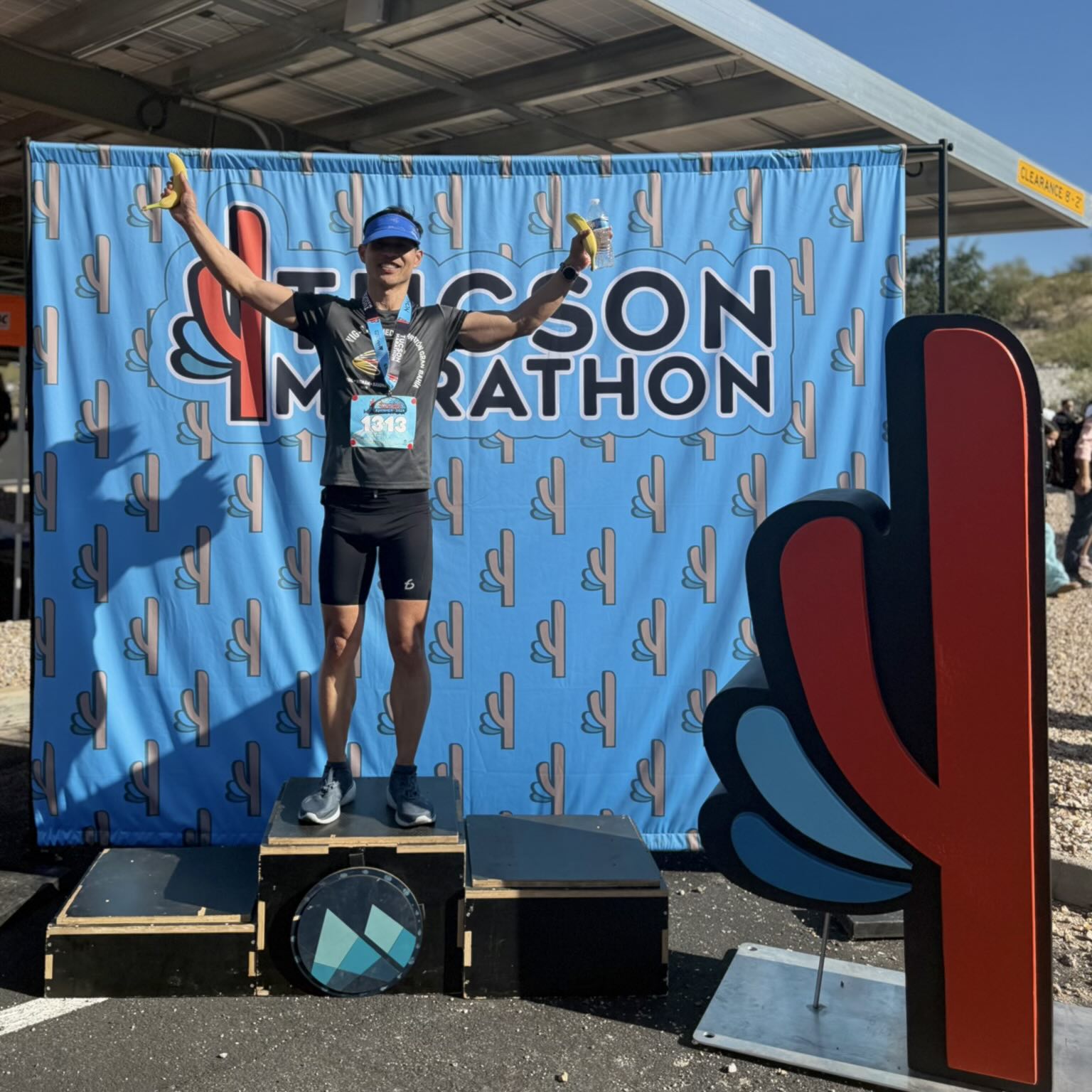
I crossed the line in 3:26:41 official time. That was only seven seconds faster than my Garmin Marathon in Olathe earlier in the year, despite the downhill nature of the Tucson course. The difference was the heat. Olathe had near-perfect temperatures, while Tucson was simply much warmer. Even so, I felt better immediately afterward than I did at the Berlin Marathon in September. I spent some time in the shade, drinking water and taking my final two SaltStick tablets.
While I was there, a mom flagged me down and asked if I could grab some food for her son, who had just finished the marathon but did not realize he could only get food inside the finish area, which did not allow re-entry. I picked up a banana, an orange, a granola bar, chips, and a bottle of water for him.
In a final bit of post-race chaos, I forgot to retrieve my drop bag before hopping on the school bus shuttle back to Oro Valley Marketplace. That meant driving back to Pima College, the finish area, after returning to my car in Oro Valley.
After showering and doing laundry in the hotel sink, I walked five minutes to a local dive bar called Putney’s Pitstop Sports Bar and Grill. I ordered a chicken Caesar wrap, fries, and a couple of Heineken 0.0s. The main event on the TVs was Green Bay Packers at Denver Broncos, with the audio on and an even mix of fans from both sides.
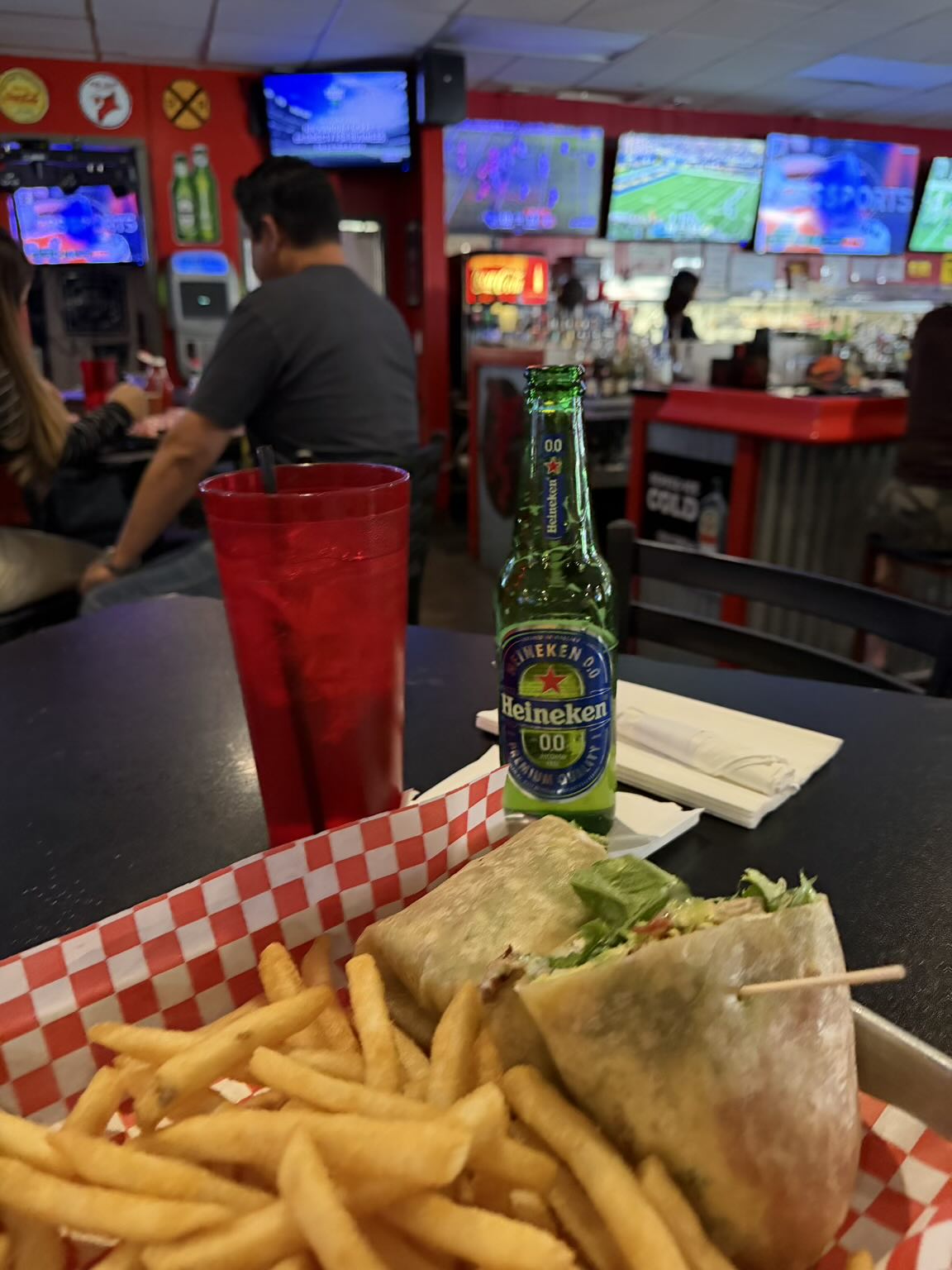
At the same time, I could see the San Francisco 49ers trounce the Tennessee Titans, and the Los Angeles Rams beat the Detroit Lions. The Broncos-Packers game itself was highly competitive, with the Packers controlling much of the first half before my Broncos surged ahead and pulled away in the second. It was a satisfying way to wind down a long, warm, and ultimately rewarding marathon day in Tucson.
Race Data
Final time: 3:26:41 (7:53/mile or 4:54/km pace)
Overall place: 239 / 1125
Age group: 18 / 71
Male place: 183 / 689
Male Masters place: 76 / 290
Official results
Other notes
For this race, I used Flipbelt Men's Compression Shorts 3.0 to great effect. They were comfortable with no chafing. I had gotten them precisely because my usual, more traditional, running shorts would chafe the inside of my legs especially if I wasn’t good about applying petroleum jelly in those areas.
Moreover, the shorts have integrated—and easily accessible—front and rear waist pockets, in addition to some zippered side pockets. Therefore, I didn’t have to wear the Flipbelt waist belt I normally wear over running shorts. I put my phone in the rear pocket, a plastic bag with 4 SaltSticks in the front pocket, and the rental car keys in the zippered side pocket.
The compression shorts are certainly more aero than my usual shorts. I’m not sure if that yields more than a couple seconds per mile, but every second counts!
I will continue to use my usual running shorts plus Flipbelt waist belt for traditional runs as I prefer that look, but otherwise I can recommend the Flipbelt Compression Shorts for marathons. They even are thoughtfully designed to hide “the bulge” well!
There are 2 comments.
Thanks for your description of this marathon, Felix. I'd never be able to do that, so I loved living it vicariously. I hope that woman who yelled at runners wasn't a Tucsonan - as I have always found most people here are nice, as well as considerate.
Hi Karen. The encounter with the angry cyclist was the only negative one. Most people I met throughout the marathon, from the race volunteers to the people I chatted with along the course, were incredibly friendly and welcoming. I also had nice interactions in Putney's Pitstop afterwards. It's great to hear you have that experience with the locals too.
Thanks again for your kind words. It was a great experience to share with you!