Baltimore Beyond the Ravens

My knowledge of Baltimore before visiting could be summarized in one sentence: the Baltimore Ravens play there, and I hate them.
That may sound harsh, but I am a Pittsburgh Steelers fan—the Ravens are their fiercest division rival. Baltimore also happens to be home to the team that beat one of my other favorite teams, the San Francisco 49ers, in Super Bowl XLVII in February 2013. Lamar Jackson is now the face of the franchise, a two-time MVP who runs like a halfback and throws like a quarterback. I admire the player in the abstract, the way you might admire a chess opponent’s brilliance right up until the moment they take your queen. My visits to AFC North cities are thus always tinged with a certain grim satisfaction when I spot a Ravens jersey and remind myself that even great teams lose in January.
So it was with some surprise that I found myself genuinely thinking “it’s not so bad” when I came to Baltimore to run in the B&A Trail Marathon, named after the Baltimore and Annapolis rail trail.
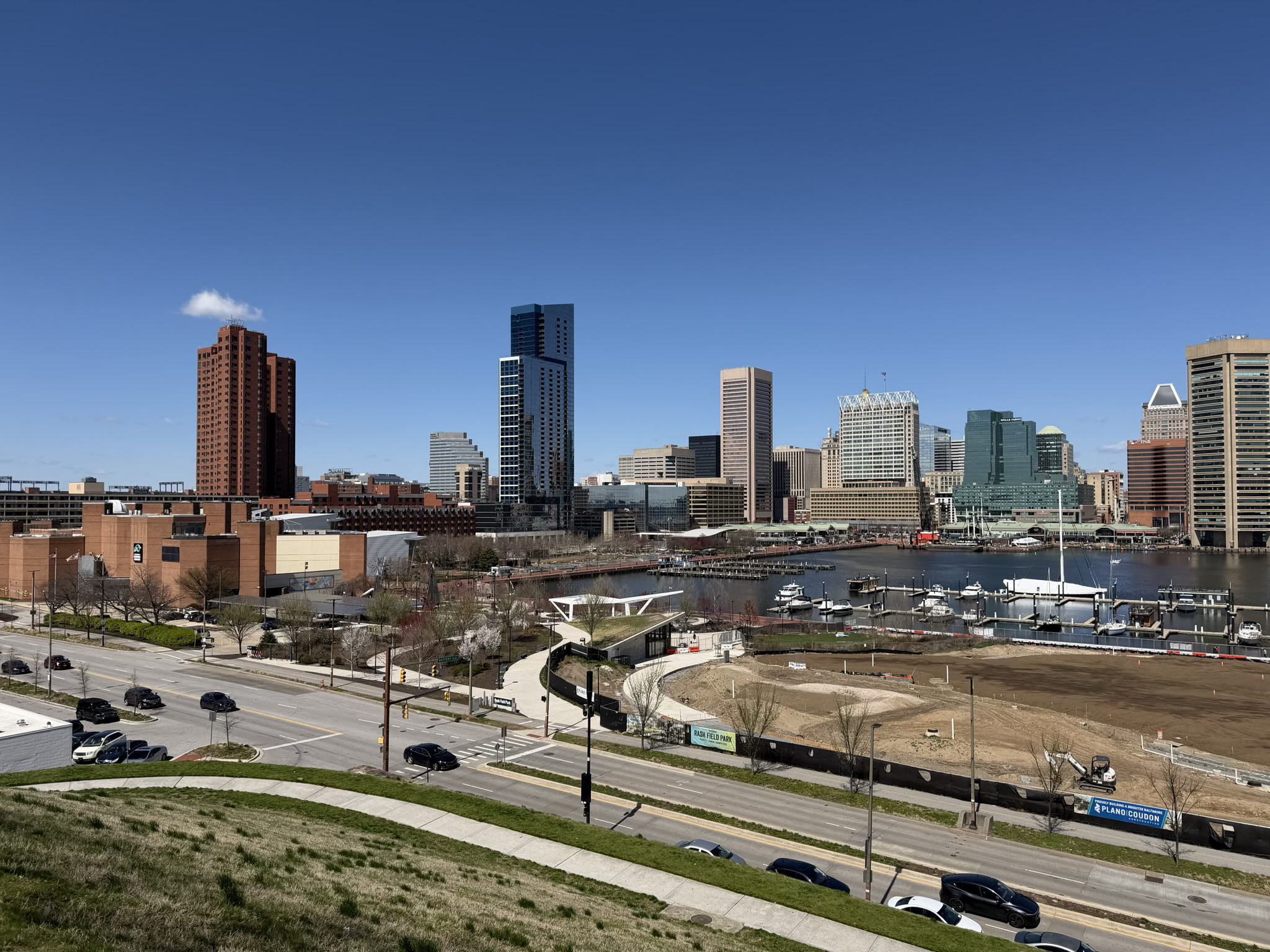
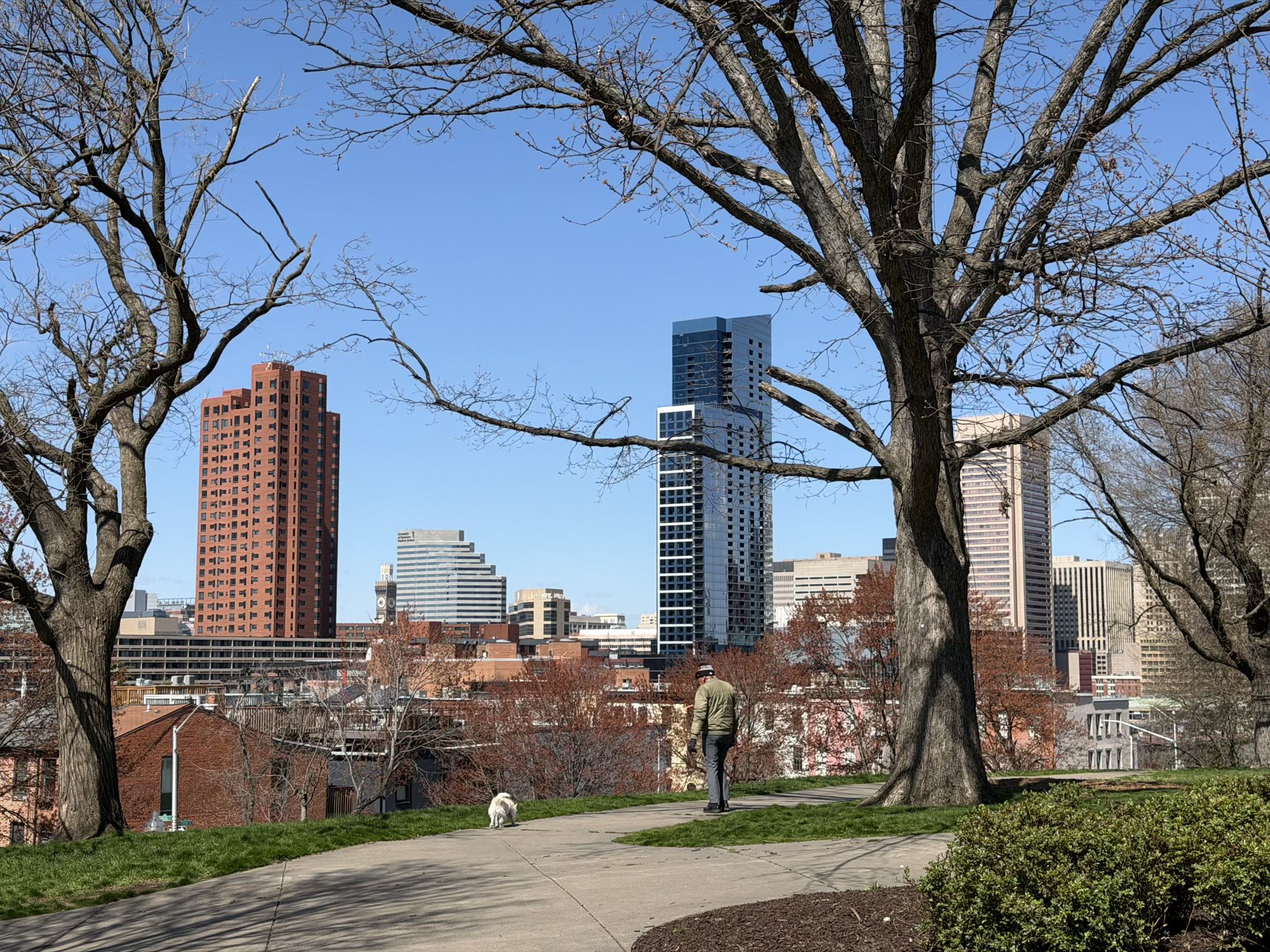
My first stop in the city proper was Federal Hill Park, a grassy bluff just south of the Inner Harbor that delivers one of the better urban panoramas I’ve encountered. The skyline is a study in architectural pluralism: glass towers, steel frameworks, and—this was the detail that stopped me—brick skyscrapers. Full-size office buildings sheathed in brick, rising above the harbor like Victorian warehouses that kept growing and refused to stop. You don’t see many of those. Denver has none. Fort Collins has none. Most cities retired brick as a construction material somewhere around the time they invented elevators. Baltimore apparently did not get the memo, and the city is probably better for it.
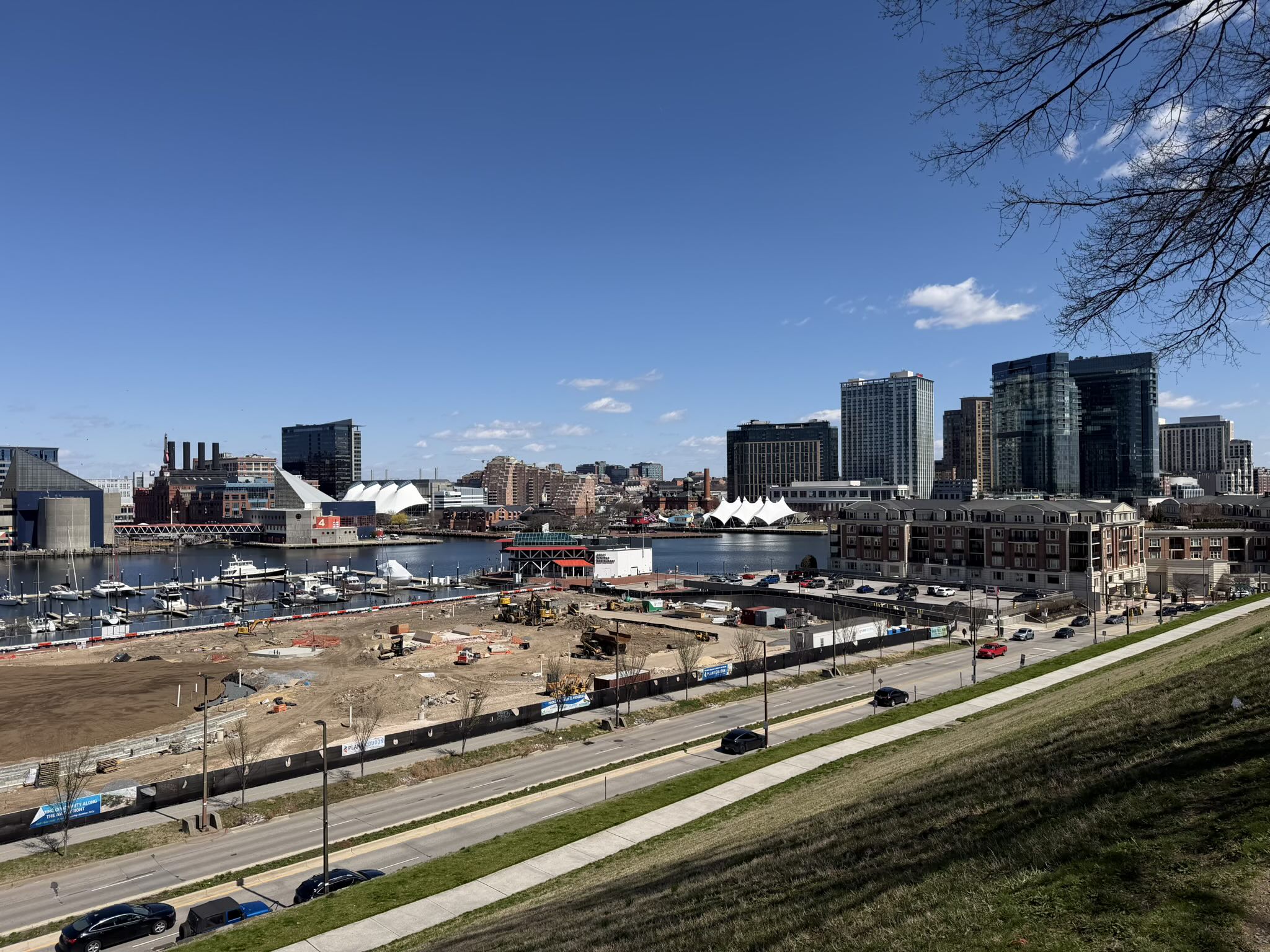
Down below Federal Hill, along the water’s edge, a large section of the Inner Harbor is being remade into Rash Field Park, due to open this summer. The plans are ambitious: a lawn for soccer and field games, six beach volleyball courts, two pickleball courts, butterfly gardens with educational paths, game tables, a fitness trail, a kayak launch, and the relocated Pride of Baltimore Memorial. It is rare to see a city take prime waterfront real estate—land that developers would cheerfully turn into condominiums—and hand it over to its residents as open space. Baltimore is doing exactly that.
From Federal Hill I drove to Fells Point, the old maritime neighborhood a mile or so to the northeast. The cobblestones here are not decorative—they are original, the same stones that waterfront workers walked on in the 18th century, and they announce your arrival with a satisfying rumble under the tires. Independent shops line the narrow streets: bookstores, boutiques, coffee counters. There is almost no graffiti to speak of—the only scribbling on a wall I noticed anywhere read “hustle not beg.” (I noticed this same absence last week in Nashville and Huntsville, and each time it struck me as a small civic courtesy that Europeans, accustomed to spray-painted everything, would find remarkable.)
What there was, in abundance, were Orioles shirts. A city that wears its baseball team on its chest—literally—is a city that has not entirely given up on itself.
A few other observations from the day: traffic was lighter than I expected for a city this size, parking was not the ordeal it tends to be in comparable East Coast cities, and there were a good number of people simply walking around.
On the other hand, sirens were a near-constant soundtrack, and a few of the characters wandering in the middle of streets I encountered likely had a rough morning.
Which brings up the obvious question about Baltimore that anyone who has spent five minutes doing a Reddit search on the city will encounter: the crime.
The honest answer is that Baltimore’s violent crime rate remains well above the national average—and the Reddit warnings about sticking to known neighborhoods are not paranoia. Locals describe a “White L,” referring to the roughly L-shaped corridor of wealthier, more-developed neighborhoods running north along Charles Street and east-west along the harbor. Step outside that L, particularly into western Baltimore, and the patchwork of safe and unsafe blocks becomes less predictable. The city has historically been one of the more racially and economically segregated in the country.
That said, the trajectory is genuinely striking. Baltimore recorded 133 homicides in 2025, its lowest in nearly 50 years.
Well, that still seems really high to me. I remember thinking that the 71 murders that Stockton, California had in 2012 was ridiculous. Fort Collins usually has only 1-3 per year. (Don’t even get me started about the vast majority of cities in Spain, where just about the only crime is petty theft and the said graffiti.)
But apparently, as recently as 2021 and 2022, Baltimore had over 330 homicides each of those years. The improvement is not a rounding error or a statistical anomaly—it is now a three-year trend, and it is getting noticed.
An article that came out on Mental Floss about how Baltimore was ranked as the number one city in the United States for young professionals. While its source seems dubious—after my digging, I am convinced that the supposed source (a gambling operation) produces disposable listicles to earn SEO backlinks from legitimate publications—the article did point out some things that make the claim believable. It cited mix of entry-level job availability, affordable rent, walkable layout, and manageable commute times. A city that was synonymous with danger is now—carefully, imperfectly, but genuinely—becoming something else.
One last observation: nobody smiled at me. Not at Federal Hill, not in Fells Point, not inside Chipotle, not at the rental car agency, not at the hotel, not even at packet pickup for the B&A Trail Marathon. I swear that I was looking perfectly presentable and friendly myself. My interactions were perfectly pleasant, but the city’s default expression is one of studied neutrality, the face of a place that has been through enough not to beam at strangers.
Of the places I’ve been to during the last week, Nashville smiles. Huntsville smiles. Baltimore does not smile—not yet. But it is building pickleball courts on the waterfront and wearing its Orioles gear with quiet pride, and sometimes that is enough.