
Blast from the past: When Garmin-Chipotle had a Tour de France Cycling Team

There is a particular kind of disappointment that comes from learning, eighteen years late, that two of your favorite companies once threw a party together and forgot to send you an invitation.
I found out while reading a road.cc feature on how EF Education-EasyPost races the Tour de France. EF is one of my favorite teams, for reasons that are not complicated: they ride Cannondales, and there are two Cannondales hanging in my garage. They are registered in the United States and run out of Boulder, an hour down I-25. They have the best-looking bikes and jerseys in the WorldTour. I do not care for pink as a rule, but their particular shade of it, laid over white argyle, works.
And I like their riders. Richard Carapaz spent the final week of this year’s Tour attacking until something broke, winning at Orcières-Merlette on stage 18 and then again two days later on Alpe d’Huez, arriving from the back side over the Col de Sarenne, a climb the Tour had only ever descended before. He took the polka dot jersey home with him. Last year Ben Healy won stage 6 into Vire Normandie and then rode into yellow on stage 10, the first Irishman to lead the race since Stephen Roche in 1987. And Kristen Faulkner—a Harvard computer science graduate from Homer, Alaska, who appears to turn everything she touches into precious metal—won the 2024 Olympic road race in Paris and then, three days later, a second gold in the track team pursuit.
The road.cc piece mentioned, almost in passing, that the squad made its Tour debut in 2008 as Garmin-Chipotle. I read that sentence twice.
Six Months in Argyle
The full name was Team Garmin-Chipotle presented by H3O. Perhaps more commonly, it was Team Garmin-Chipotle p/b H3O. Just don’t think “peanut butter H3O.”
Or H30. Nobody seems certain, including the people who paid for it. A single press release out of Garmin’s own newsroom manages “Presented by H30” in the headline and “presented by H3O” in the body, which suggests a copywriter and an editor in Olathe fought to a draw and went home. Race results almost universally printed the zero. Herbalife, whose product it actually was, used the letter.
Why H3O at all? The charitable reading is chemical: H2O, but with an extra unit of something. Water, plus. The trouble is that H3O is already spoken for. Add a proton to water and you get the hydronium ion, H3O+, which is the thing that makes acids acidic. Naming a hydration product after it takes nerve. The alternative spelling, H30, at least avoids the chemistry, though it reads like a delivery window.
Either way, it is a lot of syllables for a bicycle. Herbalife is a company you have almost certainly never bought anything from, because since its founding in Los Angeles in February 1980 it has sold through multi-level marketing rather than shelves. No convenience store. No GNC. Think Avon, but for electrolytes.
I had never heard of the drink. I assumed it had quietly died sometime in the Obama administration. It has not. H3O Fitness Drink is available today on Herbalife’s website in Orangeade, fifteen packets to a box, which means the least famous sponsor on that jersey has outlasted the team name by eighteen years and is still going. For the rest of this article I will call the team Garmin-Chipotle, partly for brevity and partly because a company that cannot get its co-sponsors to agree on the spelling has forfeited the extra words.
Garmin announced the title sponsorship on June 18, 2008, roughly two weeks before the Tour started. Jonathan Vaughters’ squad had spent the first half of the season as Slipstream-Chipotle, hunting for a title sponsor while somehow winning the opening team time trial at the Giro d’Italia, which put Christian Vande Velde in the pink jersey—the first American to wear it since Andy Hampsten in 1988. The new kit was unveiled at 1:00 p.m. on July 3 in a press room in Brest. Contrary to what you may read, Garmin did not bring the argyle; the argyle survived Garmin. Slipstream had been wearing it since 2007, in blue and orange, and the Garmin kit actually toned it down onto a white background.
The team’s first win under the new name came almost immediately, when 21-year-old neo-pro Dan Martin took the overall at the Route du Sud, June 19 through 22. Good mojo, as the team’s own website put it, heading into July.
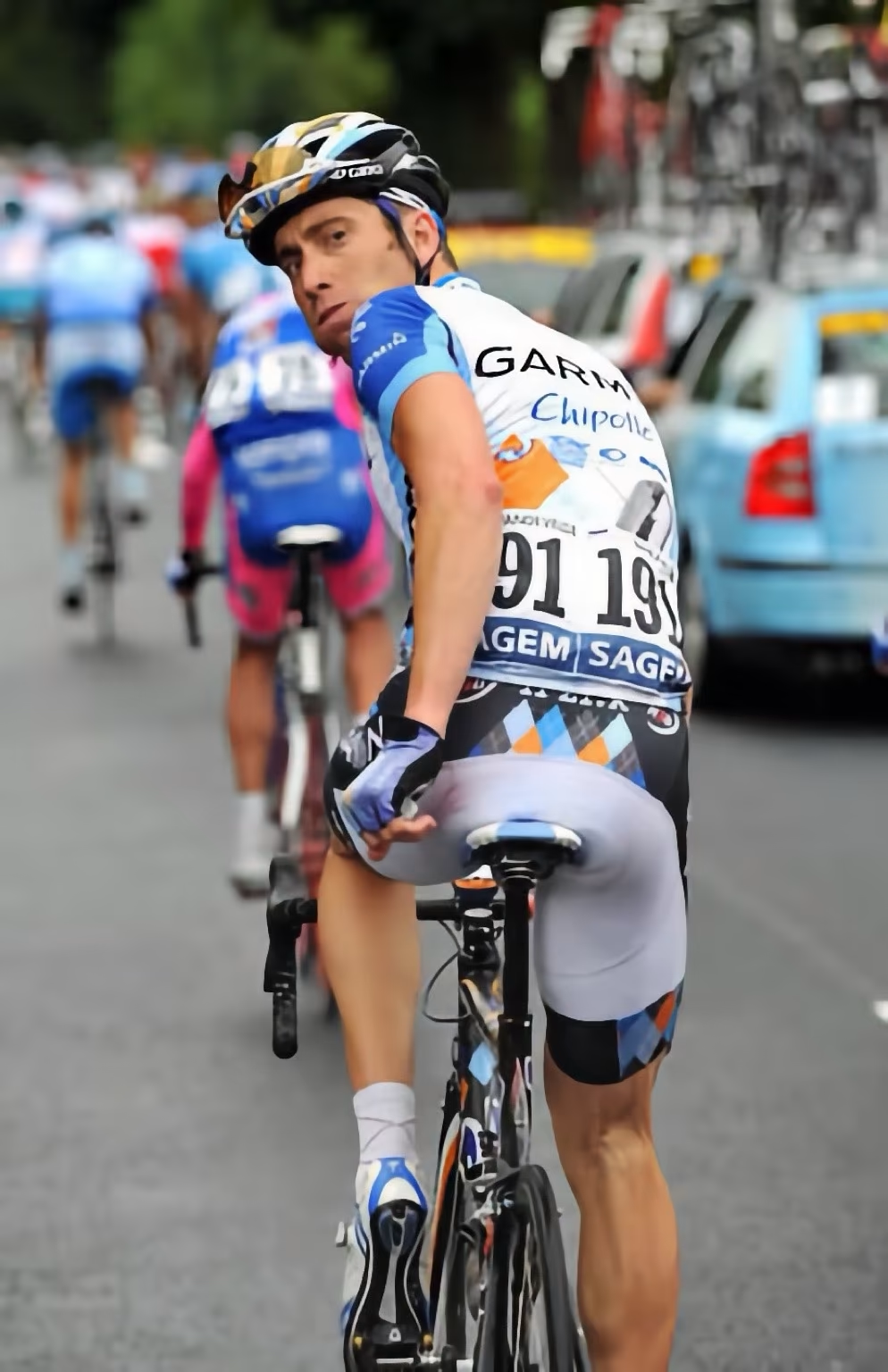
They rode a fine Tour. On stage 3 into Nantes, Will Frischkorn went up the road in the second kilometer with three others and stayed away all day, finishing second by half a wheel to Samuel Dumoulin and collecting the combativity award—an honor that only riders who cannot win have ever coveted. The team led the teams classification coming out of that stage. Vande Velde, meanwhile, kept turning up in the front group when he had no business being there, and finished fifth in Paris—later moved to fourth when Bernhard Kohl was stripped of his result for CERA, a long-acting descendant of EPO.
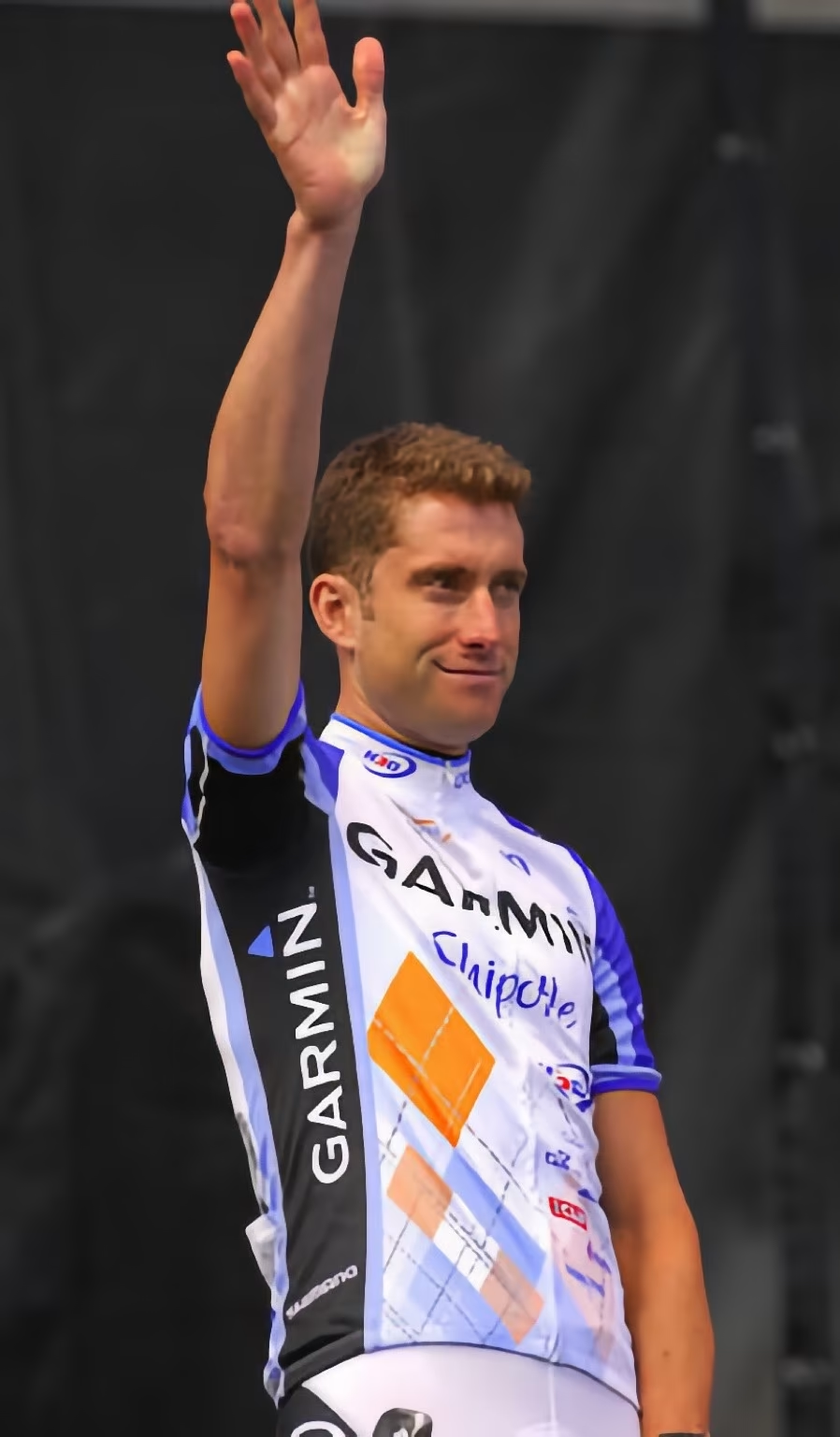
The rest of the year kept going. Dave Zabriskie took his fourth U.S. national time trial title in August. In September, Vande Velde won the stage 3 time trial at the Tour of Missouri—a few hundred miles from Garmin’s headquarters—and then the overall.
What the team was actually selling, though, was blood. Good, natural blood. Garmin-Chipotle existed in the wreckage left by Festina and Operación Puerto, and Vaughters had partnered with the Agency for Cycling Ethics to build an internal testing program stricter than the UCI’s. Twenty-five riders, at least 700 voluntary tests across the season, twenty times what a normal professional faced. NPR reported ACE’s testing ran about $20,000 per athlete per year, which for that roster came to north of $400,000. They were among the first squads to market themselves as explicitly clean.
On January 1, 2009, the team stepped up to ProTour status as Garmin-Slipstream, and Chipotle came off the name. It did not come off the payroll. Vaughters, at the 2009 kit launch: “We are still powered by Chipotle burritos, as we always have been.” The company kept backing the organization’s development squad, which raced as the Chipotle Development Team in 2011 and Chipotle-First Solar in 2012 before folding, and which sent Lachlan Morton—still at EF today—up the ladder.
Meanwhile, I Was on a Dirt Road
All of this happened while I was somewhere between Banff and Antelope Wells, racing the inaugural Tour Divide.
I was about as disconnected as a person in 2008 could arrange to be. No smartphone—the iPhone was a year old and cost $499. Just as it did for Microsoft’s CEO Steve Ballmer—who laughed at the price on camera—that number struck me as a lot of money for a telephone.
Seven Adventure Cycling Association paper maps, because no GPX file of the Great Divide Mountain Bike Route existed, and if one had, I owned nothing that could have opened it. Cell coverage along the divide was theoretical. Every day or two I would find a payphone and call in to MTBcast, which at the time felt like an impressive feat of communications technology and in retrospect still sort of does.
I did carry a Garmin nüvi car navigation unit, purely as a panic button for the event that I became comprehensively lost. It held maybe an hour of charge and had no idea the route existed. It rode in a bag for most of 2,700 miles doing nothing, which is the correct outcome for a panic button.
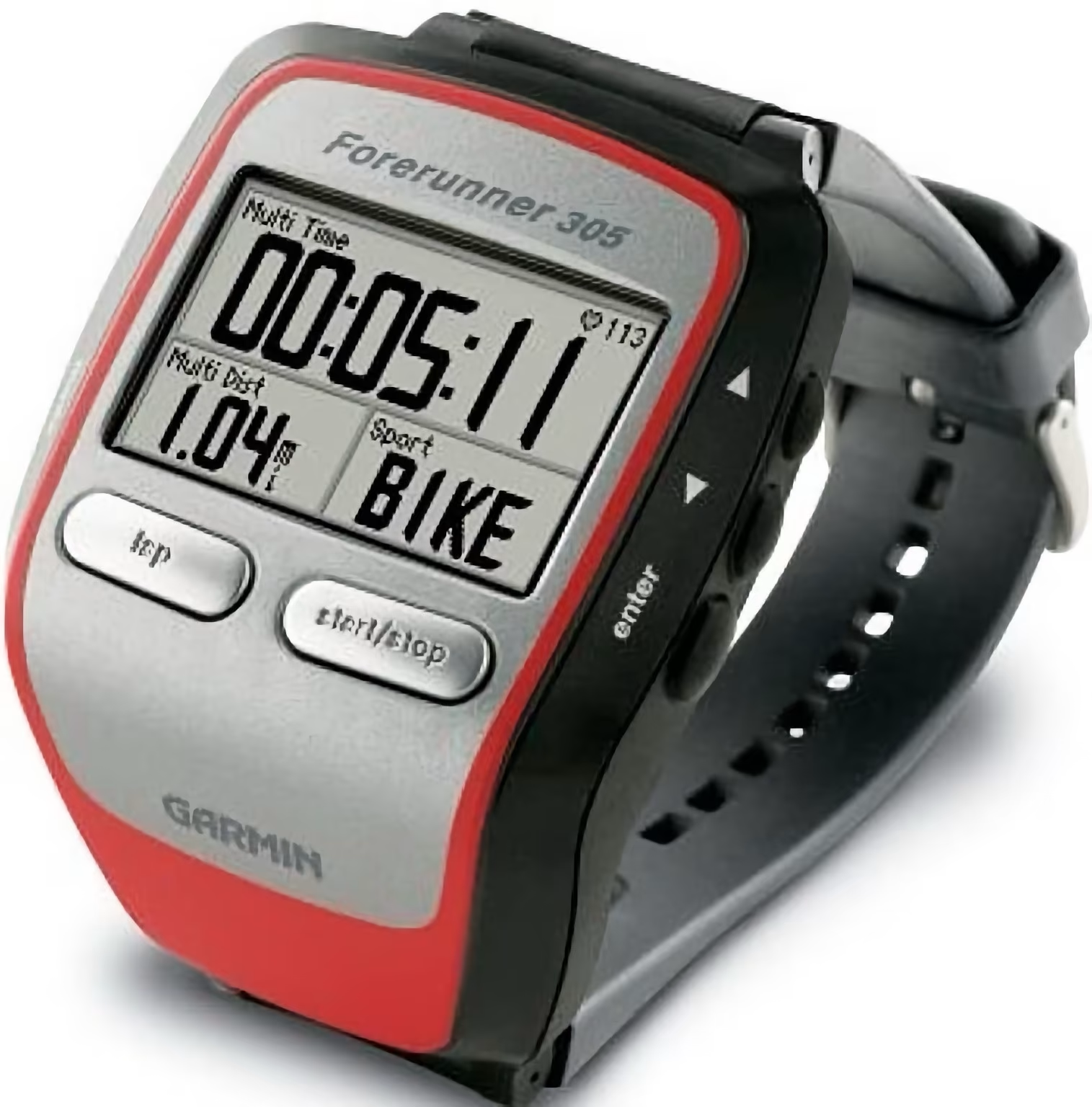
It would be two more years before I bought a Forerunner 305, a device best described as a gadget that had been strapped to a wrist against its will. It bricked several times. Garmin’s people in Olathe, Kansas fixed it every time without complaint, which is a large part of why I am writing this article at all.
So in July 2008, deep in Montana, I missed the entire thing. Carlos Sastre won that Tour. Garmin and Chipotle spent real money putting their names on a jersey in front of a global audience, and the audience did not include me.
Chipotle would not have registered anyway. The company was founded in Denver in 1993, and there was a location in Fort Collins on College Avenue next to Colorado State University, which I drove past for years without curiosity. It took reading Tim Ferriss’ The 4-Hour Body in 2011 to make me try one, as I described in Chipotle in London.
The brand was obscure enough in 2008 that pronouncing it was not yet settled knowledge. Listen to the British announcer in this Tour broadcast work his way toward it and land somewhere near “Chip-it-toll”:
Coach Garmin and the Burrito Bowl
There are a handful of companies I am an unabashed fanboy of: Apple, Cannondale, Chipotle, Duolingo, Garmin, and Saucony. (Microsoft has long dropped off the list, supplanted by Steve Jobs’ company.)
Garmin is the strange one, because Apple owns the smartwatch category and Garmin competes in it anyway. Yet like what seems to be a plurality of serious endurance athletes, I have had a Garmin on my wrist for most of the last fifteen years. My epix Pro (Gen 2) is still “coach Garmin,” and I am fully vested in the Connect ecosystem. This could change—Garmin announced the screenless CIRQA smart band on July 21 of this year, and an Apple Watch Ultra paired with a CIRQA is definitely not something I’d laugh at Steve Ballmer-style. For now, though, I like the company enough that I made a pilgrimage to Olathe last year and ran a marathon there.
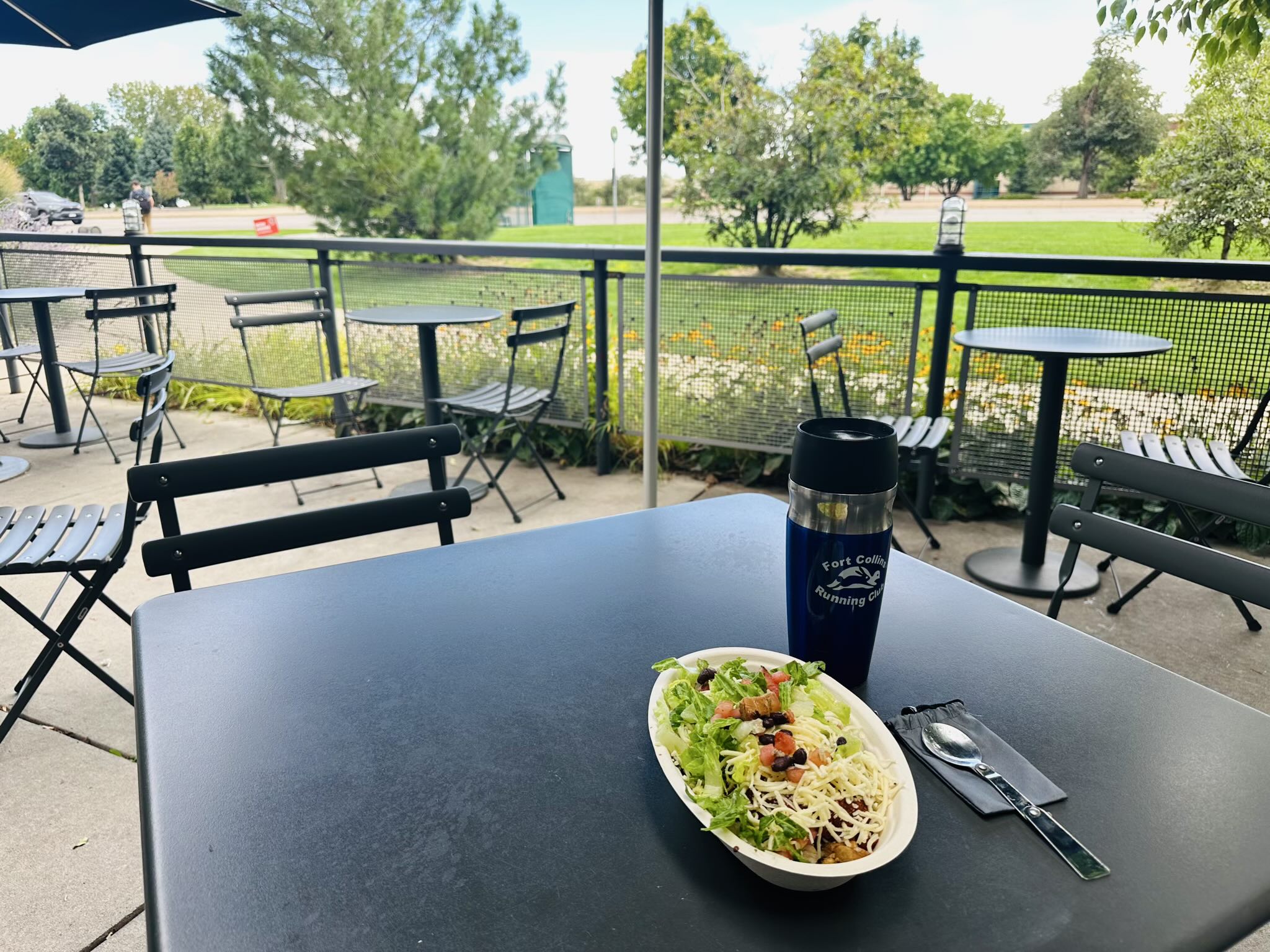
Chipotle I have explained at length elsewhere. Super quick, aligns with my health and longevity goals, sensibly priced, and tastes great. That combination is rarer than it should be.
In hindsight the pairing was peculiar. Garmin in 2008 was known for GPS units in airplanes, cars, and boats; the fitness line existed but was not yet the brand’s identity. Chipotle has never seriously marketed itself as race food, and to its credit has never pulled a Jared, pretending its menu is a weight-loss program. Two companies with no obvious reason to share a jersey shared one for about six months, and then the arrangement dissolved.
The one real shame is the bikes. Garmin-Chipotle rode Felts. The descendant team rides Cannondales.
Which leaves me with a fantasy. If Garmin and Chipotle could pull this off, why not Saucony—America’s oldest running shoe company, founded in Kutztown, Pennsylvania in 1898, and the maker of the Kinvara 15s I put 653 miles on—and Apple, the world’s most valuable company? Plenty of pros run in the off-season; Mathieu van der Poel is among them. Plenty of them use iPhones.
Duolingo turns out to be the least ridiculous name on my imaginary jersey. The EF in EF Education-EasyPost stands for Education First, a global education company whose core business is teaching people languages. The precedent is not hypothetical. It is already on the jersey as the primary sponsor, on this exact team, in a direct line of descent from Garmin-Chipotle. Duolingo would not be a novelty sponsor. It would be a continuation.
Which leaves Apple and Saucony as the only far-fetched parts. Eighteen years ago I would have said the same about a burrito chain and a GPS company.