FTC Mary Andrews Marathon: My Goofy-to-Gainesville Redemption Run

Florida was one of the remaining states where I had not yet run a sub-4-hour marathon. That gap went all the way back to 2009, when I last raced a marathon in Florida as part of Goofy’s Race-and-a-Half Challenge at Disney World. The marathon came the day after a half-marathon, and I also had laryngitis. The result was a gritty but mediocre 4:06 finish. Seventeen years later, I returned to the Sunshine State to give the 26-mile+ distance another shot.
This time, the opportunity came through the FTC Mary Andrews Marathon, held east of Gainesville in the small town of Hawthorne and hosted by the Florida Track Club. With no hotels in Hawthorne, I stayed in central Gainesville in a very nice one-bedroom apartment with a full kitchen. That kitchen turned out to be one of the quiet advantages of the trip. I could keep up my daily habit of huge salads—something I often manage even in hotel rooms—and I could also make a large batch of spaghetti with pasta sauce. I refrigerated it before eating, partly because I love the taste and texture of leftover pasta more than freshly made, and partly because chilling pasta increases resistant starch making it healthier (albeit perhaps slightly worse for running performance due to the energy diversion required to digest it). I ate some the night before the race and again a couple of hours before the start.

Before race day, my friend Mel asked what I was predicting. I answered honestly: “Good question. I feel like my training hasn’t been optimal the last few weeks, so probably around 3:40.” While I had still been running six days a week even while traveling, the longest run since the Tucson Marathon in December was only 13.1 miles, just over three laps of Hyde Park in London. At least I ran that at near race pace. Still, a longest run of thirteen miles is hardly textbook marathon preparation.
The Florida Track Club has a long and prestigious history, which added a sense of occasion to the event. Gainesville has long been a running hub, with luminaries such as Frank Shorter, Jeff Galloway, and Jack Bacheler having ties to the club. The city is also where Gatorade was invented, a fitting piece of endurance-sport lore. More recently, Parker Valby, arguably the finest NCAA long-distance track athlete in history, lived and trained here until graduating from the University of Florida a couple of years ago. Racing under the banner of a club with that pedigree made it feel like more than just another marathon on the calendar.
The race itself carries the name Mary Andrews. She was a longtime Florida Track Club member and a beloved figure in the Gainesville running community, remembered for her dedication to the sport and her support of local runners. Sadly, she passed away from cancer in her 30s. Naming the marathon after her was a tribute to both her commitment and her role in fostering distance running in the region.
Over the years, the event has built a reputation for producing an unusually high percentage of Boston Marathon qualifiers. Part of that is the course. It consists of four repeats of a 6.55-mile out-and-back, very flat, not perfectly pancake-flat but close. There are almost no turns. The only notable one is a somewhat tight U-turn in the middle of each lap. The turnaround at the end of each lap is much gentler, like rounding a roundabout.
But the other major reason for the high Boston-qualifying rate is the caliber of the runners. Many, maybe most, are members of the Florida Track Club itself, and they come ready to race.
For this marathon, I kept things deliberately simple. Because I was doing ultra-light travel for an extended period and wanted to bring only one pair of shoes, I left my carbon-plated, race-day Saucony Endorphin Pro 3s at home. Instead, I raced in my reliable, back-to-basics Kinvara 15s, “transitional minimalist” shoes with a 4mm drop that I’ve been running with daily. I also skipped my usual race-day coffee. I don’t drink caffeinated coffee at all except for marathons—the caffeine would supposedly provide a small performance boost—but this time I didn’t have easy access to it.
Both choices fall into the category of marginal gains I willingly gave up. So this marathon became the simplist type of time trial: no tricks, no enhancements, and the knowledge that I might be leaving a couple of minutes on the table.
Weather can make or break a marathon, and this day delivered nearly ideal conditions. It was in the high 30s Fahrenheit at the start, cold enough for gloves and a long-sleeved technical shirt, but still perfect for shorts. The entire course was shaded. After Tucson five weeks earlier, where strong sun added extra strain, the lack of solar radiation here felt like a gift. The day warmed steadily, and at the halfway mark I shed the gloves. By the time I was back at the rental car after race, the Ford Mustang’s display read 75 degrees. But the shade along the route made all the difference.
There were two distances, the half-marathon and the full marathon, starting together. Half runners were distinguished by an orange rectangle on their bibs. A small suggestion for the organizers would be to use completely different bib colors for each distance rather than a shared white base. It would make it easier to tell at a glance who is running which race when looking at a bib from the side.
Another organizational detail that could be improved was the water stations. There were plenty of them, about six per lap, and runners were instructed to take fluids on the right, which kept things orderly. The issue was distinguishing water from Gatorade. Some tables had water first and Gatorade second, others reversed the order, and all the cups were the same color. The only way to tell was to look down into the cup, which meant slowing or pausing briefly. It would have been better if different colored cups were used while keeping their placement on the tables consistent.
There were supposed to be a limited number of gels on course, but none were available. I had not brought any of my own and had been depending on them. Instead, I relied mostly on Gatorade—the drink that researchers at the University of Florida less than 30 minutes away had concocted 60 years ago.
One unique feature of the race was a table midway through each lap where runners could leave their own food or drinks, similar to elite aid setups. I had not brought anything for that table, and in any case, if I had carried gels, they would have gone in my Flipbelt compression shorts. What I did bring were four caffeinated SaltStick Electrolyte FastChews. I popped one into the mouth around miles 13, 17, and 22, plus one right after finishing.
At Mile 0, I had lined up with the 1:45 half-marathon pacer, but seconds after crossing the start line I was already off the front of her group. Instead, I settled about ten meters behind the 1:40 pacer, who had seven runners with her. For the first lap, I stayed there. Thanks to the cool weather, my heart rate was only in the 130s the entire first lap, indicating that I was staying well within myself despite the good pace.
During the second lap, the group became smaller, and I joined them more directly. There were six of us now, three women including the pacer and three men. Us guys stayed at the back. The pacer did a superb job. At halfway, she peeled off, and my split was 1:40 virtually on the dot. One of the other women, a 42-year-old, moved ahead and kept going with beautifully even splits. She would finish in 3:19. Serious respect for that performance.
Meanwhile, I stayed alongside or just ahead of a 24-year-old runner. By the end of the third lap, it looked like she was falling off my pace, even though my pace was beginning to falter slightly. But the fourth lap told the real story.
It is so easy to be delusional early in a marathon. When the legs feel good, you imagine yourself finishing heroically, speeding up at the end, running down everyone ahead. Reality arrives during the last 10K. It almost always does—at least for me. This time was not the rare exception. My pace deteriorated further. The 24-year-old caught me and passed decisively, and I had no response.
One more woman and two men eventually caught me as well. At that point, my only goal was damage control. I focused on not slowing any more than necessary. My last three miles were just over 9:00 per mile—well off the 7:50/mile pace I had been averaging up to then. That was disappointing, but still a far cry from the 13:00/mile collapses I experienced in marathons more than seven years ago (see the 2017 Bowling Green Marathon, for example).
Mostly, at this point I just wanted to finish under 3:30. It seemed like I had it in the bag, but I did not know exactly how much long the course would measure beyond 42.2 kilometers. By the time I crossed the line, my watch read 42.5 km. I did pick up the pace slightly over the final 200 meters, but it was not an all-out sprint, just enough to finish strongly knowing the sub-3:30 was secure.
My official time was 3:29:39. Rarely have my pre-race predictions been so wrong in a good way. Again, I had expected around 3:40. Instead, I walked away happy with the result, even if the slow final 5K left a small itch of what-if.
A nice touch at the finish was that the announcer called out each runner’s name as they crossed. In my case, he even noted that I was finishing under 3:30, which added a personal feel to the moment.
Later, he announced that runners should check with the timing staff in case they had earned an age-group award. I did, and found out I had finished third in my age group. There were only five runners in the 50-59 category, so this was less an achievement than it sounds, but the prize was genuinely cool. I received a framed certificate reading “Age Group Champion”—never mind that I was third—and a Florida Track Club scarf in colors matching my Denver Broncos. Later that day, the Broncos would win a thrilling divisional playoff game against the Buffalo Bills in overtime, which made the scarf feel like a good-luck charm.
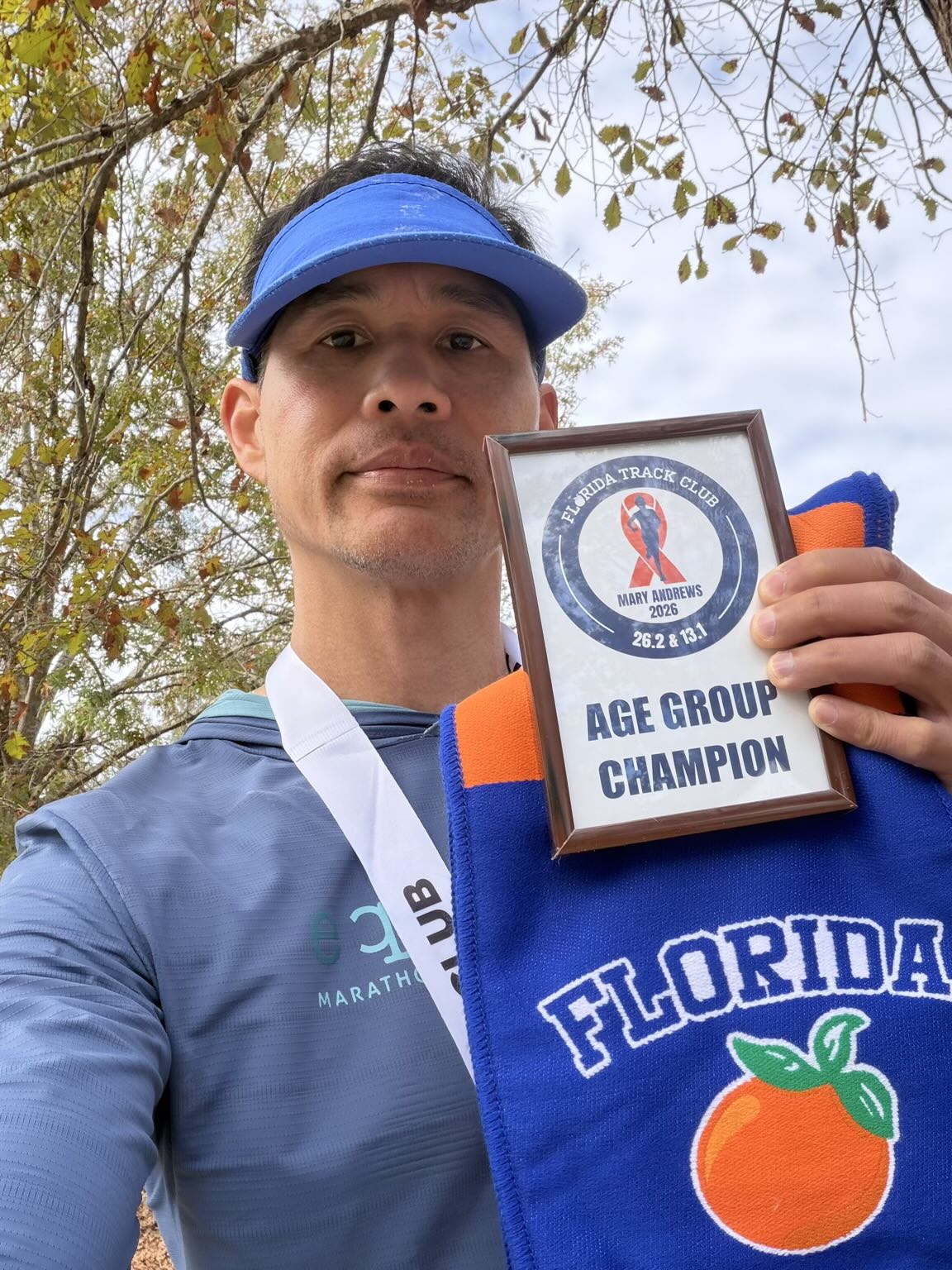
It was a genuine honor to receive something from such a storied club. And it confirmed what I had already suspected: the high Boston-qualifying rate here is not just about the flat course and favorable weather. It is also about the depth of serious runners who toe the line, many representing the Florida Track Club itself.
With this race completed, Florida became my 40th state in which I have run a marathon under four hours. Ten states remain.
One of the most surprising outcomes came afterward. The day after the race, and even two days later, I was far less sore than I usually am post-marathon. Walking down stairs was rather easy, whereas normally I would need to descend sideways while grimacing from the pain in my quads.
I wondered if my recent focus on anti-inflammatory foods played a role, including daily huge salads, sardines, kefir, nuts, fruit, Chipotle burrito bowls with guacamole, and fish oil—even while traveling. Even my pre-race spaghetti was loaded with lycopene (and augmented with olive oil) from the entire jar of organic pasta sauce used. Immediately after finishing, before walking back to the car, I ate two whole bagels smothered in peanut butter, another (mildly) anti-inflammatory ally. I also downed a lot of water with the fourth SaltStick Electrolyte FastChew. Maybe it all added up. Or maybe this marathon just went easier on my body. Either way, it was a welcome surprise.
Another surprise: my shoe! I didn’t even notice it during the race, but my Saucony Kinvara 15 suffered a wardrobe malfunction, with a black rubber piece on the sole partly delaminating:

No big deal, though—after the race on the way back to the apartment, I simply stopped by a Dollar Tree and picked up some Super Glue for a buck-and-a-half and good for a repair that took me no more than two minutes. (And before you suspect that Saucony has a quality problem, this was the first time I experienced this with my favorite brand, plus I have experienced similar or worse with both Nike and Puma. See how shredded my Nike Waffle Racers became during the Free State 100k Trail Race, for example.)

The FTC Mary Andrews Marathon delivered exactly what I hoped for: a fast course, ideal weather, a strong field, and a chance to finally erase Florida from my sub-4-hour holdout list. And now, with forty states checked off, the journey continues. Ten to go.
Race Data
Final time: 3:29:39
Strava/Garmin marathon time (since course was too long): 3:28:08 (7:56/mile)
Overall place: 21 / 51
Male place: 18 / 41
Division place: 3 / 5
Official results
Postscript
Less than six weeks after the marathon, longtime FTC luminary Jeff Galloway passed away from a hemmorhagic stroke.
I remember when Jeff Galloway came to Fort Collins to talk with us at the old Runner’s Roost on November 16, 2007. He was influential with several generations of runners, and I employed his run-walk strategy in a few ultras. I even read his book entitled Running Until You’re 100!
Unfortunately, he passed away at age 80, five years after surviving heart failure. It may seem peculiar that such a fit man (an Olympic runner who ran over 230 marathons in his lifetime) would suffer from cardiovascular disease, but that can be explained by his exposure to Agent Orange while serving in the Navy during the Vietnam War. Apparently, Agent Orange sabotages one’s heart by turning the body’s “clean-up” cells into “cloggers” that gorge on fat and get stuck in the artery walls, creating dangerous blockages that even a healthy, athletic lifestyle cannot prevent.
Rest in peace, Galloway.


There are 2 comments.
Curious about what states you still have remaining to try to run sub-4-hour. And since you live in Spain, do you intend to try to accomplish this in all 50?
Hi Mike, thanks for stopping by my blog and for your comment!
A list of the remaining sub-4-hour states is here. Most are in the Northeast or the inland South. The only ones that are not are Montana and New Mexico—two states I probably should try to check off soon, as they are at elevation and I am not getting any younger!
Are you trying to—or have already—run a sub-4-hour marathon in all 50 states too?