Meet Meter Mackenzie, My Mustang Mach-E

When Ford slapped the Mustang emblem on a compact electric SUV, the internet’s reaction was predictably measured and nuanced—which is to say, Mustang enthusiasts lost their collective minds. A Mustang with five doors? An electric motor instead of a V8? No manual transmission? Sacrilege.
I was actually entirely sympathetic to that reaction. I had spent the better part of three decades driving two-seat sports cars with manual gearboxes and (usually) folding roofs: an MGB, a Porsche 944 Turbo, a BMW Z3, an Alfa Romeo Spider, an Audi TT Roadster. Driver engagement wasn’t a preference for me—it was a prerequisite. The thought of swapping all that for a crossover SUV with no gears nor exhaust note felt less like an upgrade and more like an intervention.
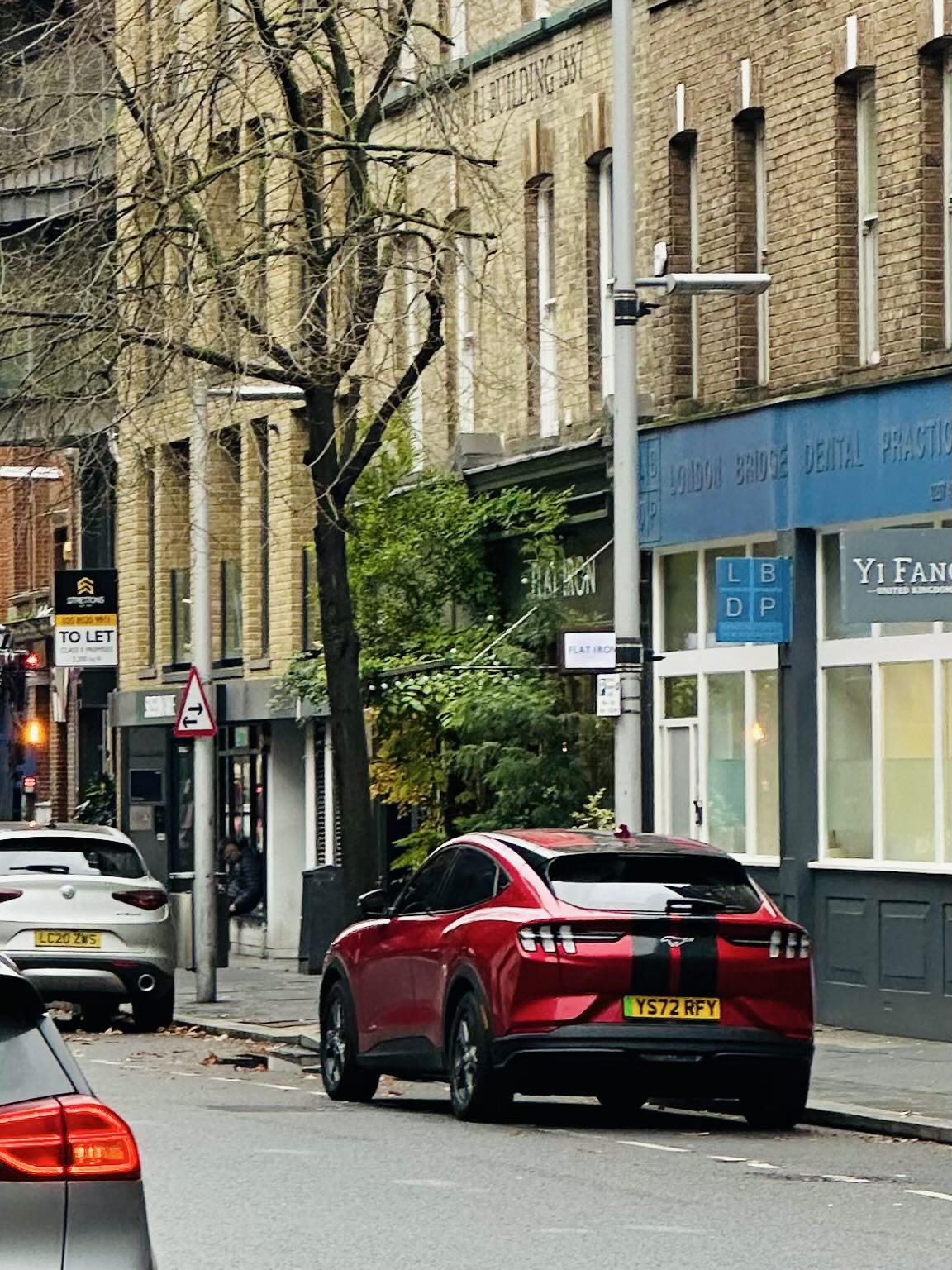
But then I started seeing the Mach-E in person. Despite myself, I kept glancing back at it in parking lots. For a compact electric SUV in a market full of rounded appliances, it had genuine presence. The muscular haunches, the sequential three-bar taillights, the Mustang-inspired headlights—Ford had managed to translate the pony car’s visual vocabulary into the crossover format without it feeling forced or embarrassing.
Then I rented one for a week. By the last day, I was thinking, “I could actually own one of these.”
Reports that the federal EV tax credits might expire in September 2025 nudged me from thinking to doing—never mind that ultimately I wouldn’t quality for the credits. I outsourced the search to AAA Autosource, a free service for AAA members that locates, inspects, negotiates, and delivers a vehicle of your specification. They found me a 2023 Mustang Mach-E Premium in short order, and the transaction was completely stress-free.
Well after I had already signed the dotted line, the AAA rep showed me the original window sticker. I raised my eyebrows: the car had listed for $69,000 new. I was paying less than half of that, just two years after the car had rolled off the assembly line.
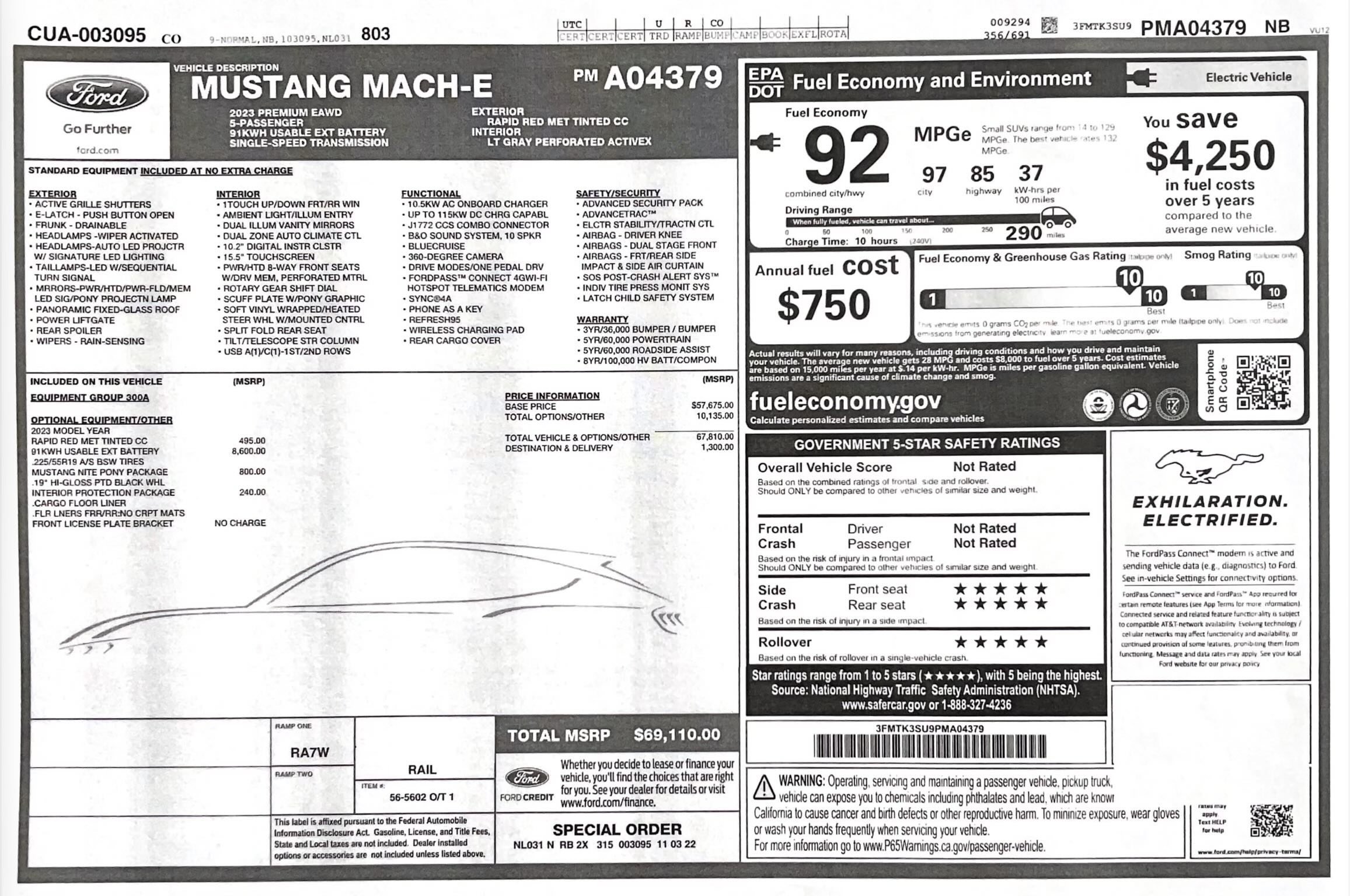
EVs, it turns out, have notoriously poor resale value—even models that once won best-in-class awards for holding their value. The common wisdom about never buying a new car because it loses value the moment it leaves the lot applies with extra force to electric vehicles (see the Mercedes EQS and Dodge Charger EV, for instance). The Mach-E’s previous owner’s misfortune was my good fortune.
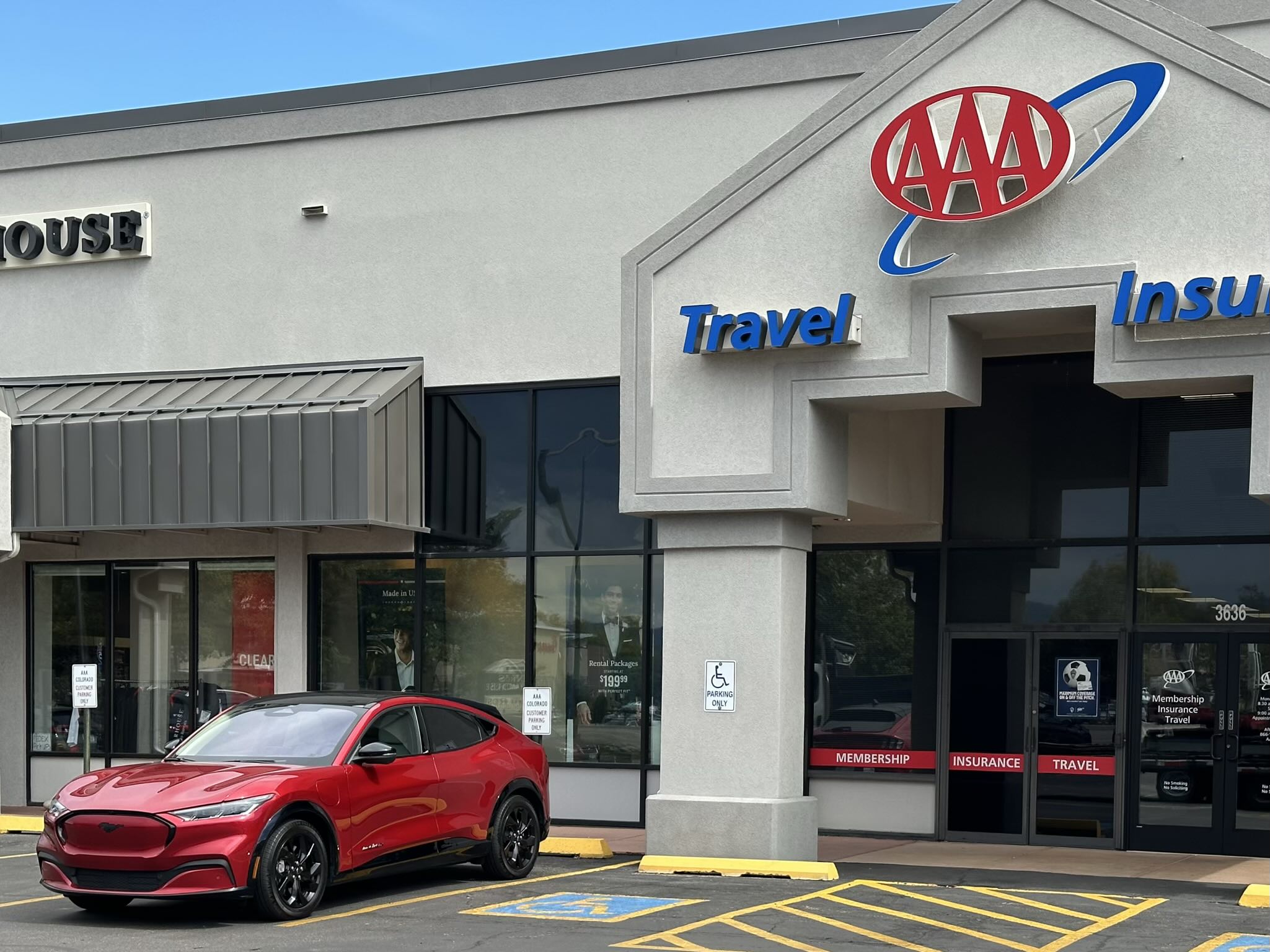
Eight months in, the car has been essentially flawless. Not a single issue.
His Name
Before the car even arrived, its name was already settled—or so I thought.
Andrea and I were having drinks with our friend Mel when she asked what this new vehicle would be called. She knew my previous cars went by Teeter and Peter.
“Machter?” she suggested.
I thought for a moment. “What about Meter?”
I knew immediately that was it. It rhymed with Teeter and Peter, and it conjured an electric meter. Done.
Andrea, however, had other ideas. For the next week she kept calling the car Mackenzie—apparently having latched onto the “Mach” part of the name. She wasn’t wrong, exactly, so we negotiated.
“Mackenzie Meter?” I offered.
“Meter Mackenzie sounds better,” she replied.
Meter Mackenzie it is.
His Nickname
As for the license plates, I wanted something that captured two things at once: this car would be my primary bicycle hauler (solving a problem I’d previously addressed with a homemade rack on the Audi TT), and it was still, nominally at least, a Mustang. “BikeStang” kept rattling around in my head until I made it official: the plates now read BKSTANG.
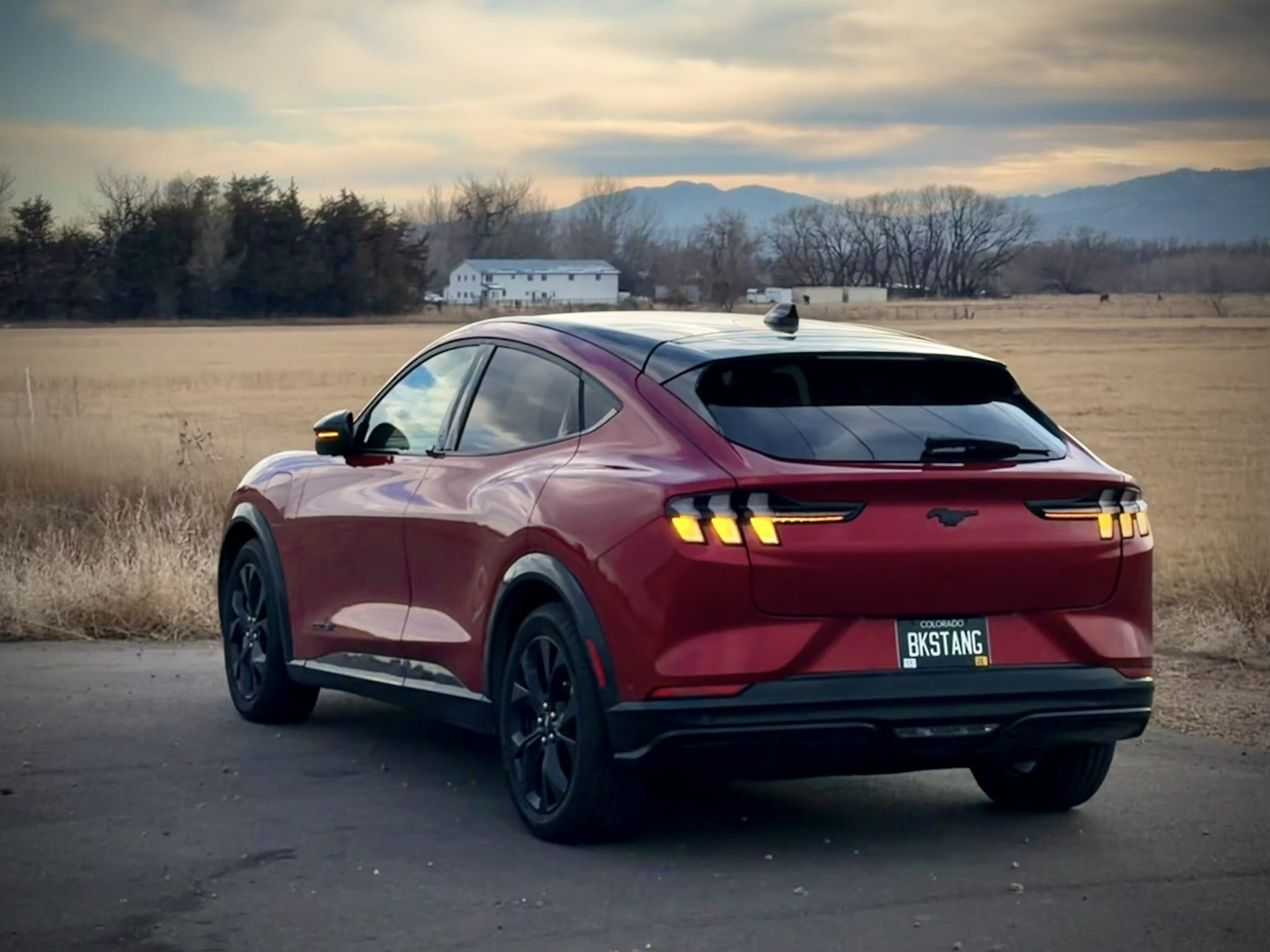
So the full name: Meter Mackenzie the Mustang Mach-E a.k.a. the BikeStang.
The Looks
In my opinion, the Mach-E is the best-looking compact electric SUV on the market. I admit that the Tesla Model Y is also a very good looking EV, but the brand has become somewhat toxic in recent years due to its CEO, and the Model Y is everywhere. I would already see one within five minutes of going outside practically anywhere. Whereas Mach-E’s still make me swivel my head.
The pony emblems throughout the car—on the steering wheel, on the rear hatch, even projected onto the ground via mirror-mounted puddle lights when you approach—give the car a consistent personality that most EVs lack.
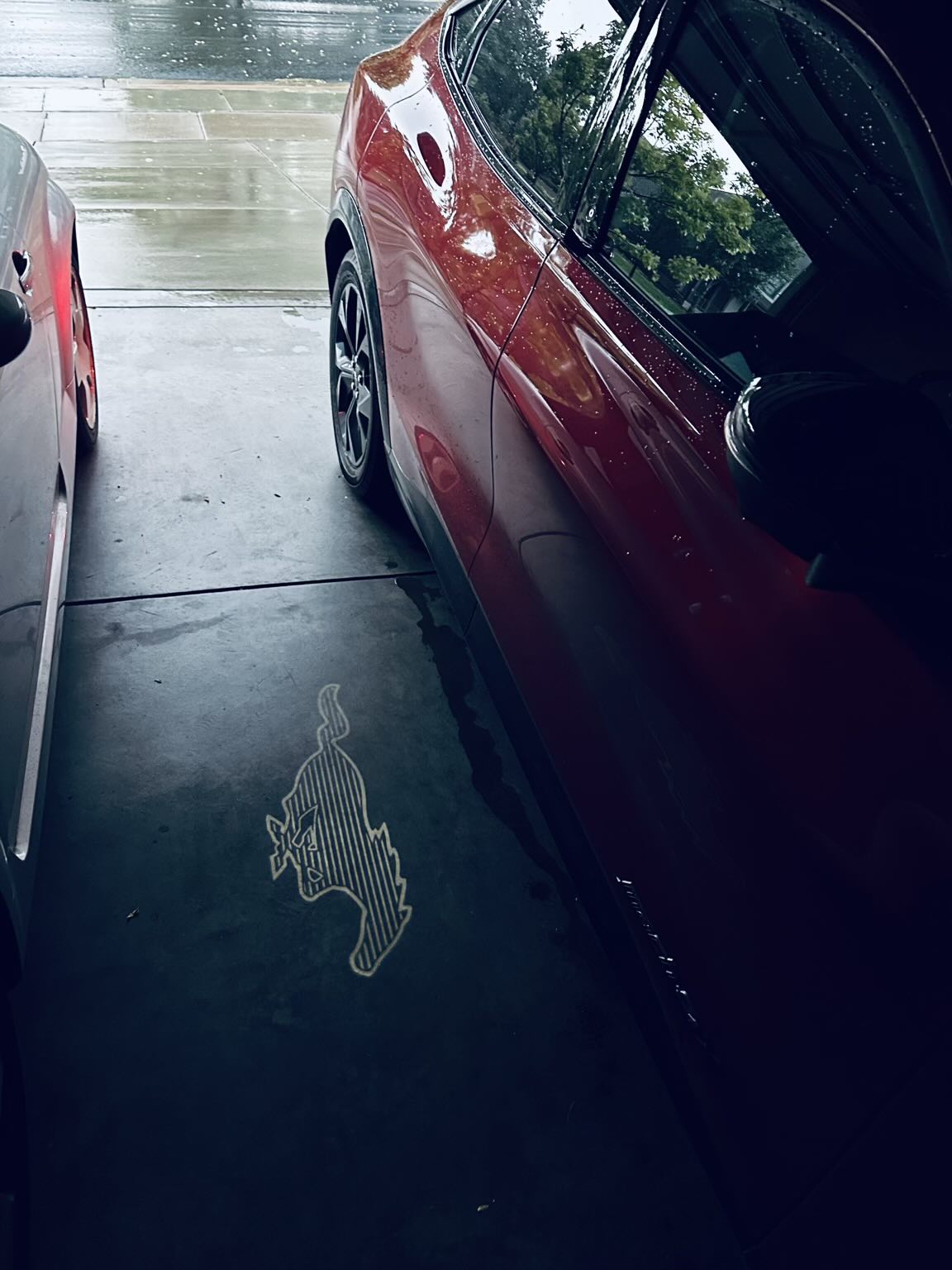
Andrea noticed the “bat signal” puddle lights before I did. She walked up to the car one evening and pointed: “Oh, look!” There on the garage concrete, illuminated in the darkness, was the galloping Mustang pony.
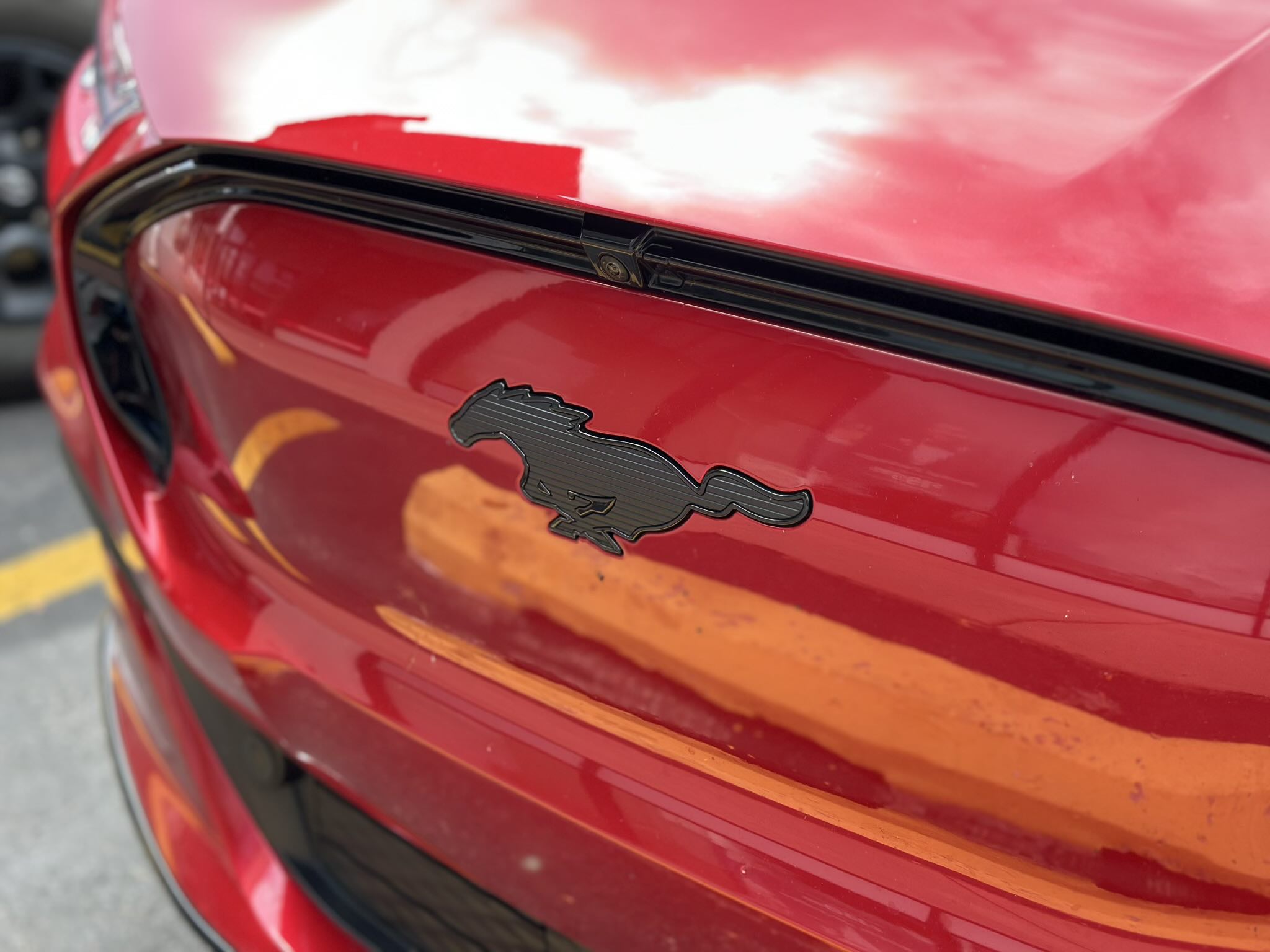
For the record, the Ferrari Purosangue and possibly the Lotus Eletre are the only SUVs I’d rank aesthetically at its level. The Lamborghini Urus is absolutely not in that conversation.
The Interior
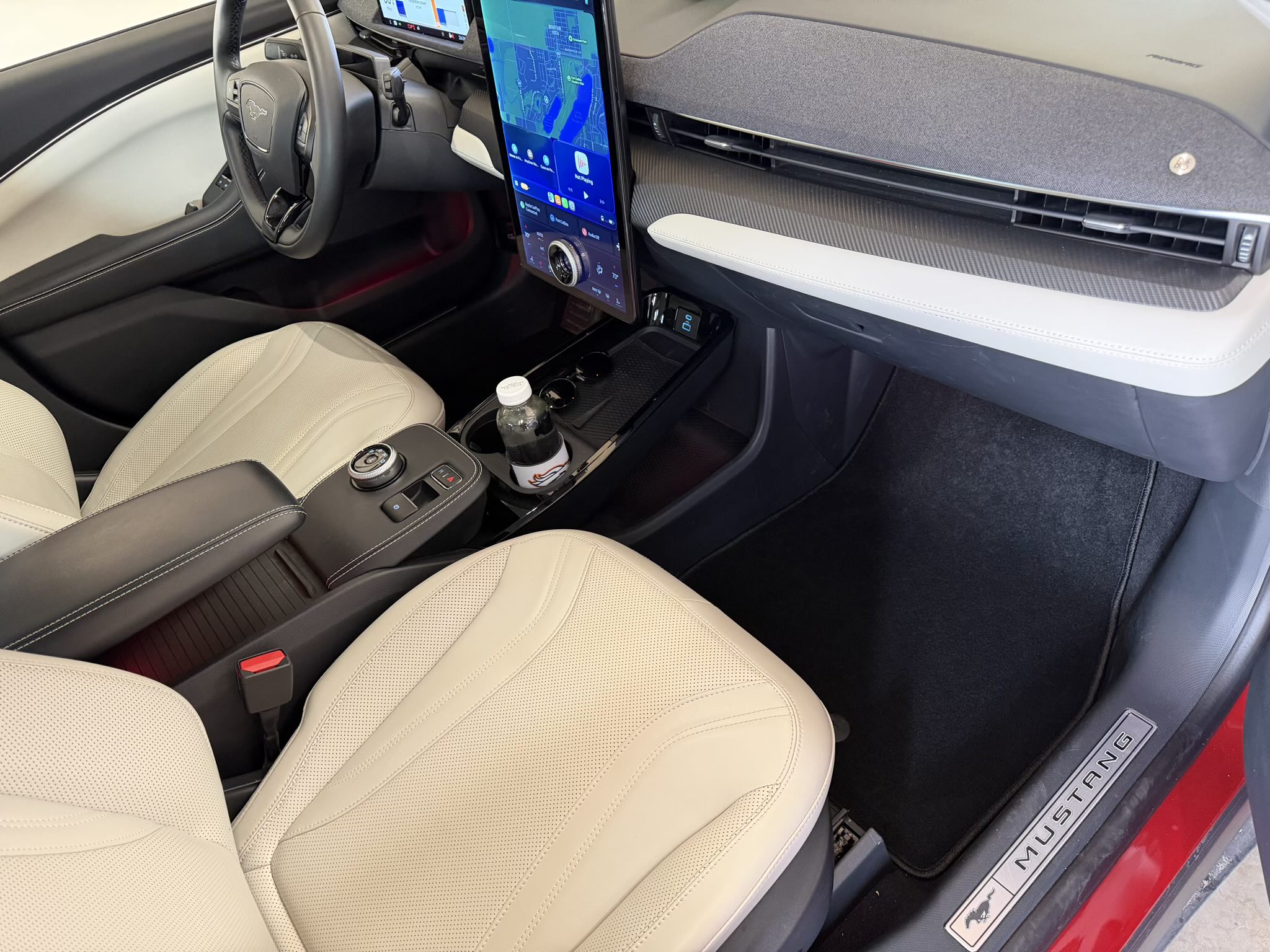
Inside, the Mach-E departs more dramatically from traditional Mustang design and clearly takes inspiration from Elon Musk’s company, but it improves meaningfully on Tesla’s pain points. The Model 3 and Y push almost everything through a central touchscreen—air vents, basic vehicle settings, even turning on the car and selecting gears. The Mach-E retains physical controls where they matter: a tactile round knob integrated into the center display, rotary gear selector, steering wheel buttons, and a dedicated 10.2-inch driver display directly ahead that shows speed, battery percentage, remaining range, speed limit data, and driver assistance status. You don’t have to take your eyes off the road for the information you actually need.
The other major advantage over Tesla is Apple CarPlay—wireless, and seamlessly integrated. The car adapts to how I already use my iPhone and iPad rather than asking me to learn a new ecosystem.
My Premium trim has a light gray (almost white) interior that gives the cabin an upscale, airy feel, amplified by the panoramic glass roof. As someone partial to open-top motoring, I appreciate how the giant glass roof approximates that sensation without requiring SPF 50 every time you get in. Heated seats, a heated steering wheel, power-adjusting seats with easy-entry movement, dual-zone climate control, a 10-speaker Bang & Olufsen sound system with a dashboard soundbar, multi-color ambient lighting—it’s a properly luxurious environment.
Keyless Everything
With this car, I never carry a key fob. My phone unlocks and starts the car via Ford’s Phone as a Key system. For the times my phone is inside and I only need to grab something from the garage, there’s a SecuriCode keypad on the B-pillar—I punch in my code and I’m in. If my phone battery dies entirely, a backup passcode starts the car. It’s a system with three layers of redundancy.
The Frunk
I use the frunk constantly. It’s particularly useful for groceries and food I don’t want perfuming the interior, and it keeps contents hidden since the Mach-E has no cargo cover for the rear area. You open it the same way as a regular hood—pull the interior release lever twice—but you can also trigger it from the touchscreen or the FordPass app on your phone.
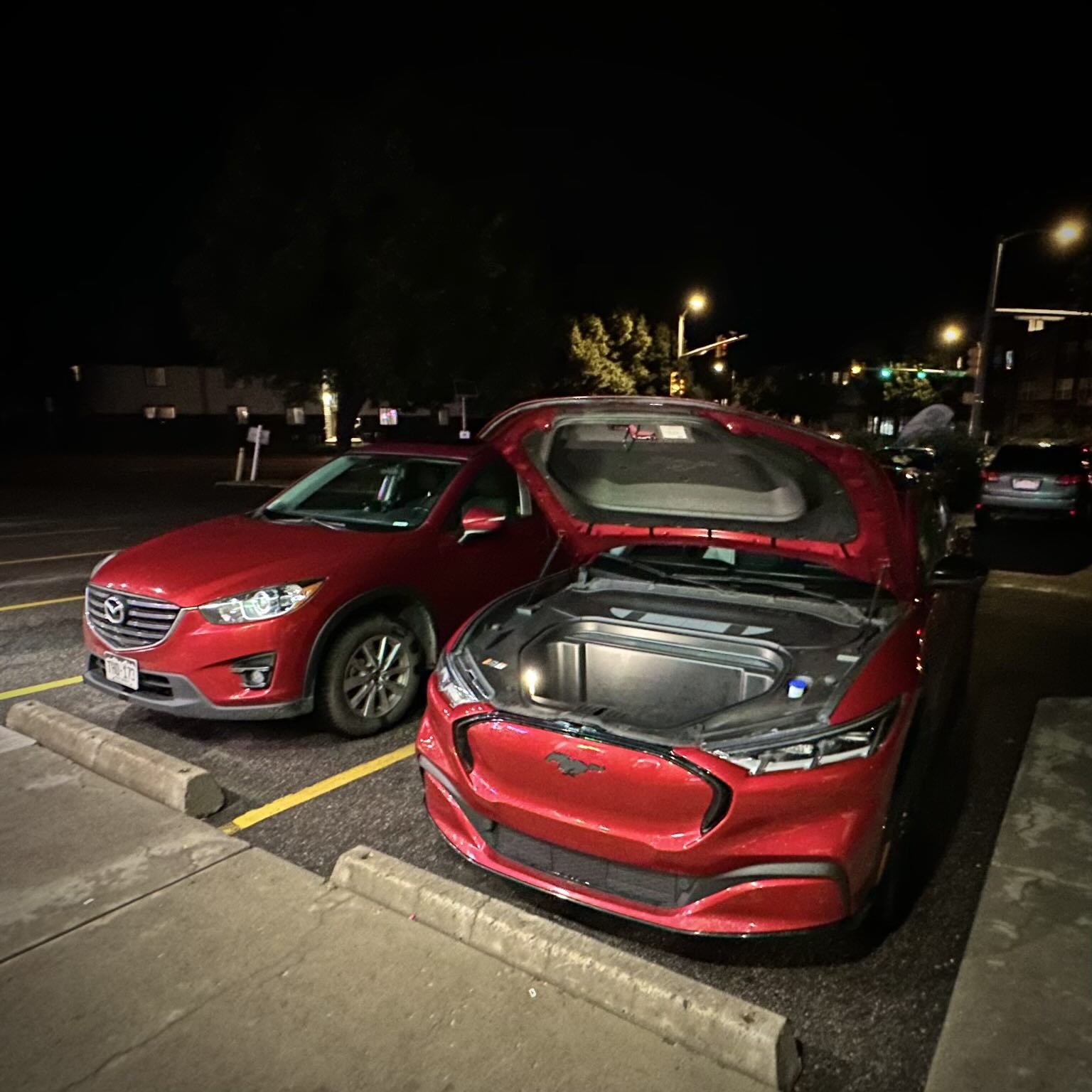
Ford has since made the frunk a $500 option on the 2026 Mach-E, citing low usage rates. I find myself using it nearly every time I drive somewhere. I also have the larger version: Ford shrank the 2025 frunk by roughly 40% to accommodate a new heat pump.
The Driving Experience
I drive almost exclusively in Unbridled mode with Propulsion Sound toggled on. Under hard acceleration, the car pipes in a synthesized performance sound that, improbably, doesn’t feel totally fake or overdone. It subtly reinforces the sensation of power without undermining the smoothness of the electric drivetrain. The result is a curious hybrid of experiences: instant, effortless EV acceleration, near-silence at cruise, and then a hint of muscle-car theater when you ask for more.
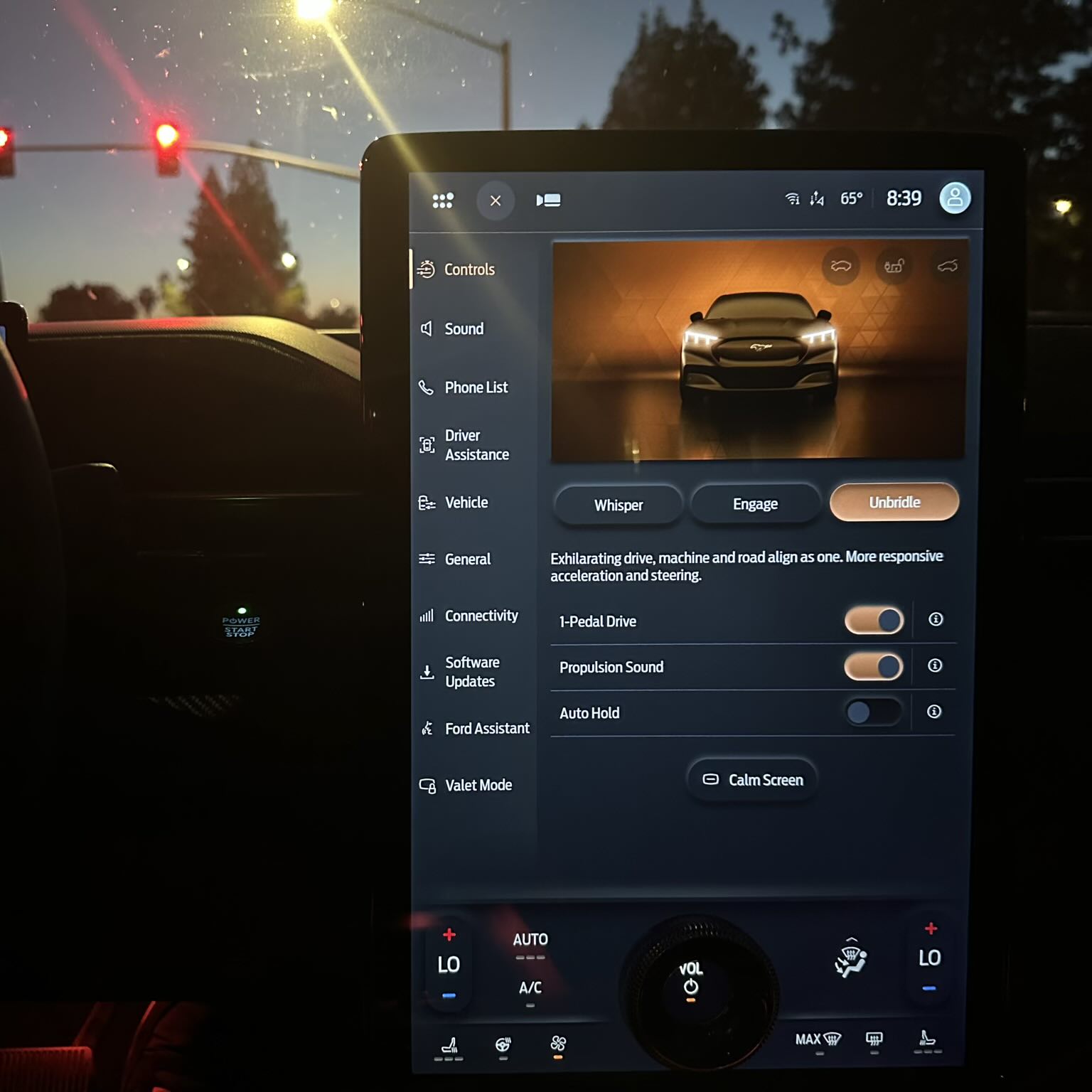
I have one-pedal driving permanently enabled. The modulation is so smooth that I almost never touch the brake pedal—which, incidentally, is something EV owners should do occasionally on purpose. Because regen handles the vast majority of stopping duties, the conventional brake hardware sees so little use that caliper slide pins and rotors can corrode from inactivity. A few deliberate pedal-brake stops now and then keeps everything moving freely. To put this in perspective: a California rideshare driver recently crossed 316,000 miles in his 2022 Mach-E with only 8% battery degradation—and his original brake pads. The brakes hadn’t worn out. They just hadn’t been used.
I also run Auto Hold, so the car doesn’t creep forward at stops the way an automatic gas car does. In that sense it behaves more like my manual cars did: no movement until I choose to move.
BlueCruise
Perhaps the most mind-bending feature was BlueCruise, Ford’s hands-free highway driving system. On approved highway segments, the car drove itself while I kept my eyes on the road. It could self-center in the lane, maintain following distance, read speed limits, and even change lanes by itself after I activated the turn signal.
My free subscription expired in February 2026, but even without it (it costs $500/year), the remaining driver assistance suite is extensive: adaptive cruise with stop-and-go, lane centering, automatic high beams, blind spot monitoring, and more. On long highway drives—particularly at night—the assistance reduces fatigue in a way that’s hard to quantify until you’ve experienced it. It’s the difference between arriving alert and arriving wrung out.
Charging
I covered the road-charging experience in detail in my rental post, so I’ll keep this brief. At home, I charge on a standard 110V outlet overnight using a smart plug that shuts off during peak rate hours, when electricity costs roughly four times as much (30 vs. 9¢/kWh). That setup recovers about 35 miles of range per day. Yes, that is slow, but is adequate for typical use and optimal for battery health. So far I have had no motivation to wire 220V into the garage and get a Level 2 charger, despite repeated offers from a friend to help me with the former. I normally only charge to 80%, again to optimize battery longevity.
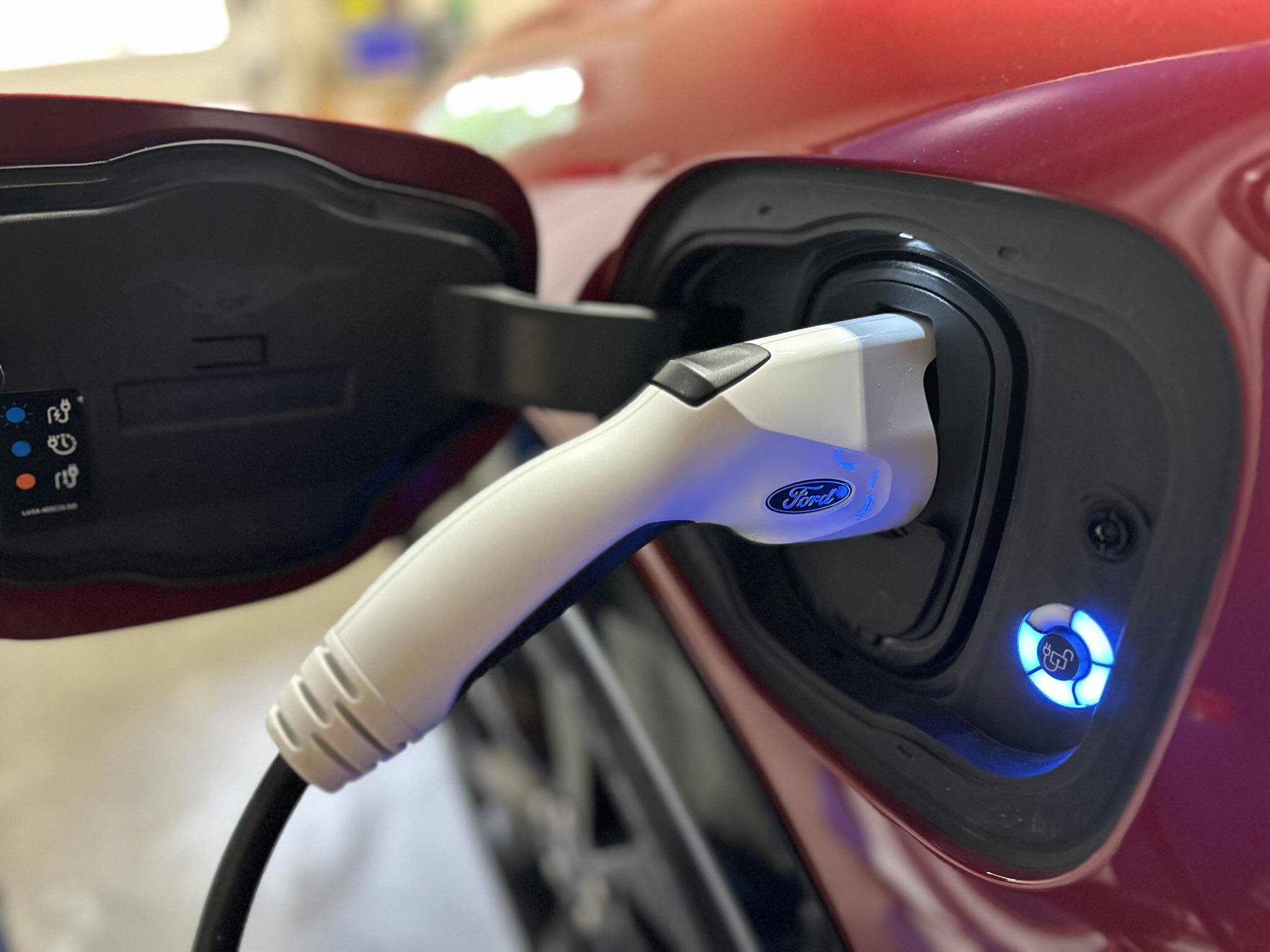
The practical upside of home charging is that I almost never need to charge on the road. I can make a 150-mile round trip to Denver International Airport and return with a comfortable margin remaining. The range estimates are accurate—sometimes even conservative. I’ve arrived home with 20 miles showing on the gauge and felt no anxiety about it.
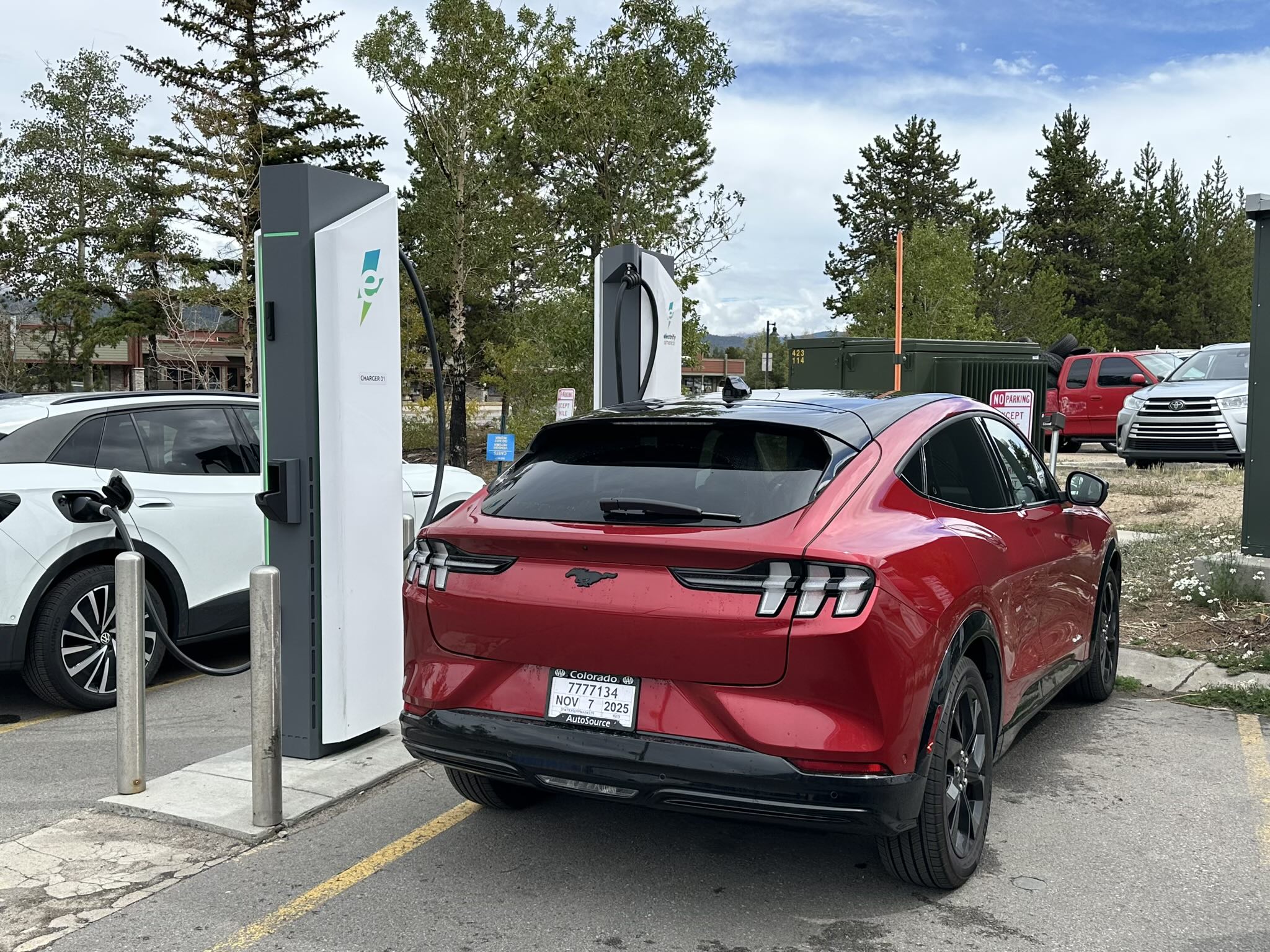
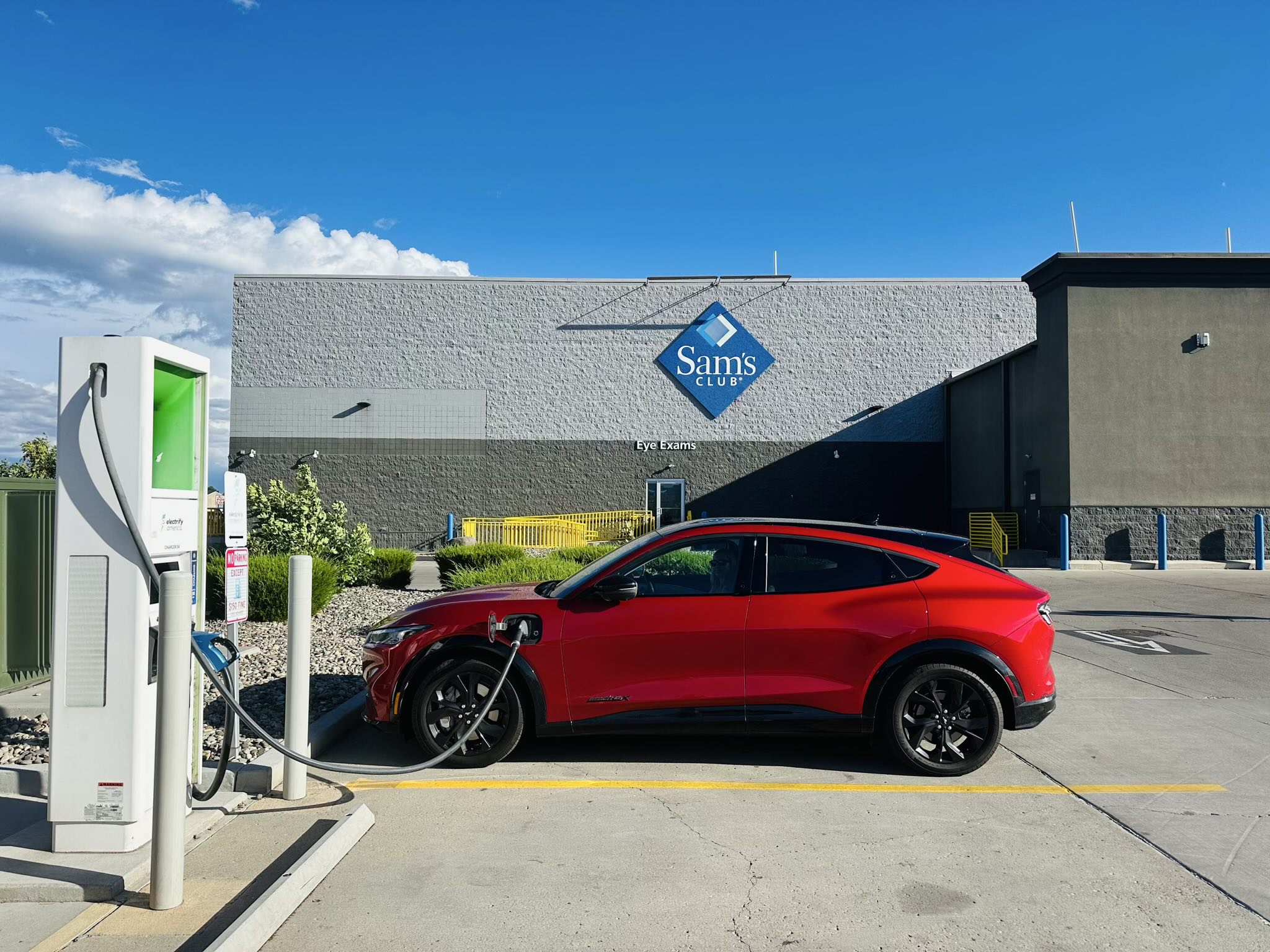
When I do need a public charger, Electrify America stations handle the job quickly enough. Charging away from home (at 56¢/kWh, or 36-42¢/kWh with monthly $7 EA subscription) costs roughly the same as fueling a comparable gas vehicle at $5 per gallon—not cheap, but not a disaster either. (I just paid around $7/gallon in gas for a rental car in South San Francisco the other week.)
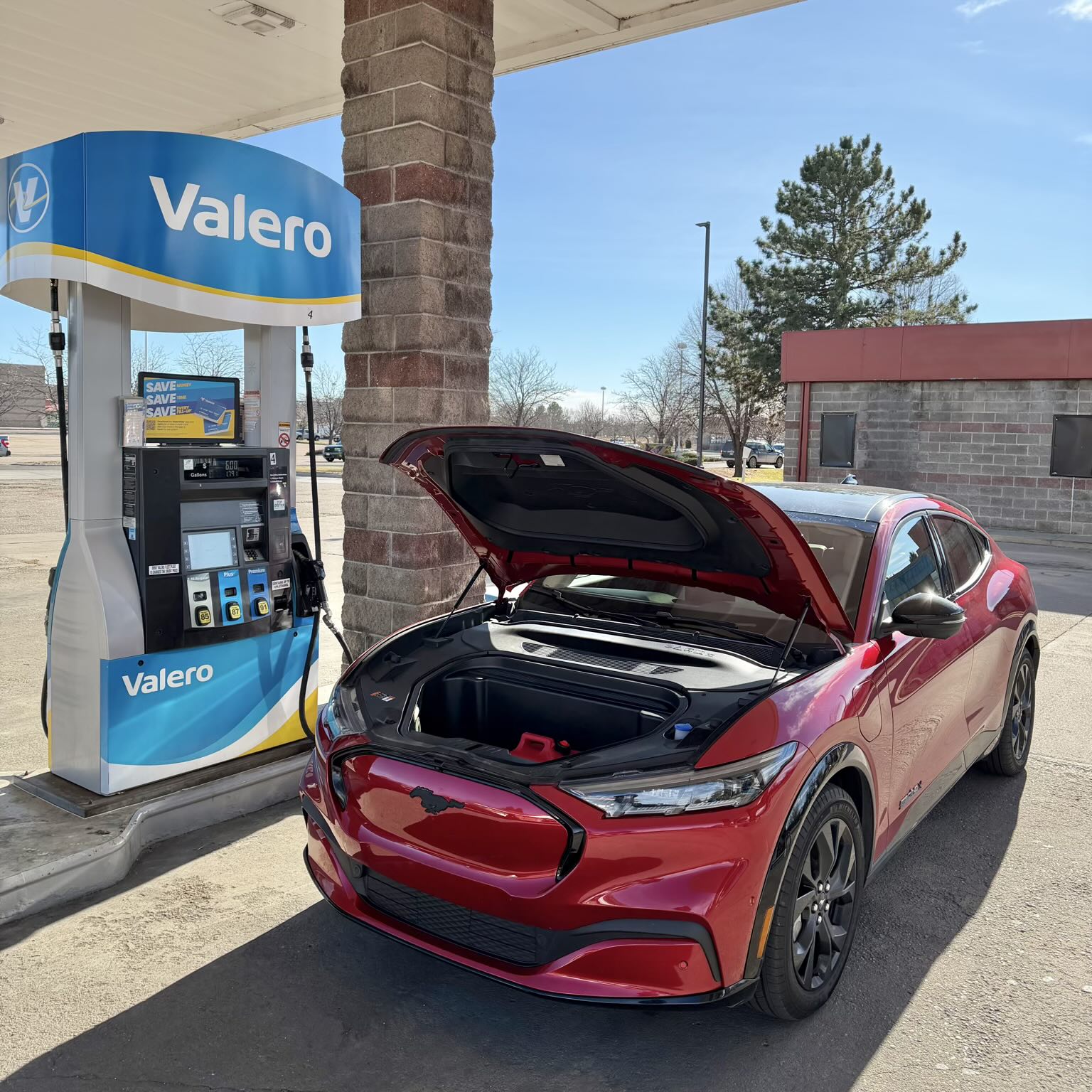
One thing I do not miss: gas stations. I visited one earlier in the year, but not for Meter Mackenzie—the fuel pump on the Audi TT failed and I needed gas. Below is probably the only time you’ll ever see the BikeStang at a pump.
Things Neither of My Previous Two Cars Had
The Mach-E’s feature set, compared to my previous cars—a 2001 Audi TT Roadster Quattro and a 2005 Chrysler PT Cruiser—deserves its own section. The list is long enough that I’m keeping it in bullets.
Powertrain & Driving Dynamics
- All-Electric Drivetrain: Dual electric motors providing instant torque with no combustion engine, no exhaust, and no oil changes.
- Liquid-Cooled 91kWh Battery Pack: Extended-range lithium-ion battery with active thermal management.
- One-Pedal Drive: Lifting off the accelerator slows the car to a complete stop.
- Regenerative Braking: Kinetic energy during deceleration is recaptured and returned to the battery.
- Selectable Drive Modes: Whisper (efficiency-focused), Engage, and Unbridled (performance-focused, with synthesized sound).
- Active Grille Shutters: Automatically open and close to optimize aerodynamics and cooling.
- Intelligent Range Estimation: Calculates remaining miles using real-time weather, terrain, and traffic data.
Driver Assistance & Safety (Ford Co-Pilot360)
- BlueCruise: Hands-free highway driving on pre-mapped segments. (Annual subscription required.)
- 360-Degree Camera System: Bird’s-eye view for parking and tight maneuvering.
- Adaptive Cruise Control with Stop-and-Go: Maintains following distance and can bring the car to a complete stop in traffic.
- Predictive Speed Assist: Adjusts speed proactively for curves, speed limit changes, and highway exits.
- Lane Centering Assist: Actively keeps the car in the center of the lane.
- Lane Keeping System: Alerts to unintended lane departures; in Aid Mode, steers the car back.
- Blind Spot Information System (BLIS): Detects vehicles in blind spots and provides rear cross-traffic alerts.
- Pre-Collision Assist with Automatic Emergency Braking: Detects potential collisions with vehicles or pedestrians.
- Driver Alert: Monitors for signs of drowsiness and warns you to rest.
- Parking Finder: Press a “P” button for parking, and the nearest parking lots and garages are listed.
- Evasive Steering Assist: Provides steering support when a collision cannot be avoided by braking alone.
- Intersection Assist: Detects oncoming traffic during left turns.
- Speed Sign Recognition: Reads speed limit signs with a camera and displays the limit on the driver display.
- Post-Collision Braking: Applies brakes automatically after impact to prevent a secondary collision.
- Automatic High Beams: Toggles high beams based on oncoming traffic.
- 911 Assist: Automatically calls 911 through your connected phone if airbags deploy.
Infotainment & Connectivity
- 15.5-inch Vertical Touchscreen: Central command center running Ford’s SYNC 4A interface.
- 10.2-inch Digital Instrument Cluster: Fully configurable display directly in front of the driver.
- Phone as a Key (PaaK): Lock, unlock, and start the car using only your smartphone.
- Over-the-Air Updates: Software improvements delivered wirelessly while the car is parked.
- Wireless Apple CarPlay & Android Auto: Full smartphone integration without a cable.
- Qi Wireless Charging Pad: Inductive phone charging in the center console.
- FordPass Connect: 4G LTE Wi-Fi hotspot and remote vehicle monitoring and control via app.
- Connected Navigation: Live traffic, EV route planning, and charging stop suggestions.
- USB-C Ports: High-speed charging ports front and rear.
- 4 × 12V Power Outlets: Including one in the cargo area.
Interior Comfort & Luxury
- Panoramic Fixed-Glass Roof: Large tinted glass panel with infrared-reflective coating to manage heat.
- 10-Speaker Bang & Olufsen Sound System: Includes an integrated dashboard soundbar and subwoofer.
- Multi-Color Ambient Lighting: Adjustable LED accent lighting throughout the cabin.
- Heated Steering Wheel: (The TT had heated seats but not a heated wheel.)
- 8-Way Power Passenger Seat: (The TT’s seats were largely manual.)
- Driver Seat & Mirror Memory: Saves multiple driver profiles.
- Dual-Zone Electronic Climate Control: Independent temperature settings for driver and passenger.
- Auto-Dimming Rearview Mirror: Tints automatically to reduce glare from following headlights.
- Easy Entry/Exit: Seat moves up to two inches to ease getting in and out, then returns to your saved position.
- Personal Profiles: Remembers seat, mirror, and vehicle settings per driver.
- Remote Start with Preconditioning: Heats or cools the cabin before you get in.
Exterior & Utility
- Drainable Frunk: 4.7 cubic feet of water-resistant storage under the hood, with a drain plug.
- E-Latch Door System: Button-activated releases instead of traditional door handles.
- Power Liftgate: Hands-free or button-operated rear cargo access.
- LED Projector Headlamps: With Mustang-signature light bars.
- Sequential LED Taillamps: Three-bar turn signals that animate when signaling.
- Welcome Lighting: Exterior lights activate automatically as you approach.
- Pony Puddle Lamps: Projects the Mustang logo onto the ground from the mirror housings.
- Power-Folding Side Mirrors: Fold automatically when the car locks.
- SecuriCode Keyless Entry Keypad: B-pillar touchpad for entry without a phone or fob.
- 19-inch Machined-Face Aluminum Wheels: Considerably larger than the 16/17-inch wheels on the TT.
- Tire Pressure Monitoring System
A Great First Effort, Ford!
The Mach-E was Ford’s first ground-up electric vehicle, and the learning curve showed in some places. Ford CEO Jim Farley acknowledged publicly that the Mach-E’s wiring harness alone was 1.6 kilometers longer than it needed to be—contributing 70 extra pounds of weight and $300 in unnecessary cost per vehicle. The thermal system was similarly over-engineered. Ford lost money on every Mach-E it sold; the negative profit margin was a poorly kept secret within the industry, a side effect of the enormous investment required to compete with a company that had been refining its EV architecture for years.
Technology is improving fast enough that these first-generation compromises will look quaint by the time the next decade rolls around. But for now, the Mach-E does exactly what I need it to do. I look forward to seeing how far the category has come when it’s eventually time to move on—but that’s not a conversation I’m expecting to have for at least the rest of the decade.
A Copilot
I was in London during New Year’s, and the Apex Hotel there gave me this rubber duck as a holiday momento. He now has a home on Meter’s dashboard:

Before you ask, yes, this was directly inspired by the Duck Duck Jeep phenomenon that took the U.S. by storm during the last few years. Or even to a lesser extent, Moo Moo Subaru. I see no reason that other car owners can’t join in the fun too.
Meter’s On Instagram
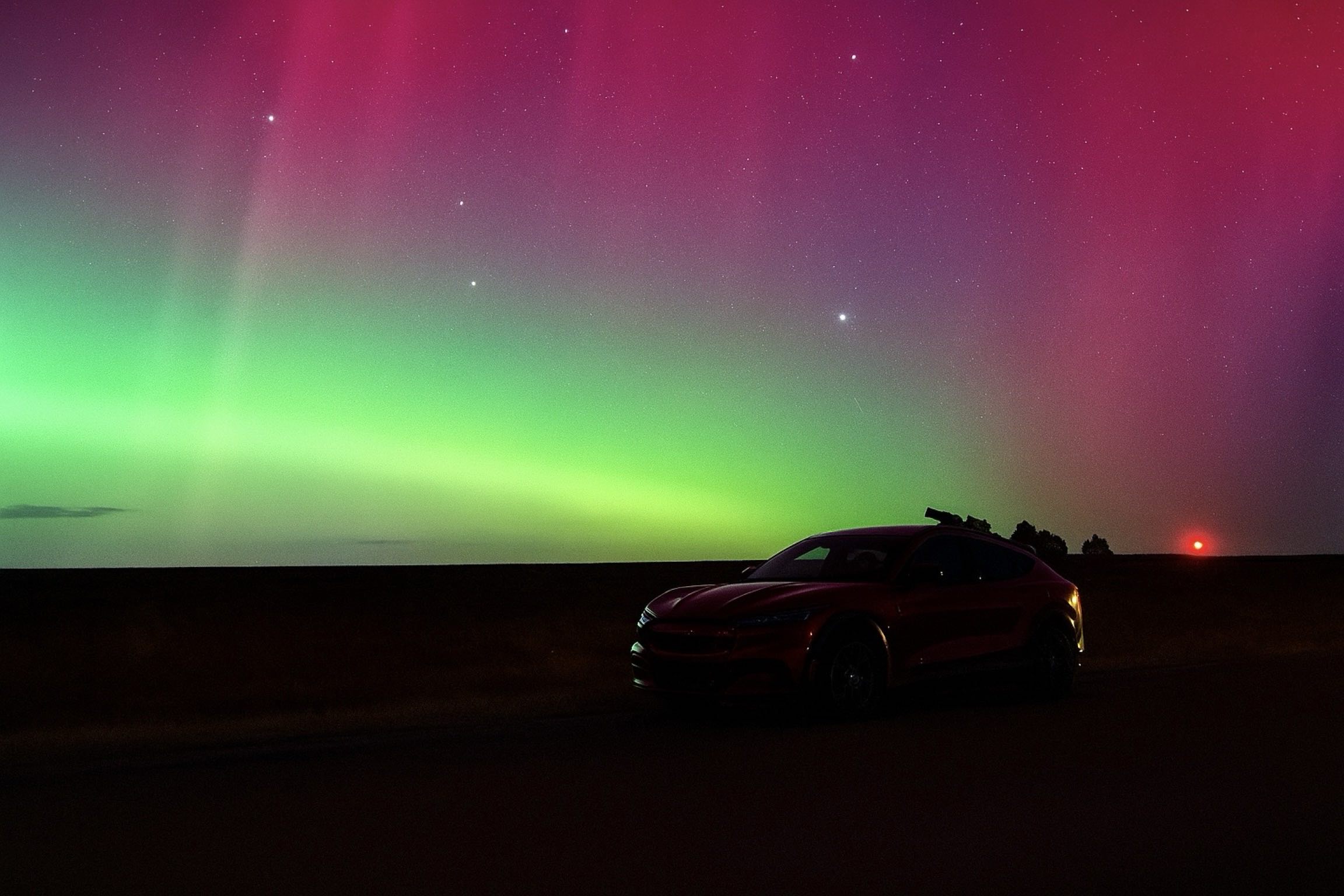
Yes, Meter has his own Instagram page now. Please follow it!
There are 2 comments.
Been waiting for this article, and it didn’t disappoint. Glad you are enjoying the car. We love our IONIQ6.
Glad you are enjoying your IONIQ6. It’s a unique design and I still very rarely see them.
Everyone I know who has gotten an EV would not go back to ICE—at least for their primary vehicle. I’m convinced that if EVs in the U.S. were able to be priced like those in China, they would be dominating the market.