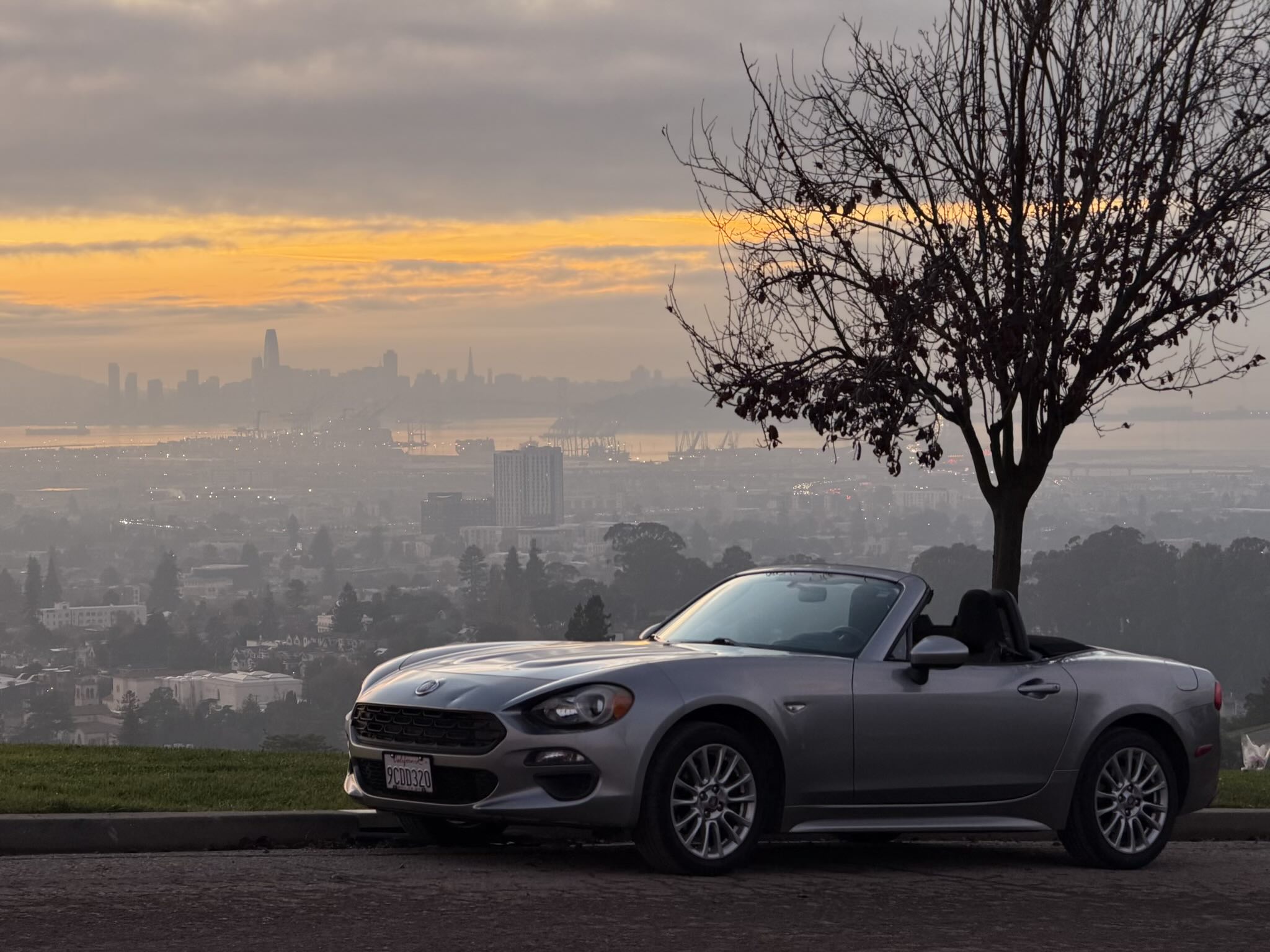
A Tale of Two Turos, a Turbocharged ‘Stang, and a Silver Ghost

Recently I have been introduced to—and enjoying—a whisper-quiet world of glass screens and instantaneous electric torque. I love my new Ford Mustang Mach-E dubbed Meter Mackenzie, but every now and then, I feel the need to unplug from the “future” and reconnect with the mechanical.
In this instance, the motivation for this detour was not only an upcoming six weeks of travel, but the slippage of a longtime partner-on-wheels. Teeter, my beloved Audi TT Roadster Quattro, had stood the test of time now pushing 25 years—and nearly 17 on my watch—but the clock finally caught up. Two days before a planned trip to Arizona and just two miles from home—most unfortunately, on a busy road at night—the fuel pump died and I was caught out on the side of the road with hood up, emergency blinkers on. For the first time in 22 years, I had to call for a tow truck. I took it as a sign: maybe it’s time to push plans forward for an eventual successor, as I will always have a two-seat roadster in the garage as I have ever since I was a teenager. (Although you can be bet I am glad to have another more practical car in the garage once again—welcome, Meter!)
So over the ensuing weeks, the rental car market became my laboratory. I tested three very different machines, two with Turo: an elegant Teutonic vault, a raspy Italian roadster with some Japanese mechanicals, and a modern American icon. It was a study in contrasts: luxury versus soul, competence versus character.
Part I: The Arizona Grand Tourer
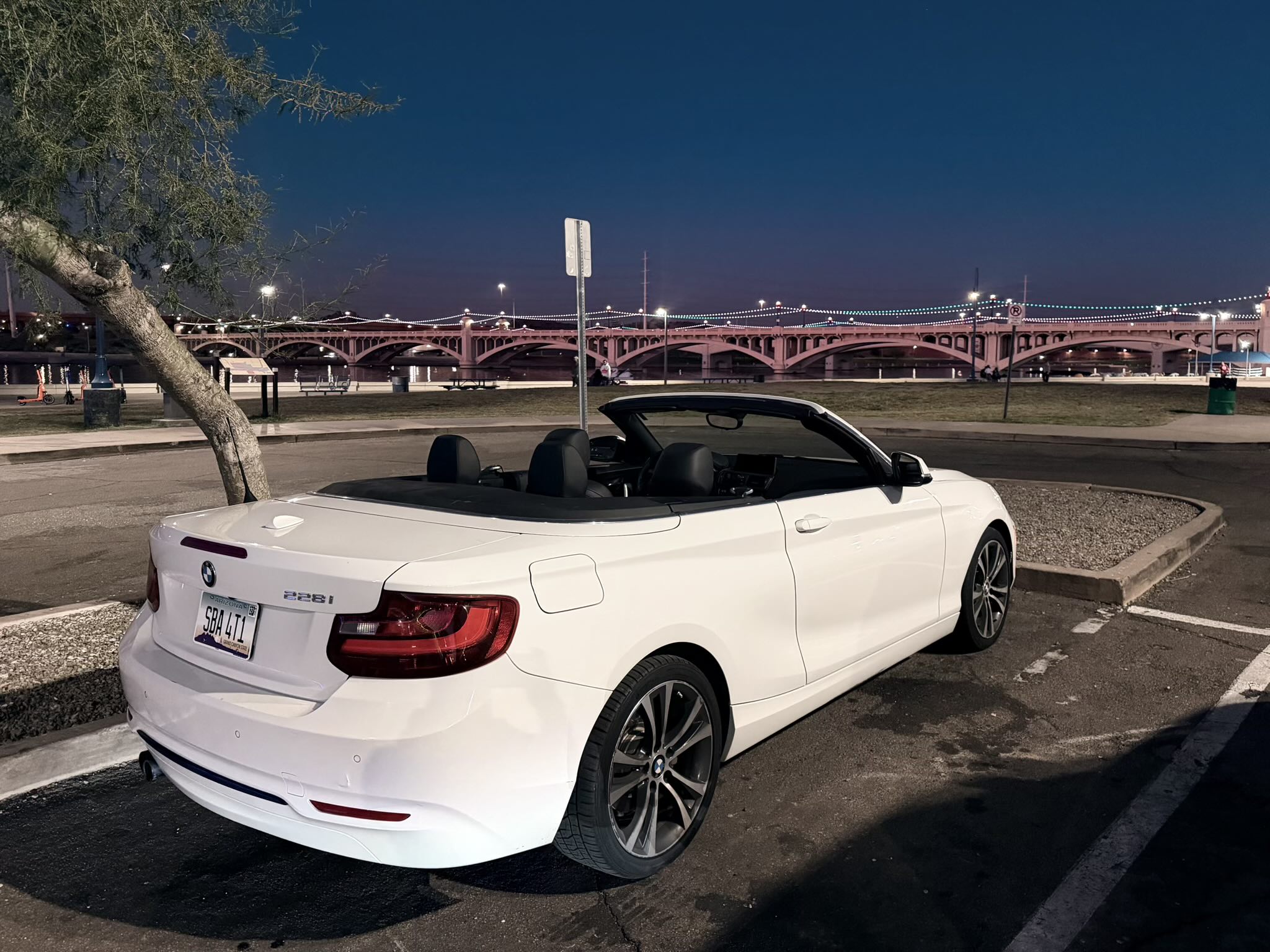
In Phoenix, the December sun is a deceptive beauty. To avoid the midday UV index, I chased sunrises and sunsets in a 2016 BMW 228i Convertible finished in crisp Alpine White.
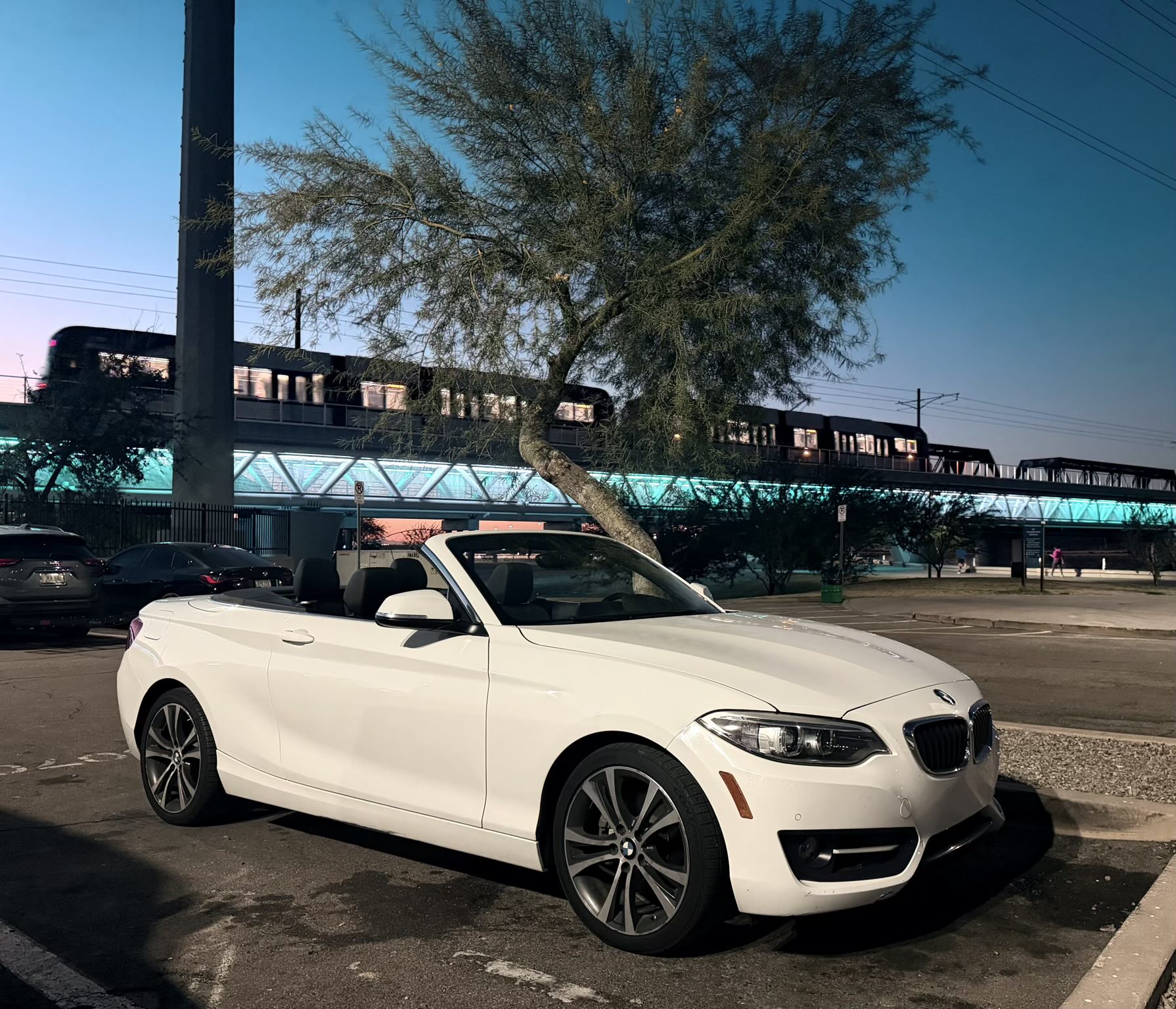
I piloted this car all around the Phoenix valley and down to Tucson, winding through the towering giants of Saguaro National Park. With its 2.0L TwinPower Turbo pushing 240 hp and 255 lb-ft of torque, it was a masterclass in grand touring competence.
On paper, it’s an athlete, hitting 0–60 mph in 5.6 seconds. But the experience was defined by a certain distance. The electronic steering, while precise, felt “mushy” and isolated, like I was navigating more through a simulation rather than the desert floor. I sat in it, surrounded by a volume of leather and Germanic plastic, rather than feeling connected to the road.
The Evolution of the Shift
It’s no secret that we are living through the quiet death of the manual transmission, particularly in the United States, where three-pedal cars have dwindled to less than 1% of new car sales. While I normally much prefer a manual transmission for the raw connection and driver engagement it provides, my time in the BMW reminded me that there are advantages to a modern Dual-Clutch Transmission (DCT).
The tranny was something of a savior in the relentless stop-and-go of Phoenix’s rush hour traffic. Yet it also found its voice on the winding, uphill ascent toward Taliesin West. In the city, the 8-speed Sport Automatic was seamless and polite, but the moment the road began to coil, I reached for the paddle shifters.
There is a specific, high-tech thrill to a DCT—the shifts are surgical, instantaneous, and accompanied by a satisfying mechanical “pop” as the next gear slams into place. Unlike a traditional manual, the BMW’s paddles felt like conducting a high-stakes performance; you aren’t fighting the machine, you are conducting it with effortless velocity and keeping both hands glued to the wheel through every desert curve.
While the transmission feels very modern for a car with an internal combustion engine, what was the one thing that reminded me the most of the car’s age (nine years)? The key. Unlike my Mach-E, where my phone acts as the key, the BMW required me to pull a fob out of my pocket and press a button to unlock the doors. At least it has a start/stop button and you do not have to slot the key anywhere in or near an ignition switch.
And then there was the roof—a silent, hydraulic ballet that took a mere 20 seconds to cycle. In the city, those 20 seconds felt like an eternity at a red light during the only time I was foolish enough to do so. I only lowered or raised the roof while parked during the rest of my time.
Part II: The Ghost of California Cooler—and a Pontiac that was Love at First Sight
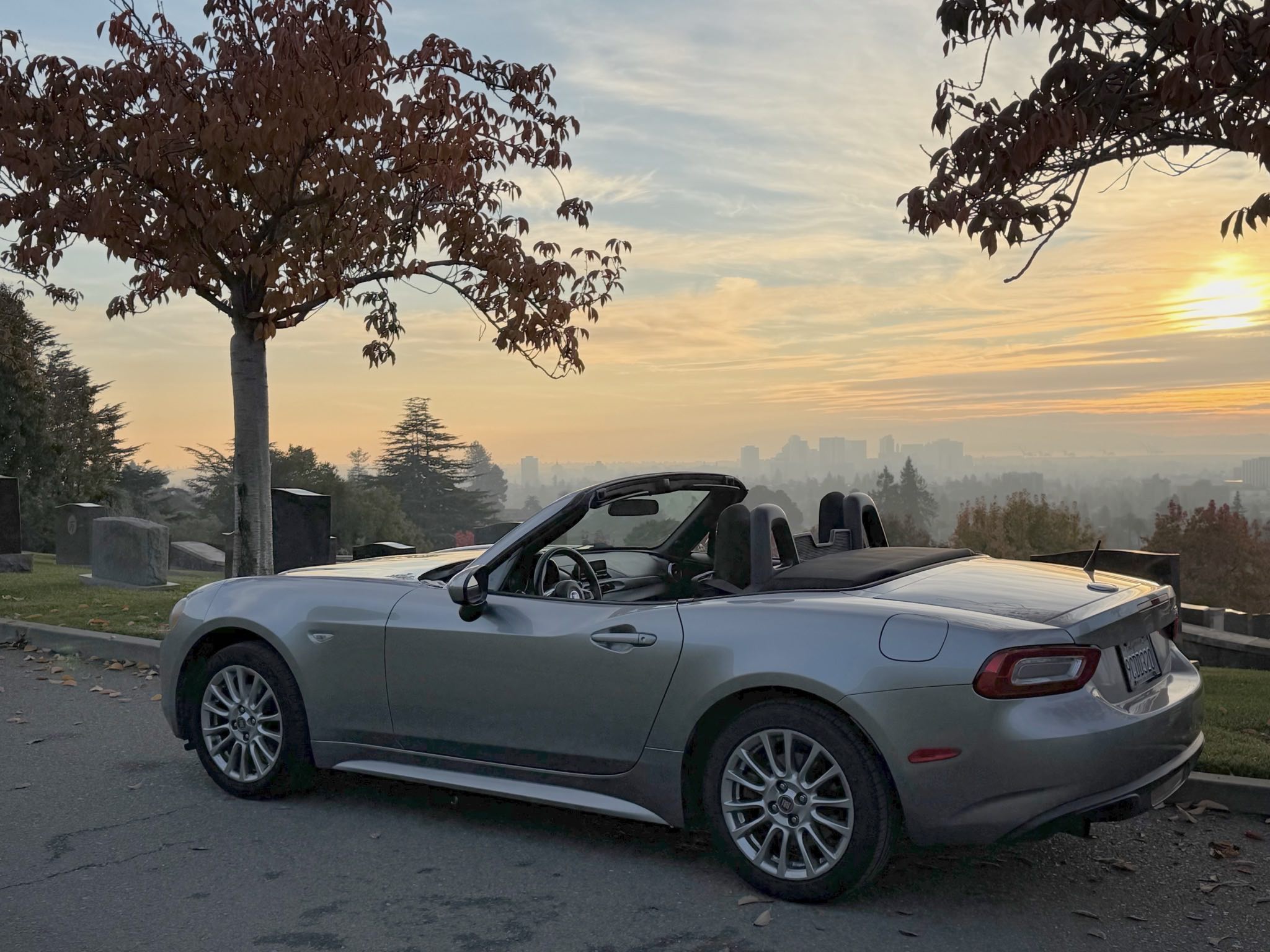
A week later and moving on to Northern California, I swapped the German vault for something much more evocative: a 2017 FIAT 124 Spider in shimmering Grigio Argento—or Aluminum Metallic as the color is known in America—affectionately (or derisively) referred to as the Fiata by those in the know. It shares the same chassis and interior bits as the Mazda Miata, after all—certainly not bad bones to share.
As I walked up to it, I was hit by a wave of nostalgia. Growing up, there was a house exactly one mile down the road that my brothers and I called the “California Cooler house” as it was owned by the founder of that iconic ’80s brand. There was a gleaming, cream-colored Spider (which I’m fairly certain was the Azzurra marketed by Pininfarina after FIAT left the U.S.?) on its long, semicircular driveway behind a white, wrought iron-fence that surrounded what would rightly be called a yellow McMansion, if the term existed back then.
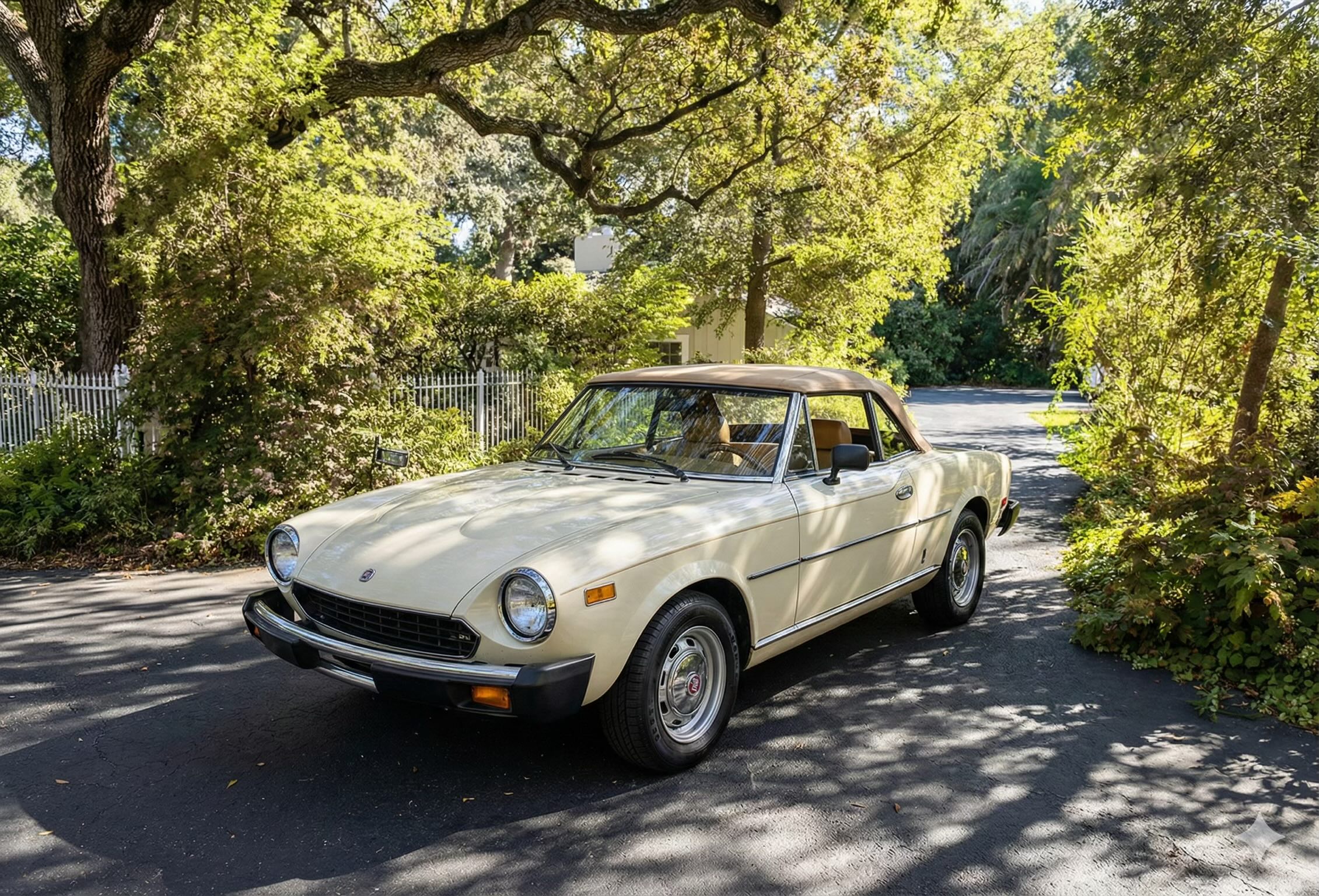
Interestingly, both the beverage and the 124 Spider are icons of “accessible sunshine.” The original 124 Spider finally met its demise in the late 80s after the final said Pininfarinas left the production line. The modern FIAT I drove was an attempt to revive the brand in the late 2010s, being produced from 2016-2019. Considering that only 41,321 of them were made in those four short years, it is safe to say that it wasn’t a resounding success.
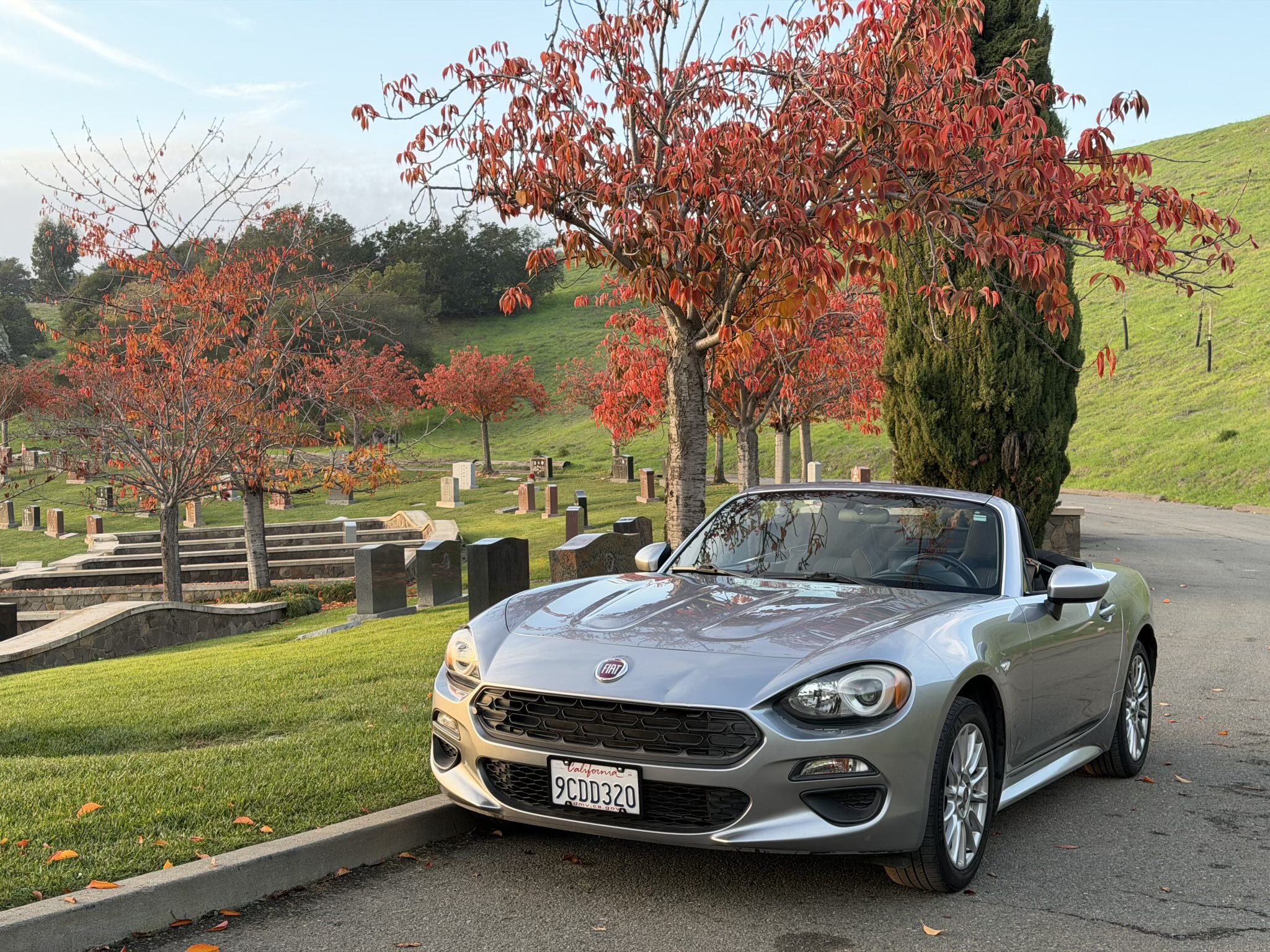
Likewise, well after wine cooler sales had nearly gone extinct by the 1990s, a company in Danville tried to revive the California Cooler brand decades later. That attempt was ultimately fruitless. Both California Cooler and the FIAT 124 Spider are now rare, beautiful remnants of an era that prioritized personality over mass appeal.
Go-karting Around
In my week with the FIAT, I drove it around northern California. The highlight was certainly from Stockton to Marin County and back, carving through miles of sinuous terrain. In the Fiat, you don’t sit in the vehicle—you wear it. The cockpit wraps around you like a bespoke suit.
The steering was the highlight: heavier, communicative, and featuring a noticeably quicker ratio and smaller turning radius than the BMW, making the car feel like a go-kart. With the 6-speed manual transmission sourced from the third-generation Mazda Miata, every shift was a tactile conversation. I found myself reveling in the lost arts of heel-toe downshifting and double-clutching, feeling the mechanical “click-clack” through the delightfully short-throw shifter as I matched revs into tight coastal corners.
Practicality Check
The FIAT has one of the smallest trunks I’ve seen. It’s even smaller than that of my MGB, which also had the benefit of a rather large parcel shelf behind the front seats. Yet, the 124 Spider’s trunk was infinitely more usable than the Pontiac Solstice GXP, where trunk space was virtually non-existent with the top down. And the 3-second manual top was a revelation—one latch and a flick of the wrist, no hydraulic waiting required.
The Sound of Soul
Much like the 92 hp 1.8L engine in my old British MGB, which had a deep, sporty resonance, the 160 hp 1.4L MultiAir Turbo engine sounded mighty despite being tiny. It was all about authentic exhaust tuning—a stark contrast to the 2025 Ford Mustang I rented the following month and will talk about in a followiing section, which pumped fake engine sounds through the speakers to compensate for its four-cylinder turbo.
A Kindred Spirit to a Silver Ghost?
Of all the cars I’ve driven, the FIAT 124 Spider is the only one that transports me back to that Oregon road trip in the silver Pontiac Solstice GXP that absolutely adored. It captures that same elusive “go-kart” essence, where the car feels less like a machine and more like a physical extension of your own intent. From the mechanical chatter and engine notes to the way it hunkers down in a corner, the FIAT mirrors that raw sense of connectedness and aesthetic beauty that made the Pontiac so special.
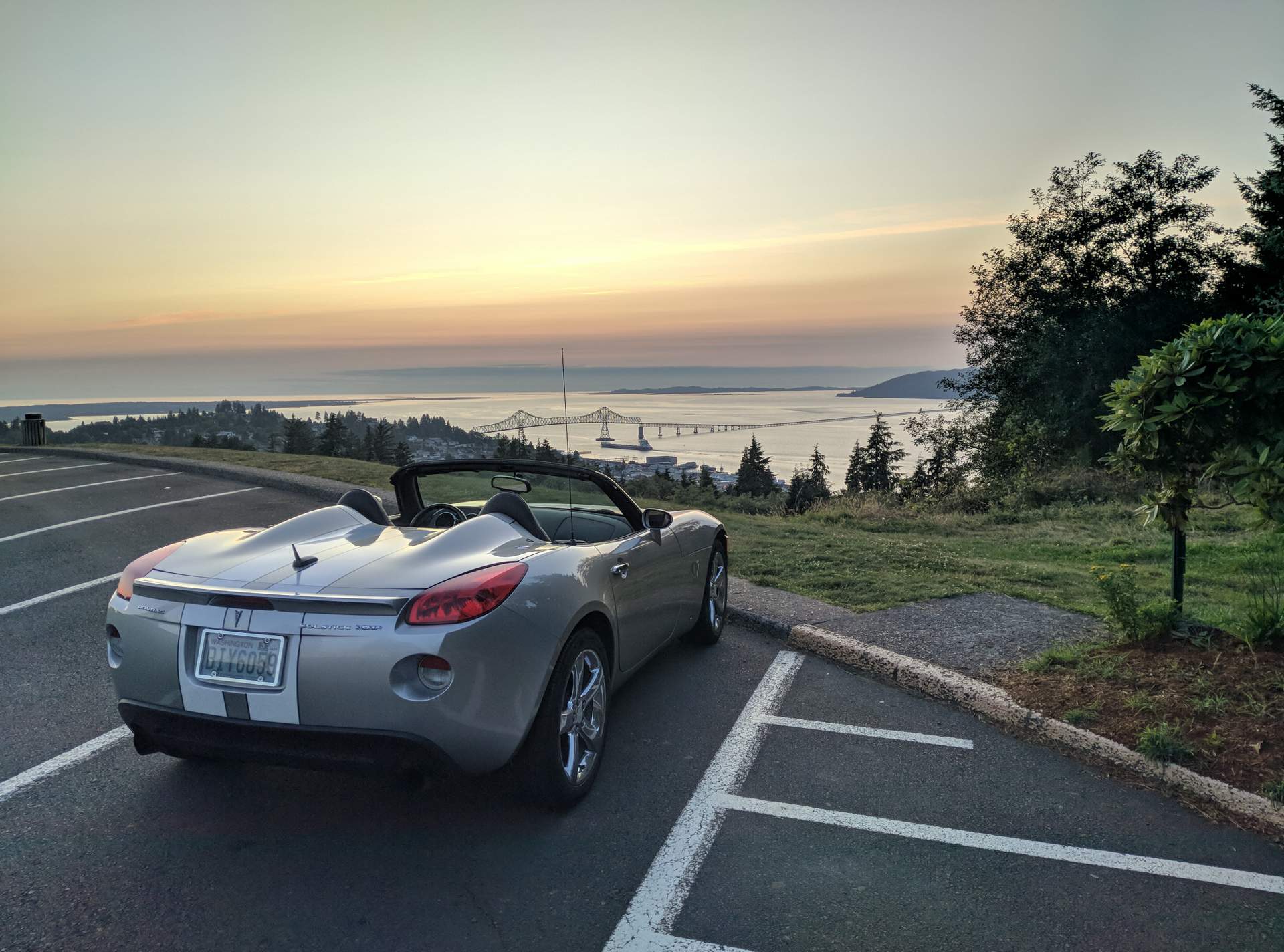
Admittedly, the two aren’t twins—or even in the same family, really—when it comes to the throttle despite both having turbocharged four-bangers. The Solstice GXP had a 2.0-liter powerhouse—rated at 260 horsepower and 260 foot-pounds of torque—that the much smaller engined FIAT only attempts to chase. That the 124 Spider is not completely blown out of the water performance-wise is due to its ultra-light weight: roughly 2300 pounds, barely any more than my 1969 MGB that had virtually zero safety equipment.
However, the FIAT makes a compelling argument for itself by being close in spirit to the Solstice—the looks, the sounds, the tossability, the intimacy, the driver engagement—while remaining significantly more practical. Being a decade newer, it offers a level of reliability and modern conveniences (like Bluetooth) that makes the spiritual successor experience easier to live with on a daily basis.
Part III: The Dark Horse: A Modern Contrast
The 2025 Ford Mustang Coupe in Carbonized Gray Metallic that I rented from Budget in Orlando the next month was an interesting study.
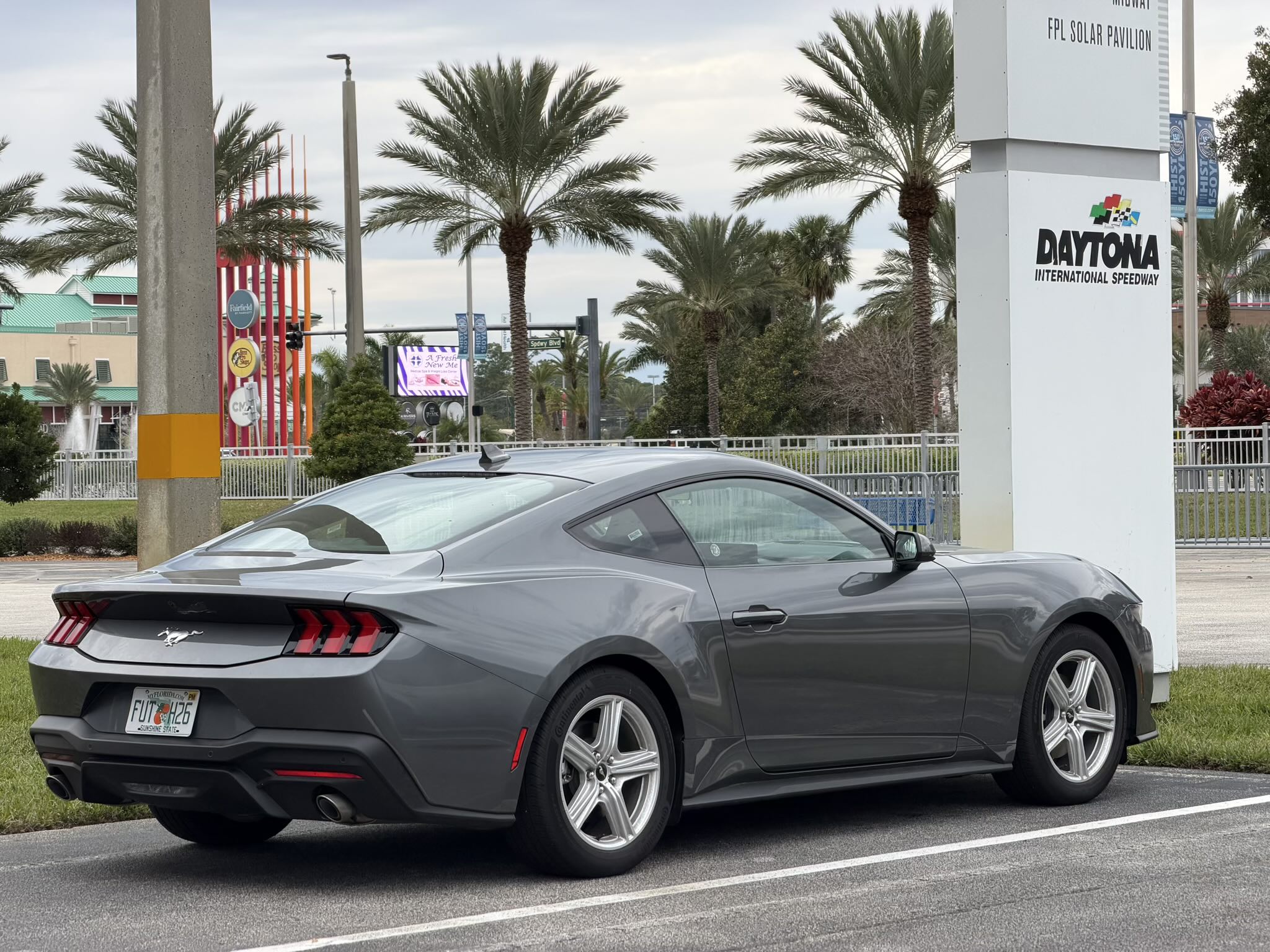
It was just as practical as the BMW and—having the benefit of nine years of automotive progress—even more luxurious. However, it lacked the intimate “wearable” feeling of the Fiat. It felt like a capable, high-tech tool, whereas the Fiat more felt like a partner.
The Ford Mustang proved to be a stellar highway cruiser as I wound my way across the Florida landscape, tracing a path from Orlando to Daytona, up through Ponte Vedra to Jacksonville, before cutting inland to Gainesville and back. On those long stretches of asphalt, the Mustang was effortlessly comfortable, reliable, and impressively rattle-free. The integration of Apple CarPlay made navigation and music seamless, and while the exterior is certainly not bad to look at, I have to admit I find the lines of the previous generation (2015-2023) Mustang more beautiful. Inside, it offers about the same amount of passenger and trunk space as the BMW, though it requires a significantly larger physical footprint to achieve it.
The driving experience is where the Mustang truly carves out its own identity, standing in stark contrast to the FIAT and the BMW. While the FIAT is a darter—all go-kart agility and lightweight feedback—the Mustang feels planted and substantial, favoring stable high-speed cruising over “tossable” cornering. Its handling was on par with the BMW while providing more steering weight and feel, with both cars offering grand touring feel that prioritizes comfort on the open road. It’s less about the intimate connectedness of a canyon carver and more about the confidence of a machine built to swallow hundreds of miles of coastline without breaking a sweat.
Conclusion
If I had to rank these weeks of analog escape, the hierarchy is unmistakable. The FIAT 124 Spider takes the top spot for its soul and that inimitable “Solstice” feeling, followed by the BMW 228i for its sheer competence and grand-touring poise. The Ford Mustang rounds out the list for its tech and presence, though I suspect the rankings would have shifted significantly had I been behind the wheel of a V8 manual convertible. In that configuration, it likely would have fought for first or second place, though it’s hard to say which.
The search for that feeling undoubtedly would make many car enthusiasts ask about the FIAT’s brother—the venerable Miata—which I rented (again on Turo) during the height of the pandemic. While they share a DNA, I find myself preferring the “Fiata” in nearly every category, from the exterior styling and interior detailing to the rowdier exhaust note. The Miata is arguably more light-footed and has the distinct advantage of still being in production, but the FIAT simply has more presence.
For me, the “gold standard” remains the Pontiac Solstice GXP that I still have the most fond memories of even after that road trip up in the Pacific Northwest. However, with that car now 17 years out of production and saddled with daily-driver compromises like a non-existent trunk, it remains more of a beautiful memory than a practical reality.
The list of cars left to test is getting thin, though a Porsche Boxster remains a notable omission I’d love to rectify. For now, I return to the world of quiet, electric competence provided by Meter Mackenzie, and a “to-do” list that includes replacing the fuel pump on Teeter. The high-octane escapes are over for the moment, but the bar for what comes next has been firmly set.